
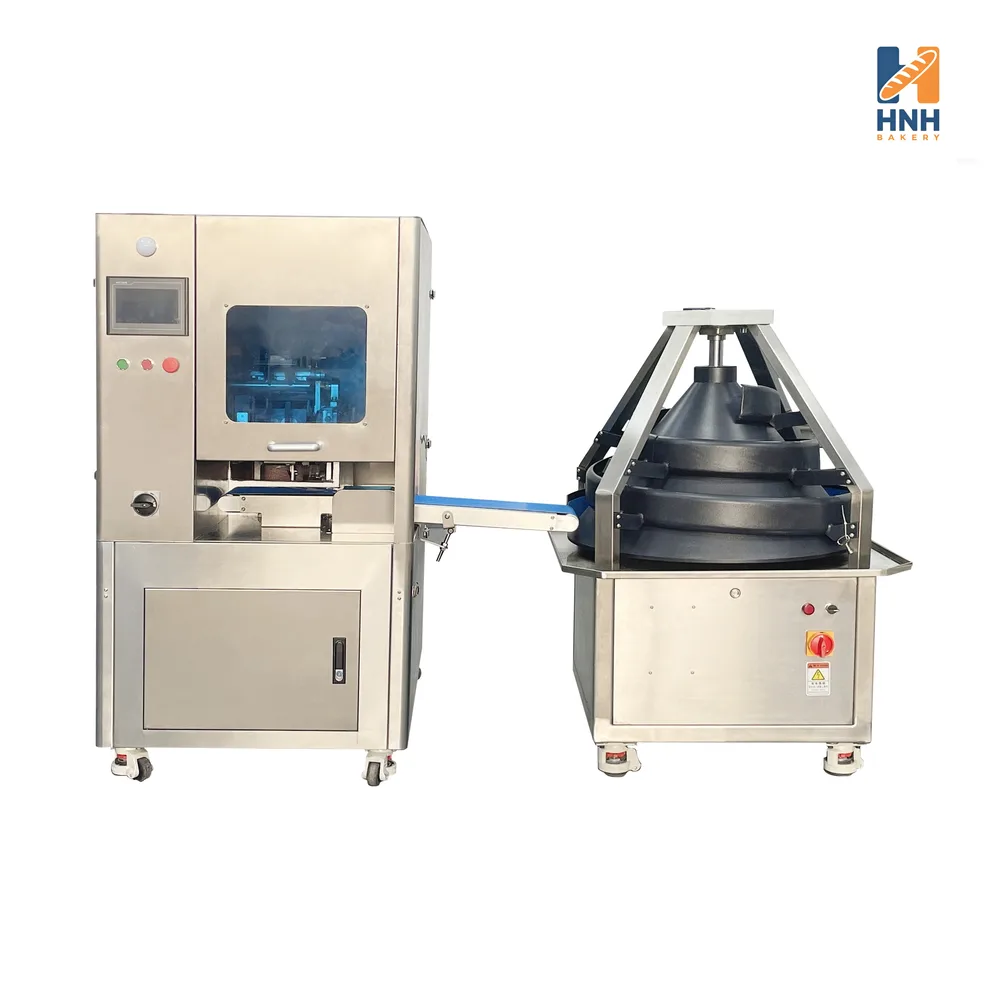
Commercial Dough Divider and Rounder Machine Series
The commercial dough divider and rounder is the core machine for any high-volume bakery. As a leading dough divider manufacturer in China, our machines automatically divide dough into equal portions and round them into uniform balls in a single operation — replacing hours of manual work and ensuring every loaf, bun or pizza base is the same size. Available in manual, semi-automatic and fully automatic (PLC touch screen) models with capacities from 500 to 5000 pieces per hour to match your production needs and budget.
Quick Answer
Commercial dough divider and rounder: Combined machine that divides dough into equal pieces and rounds them automatically. Manual, semi-automatic, and fully automatic models available. Capacity: 1,000-12,000 pieces/hour, dough weight 30-500g. Price: $3,000-$25,000 depending on automation level. Ideal for bakeries, pizza shops, food factories producing rolls, buns, pizza dough, bread loaves. Features: food-grade stainless steel, adjustable weight, CE certified.
Table of Contents
- Why Choose Our Commercial Dough Divider?
- Dough Divider Applications for Your Bakery
- How to Choose the Right Dough Divider
- Customer Success Stories with Our Dough Divider Rounders
- Dough Divider Rounder Installation & Commissioning Guide
- Dough Divider Rounder Operation Tips & Best Practices
- Manual vs Semi-Automatic vs Fully Automatic Dough Divider Rounder: Complete Comparison
- Often Asked Questions About Commercial Dough Dividers
- You May Also Like
Why Choose Our Commercial Dough Divider?
Consistent portion weight is critical for bakery profitability — even a 5-gram variance per loaf adds up to significant product loss over thousands of pieces. Our automatic dough dividers deliver ±1% portion accuracy, ensuring every product meets your quality standards and reduces giveaway. The integrated rounding function produces smooth, uniform dough balls that proof and bake evenly. Compared to manual dividing and rounding, our industrial dough dividers reduce labor requirements by 60-70% while tripling output. Food-grade stainless steel construction ensures easy cleaning and compliance with international food safety standards.
Key Features
- Dividing & rounding in one automatic cycle
- Two models available: Manual version & Automatic version with PLC touch screen control
- Automatic model: PLC touch screen for precise weight & speed setting
- Wide dough weight range for buns, bread, pizza and baguette
- Food-grade stainless steel construction, easy to clean
- Voltage available for your local market (220V / 380V / 415V)
Technical Specifications
| Model | HNH-DR30 / DR36 / DR360 (Reference) |
|---|---|
| Capacity (pcs/hour) | 300-3600 pcs/hour (Reference) |
| Dough weight range | 30-500g per piece (Reference) |
| Voltage / Power | 220V, 0.75kW-1.5kW (Reference) |
| Dimension (L×W×H) | Varies by model, contact for exact specs (Reference) |
| Weight | 120-350 kg depending on model (Reference) |
| MOQ | 1 unit |
| Lead Time | 15-30 days |
※ Specifications above will be finalized once confirmed with the factory. Contact us for the latest data sheet and price.
Dough Divider Applications for Your Bakery
Our commercial dough divider and rounder machines handle many dough types and products:
- Bread rolls and burger buns — uniform 30-120g dough balls for consistent baking
- Pizza dough balls — 150-500g portions for Neapolitan, New York and pan pizza
- Baguette and French bread — 250-400g portions for authentic shape and crumb
- Toast and sandwich bread — 400-800g portions for standard loaf pans
- Sweet rolls and pastries — 40-150g portions for cinnamon rolls, danish and more
- Wholesale and industrial production — high-capacity models for large orders
How to Choose the Right Dough Divider
Selecting the correct dough divider rounder depends on your production volume, dough types and automation needs:
| Model Type | Capacity | Best For | Typical Price Range |
|---|---|---|---|
| Manual dough divider | 500-1000 pcs/hr | Small bakeries, startups | $800-2,000 |
| Semi-automatic | 1000-2000 pcs/hr | Medium retail bakeries | $2,000-4,000 |
| Fully automatic PLC | 2000-5000 pcs/hr | Wholesale, industrial | $4,000-10,000 |
| Hydraulic divider | 1000-3000 pcs/hr | High-volume bread | $3,000-7,000 |
Not sure which model is right? Contact our dough processing experts with your daily production numbers and dough types, and we'll recommend the perfect dough divider and rounder for your operation.
Add products to cart, then submit to get a formal quotation. Pay deposit via XTransfer to start production.
Add products to cart, submit to get a formal quotation. Pay deposit via XTransfer to start production.
Customer Success Stories with Our Dough Divider Rounders
Accra, Ghana — Fully Automatic Divider Rounder
"Before this dough divider rounder, two workers spent 4 hours every morning dividing and rounding dough by hand. Now one person does it in 30 minutes. The consistency is incredible — every dough ball within 1 gram. Our bread size is now uniform, customers notice the difference, and our food cost dropped 3% because we're not wasting oversized or undersized dough. Paid for itself in 5 months."
— Kwame A., Owner, Accra Fresh Bakery
Dar es Salaam, Tanzania — Semi-Automatic Divider Rounder
"We started with a manual divider because we thought automatic was too expensive. After 6 months of hand pain and inconsistent results, we upgraded to HNH's semi-automatic model. Best decision we made. The dough divider rounder does the hard work — dividing and rounding — while our baker focuses on quality control. Production up 40%, labor down, and our baker's wrist pain is gone. Worth every dollar."
— Fatima S., Operations Manager, Dar es Salaam Bake House
Addis Ababa, Ethiopia — Two Automatic Divider Rounders
"Our wholesale bakery produces 8,000 loaves daily. We needed consistency at scale. HNH's automatic divider rounders deliver — 360 pieces per batch, ±1g accuracy, cycle after cycle. We run two machines side by side, and they've been running flawlessly for 14 months. Our rejection rate dropped from 5% to under 1%. The ROI was less than 4 months. We're ordering a third machine for our new facility."
— Tadesse M., CEO, Addis Ababa Wholesale Bakery
Dough Divider Rounder Installation & Commissioning Guide
Proper installation ensures your dough divider rounder operates at peak accuracy and lasts for years. Here is our step-by-step guide:
Step 1: Site Preparation
- Space requirements: Allow at least 1 meter (3 feet) of clearance on all sides for operation and maintenance. Automatic models need additional space for the operator to move around
- Floor requirements: A level, non-slip concrete or tile floor is essential. The dough divider rounder vibrates during operation — an uneven floor causes movement and affects accuracy
- Power supply: Most models require 220V single-phase or 380V three-phase power. Install a dedicated circuit with proper grounding. Verify voltage before connecting
- Work surface: Place near your mixer and proofing area for efficient workflow. The ideal workflow is: mixer → divider rounder → proofing → oven, all in close proximity
- Cleaning access: Ensure easy access to all parts that need daily cleaning — the dividing chamber, rounding plates, and dough collection area
Step 2: Unpacking and Placement
- Use a forklift or at least two people to move the dough divider rounder — never lift by the dividing chamber, rounding plates, or control panel
- Remove all packaging materials, including foam, zip ties, protective film, and shipping bolts. Check the manual for a list of items to remove before operation
- Check for shipping damage before signing the delivery receipt. Document any damage with photos and report immediately
- Level the machine using the adjustable feet. Use a spirit level on the work surface — proper leveling is critical for accurate dough division
- Verify all moving parts operate freely without binding. Manually cycle the machine (if possible) to check for obstructions
Step 3: Electrical Connection and Initial Setup
- Electrical connection: Connect to the dedicated circuit by a qualified electrician. Verify voltage matches the machine specification. For three-phase models, verify correct phase rotation
- Grounding: Verify proper grounding to prevent electrical shock and ensure operator safety
- Safety features test: Test all safety features — emergency stop button, safety guards, and interlock switches. The dough divider rounder should not operate with any safety guard open or bypassed
- Control panel setup: Power on the machine and familiarize yourself with the control panel. Set the language, units, and any programmable settings per the manual
- Initial test run: Run the machine empty for 5-10 cycles. Listen for unusual noises — grinding, squealing, or knocking indicates a problem. Check that all movements are smooth and accurate
Step 4: Calibration and Test Batch
- Prepare test dough: Mix a standard batch of dough using your regular formula. Allow the dough to rest for 10-15 minutes before dividing — this makes the dough easier to divide and improves accuracy
- Set target weight: Program the desired dough piece weight on the control panel (if automatic) or set the dividing chamber volume (if manual/semi-automatic)
- Run test batch: Divide and round 10-20 dough pieces. Weigh each piece individually and record the weights
- Check accuracy: Calculate the average weight and variation. Target is ±1% of target weight. If variation exceeds 2%, adjust the machine settings and re-test
- Check rounding quality: Inspect the dough balls — they should be smooth, uniform, and properly sealed. Adjust the rounding plate pressure and speed if needed
- Record baseline settings: Once calibrated, record all settings (weight, pressure, speed, etc.) for future reference. This makes it easy to return to optimal settings after cleaning or maintenance
Pro Tip: We provide detailed installation videos and remote video support for every dough divider rounder purchase. Our technicians can guide you through installation and calibration via WhatsApp video call, typically in under 2 hours. Contact us to schedule your installation support →
Dough Divider Rounder Operation Tips & Best Practices
Getting the best results from your dough divider rounder requires proper technique and regular maintenance. Here are proven tips from our customers and technicians:
Dough Preparation Tips
- Rest the dough: Allow mixed dough to rest for 10-15 minutes before dividing. This relaxes the gluten and makes the dough easier to divide accurately. Skipping this step causes uneven division and tearing
- Consistent dough temperature: Maintain dough temperature at 24-26°C (75-79°F). Dough that is too warm is sticky and hard to divide; dough that is too cold is stiff and resists rounding
- Proper hydration: Most divider rounders work best with dough hydration of 55-65%. Very wet dough (>70% hydration) may stick to the machine; very stiff dough (<50%) may not round properly. Adjust your formula or use flour dusting for extreme hydrations
- Uniform dough mass: When loading the dividing chamber, ensure the dough is evenly distributed with no large air pockets. Air pockets cause weight variation in the divided pieces
- Flour dusting: Lightly flour the dividing chamber and rounding plates to prevent sticking. Use rice flour or semolina for best results — they don't absorb into the dough as quickly as wheat flour
Operation Best Practices
- Calibrate daily: Weigh the first 5-10 dough pieces at the start of each production day. Adjust settings if needed. Daily calibration ensures consistent accuracy throughout the day
- Don't overload: Follow the machine's maximum dough capacity. Overloading causes inaccurate division, excessive wear, and can damage the machine. If you need more capacity, run multiple batches or upgrade to a larger model
- Maintain consistent cycle time: For automatic models, use the same cycle time for all batches. Rushing or slowing the cycle affects both division accuracy and rounding quality
- Keep the machine clean during operation: Wipe down dough buildup from the dividing chamber and rounding plates every 1-2 hours. Accumulated dough affects accuracy and can cause bacterial growth
- Train operators properly: Ensure all operators are trained on proper loading, operation, and cleaning procedures. A well-trained operator gets 20-30% better results and causes less wear on the machine
- Monitor wear parts: Keep an eye on the dividing chamber seals, rounding plates, and drive belts. Replace worn parts before they cause quality issues or machine failure
Common Problems and Solutions
| Problem | Possible Cause | Solution |
|---|---|---|
| Uneven dough weights | Dough not rested; uneven loading; worn chamber seals | Rest dough 10-15 min; load evenly; replace seals |
| Dough sticking to machine | Dough too warm; insufficient flour dusting; dirty plates | Lower dough temp; dust with rice flour; clean plates |
| Poor rounding (irregular shape) | Rounding plate pressure too low/high; dough too stiff | Adjust plate pressure; rest dough longer; check hydration |
| Machine vibrates excessively | Uneven floor; loose components; worn bearings | Level machine; tighten all bolts; replace bearings |
| Motor overheating | Overloading; blocked ventilation; worn motor | Reduce batch size; clean vents; service motor |
Expert Tip: The most common mistake we see is operators trying to divide dough immediately after mixing. Gluten needs time to relax. A 10-15 minute rest period improves division accuracy by 30-50% and reduces machine wear. Train your team to build this rest period into their production schedule. It's the simplest way to get better results from any divider rounder.
Manual vs Semi-Automatic vs Fully Automatic Dough Divider Rounder: Complete Comparison
Choosing the right level of automation depends on your production volume, labor costs, and budget. Here is a detailed comparison:
| Feature | Manual Divider | Semi-Automatic | Fully Automatic |
|---|---|---|---|
| Operation | Hand lever / hand press | Motorized division, manual loading | Fully automated cycle |
| Pieces per batch | 30-36 (fixed) | 30-360 (adjustable) | 30-360 (adjustable) |
| Cycle time | 2-3 minutes (manual) | 30-60 seconds | 10-30 seconds |
| Weight accuracy | ±3-5g | ±1-2g | ±0.5-1g |
| Labor required | 1 full-time operator | 1 operator (loading only) | 1 operator (supervision) |
| Hourly output | 300-600 pieces | 1,000-2,000 pieces | 2,000-5,000 pieces |
| Price range (USD) | $300-800 | $1,500-3,500 | $3,000-8,000+ |
| Typical ROI | 3-6 months | 6-12 months | 4-8 months (high volume) |
| Ideal bakery size | Small (50-150 kg/day) | Medium (150-400 kg/day) | Large/wholesale (400+ kg/day) |
| Physical effort | High (manual lever) | Low (loading only) | Minimal (supervision) |
Which Level of Automation Should You Choose?
- Choose a manual divider if: You're a small bakery (50-150 kg dough/day), budget is very tight, labor costs are low in your region, or you're just starting out. Manual dividers are affordable and simple, but require significant physical effort and have lower accuracy. Many bakeries start with manual and upgrade as they grow
- Choose a semi-automatic divider if: You're a medium bakery (150-400 kg/day), you want to reduce labor but don't need full automation, or you have varying product sizes. Semi-automatic models offer the best balance of price, accuracy, and ease of use. The motor does the hard work while the operator focuses on loading and quality control
- Choose a fully automatic divider if: You're a large or wholesale bakery (400+ kg/day), you need maximum consistency at scale, labor costs are high, or you're running multiple shifts. Fully automatic models deliver the highest accuracy (±0.5-1g) and fastest cycle times (10-30 seconds). They pay for themselves quickly in high-volume operations
- Consider upgrading in stages: Many successful bakeries start with a manual divider, upgrade to semi-automatic when production reaches 200 kg/day, and then add a fully automatic model when they exceed 500 kg/day. This staged approach matches equipment investment to business growth and minimizes financial risk. Contact us for a customized equipment recommendation based on your production volume →
📋 Bakery Equipment Checklist
Download our complete bakery equipment checklist with budget estimates for 5 different bakery types.
Free Bakery Equipment Checklist →📋 Bakery Equipment ROI Calculator
Use our interactive ROI calculator to see how quickly your bakery equipment investment pays off.
Calculate Your Equipment ROI →📋 Bakery Equipment Maintenance Calendar
Get our printable maintenance calendar to keep your bakery equipment running at peak performance.
Printable Maintenance Calendar →🏭 Bakery Equipment Capacity Calculator
Not sure what size equipment you need? Use our free interactive calculator to find the perfect dough divider, mixer, oven, and proofer capacity for your production volume.
Calculate Your Equipment Needs →⚖️ Bakery Equipment Comparison Tool
Compare dough dividers, spiral mixers, ovens, proofers and dough sheeters side by side. View specs, prices, capacity and features to find the best equipment for your bakery.
Compare Equipment Now →What Our Customers Say
"We run two shifts making pide and burger buns, and this divider rounder has cut our dough prep time nearly in half. Every piece comes out the same weight — we check with a scale daily and it stays within a couple of grams. The rounder forms tight, even balls so our buns proof consistently. It's simple to operate, easy to clean between runs, and the HNH support team answered all our setup questions on WhatsApp within the hour."
— Mustafa K., Bakery Owner, Turkey
"We had been dividing dough by hand for years, so switching to this machine felt like a huge step up. The divider handles our 10kg batches smoothly and the weight accuracy has reduced our dough waste noticeably. My team learned the controls in a day. The build quality is good for the price, and after six months of daily use we haven't needed any repairs. I would recommend it to any medium-sized bakery."
— Grace N., Bread Factory Manager, Nigeria
Often Asked Questions About Commercial Dough Dividers
Q: How much does a commercial dough divider cost?
A: Dough divider price depends on capacity, automation level and features. Our manual models start around $800-2,000, semi-automatic models range from $2,000-4,000, and fully automatic PLC-controlled models start from $4,000-10,000. Hydraulic dough dividers for high-volume bread production range from $3,000-7,000. As a direct dough divider manufacturer in China, we offer factory-direct pricing without middleman markup. Contact us for a detailed quotation based on your capacity requirements and destination port.
Q: Manual vs automatic dough divider — which is right for my bakery?
A: Manual dough dividers require an operator to press the dividing mechanism, but offer lower cost and simpler maintenance. They are ideal for small bakeries producing 500-1000 pieces per hour. Automatic dough dividers use PLC touch screen controls for precise weight and speed settings, with capacities of 2000-5000 pieces per hour. They require less labor and deliver more consistent results, making them ideal for wholesale and industrial bakeries. For growing bakeries, we recommend starting with a semi-automatic model that can be upgraded as production increases.
Q: What dough weight range can a commercial dough divider and dough rounder handle?
A: Our commercial dough dividers handle many dough weights depending on the model. Standard models handle 20-500g per piece, covering everything from small dinner rolls (20-40g) to burger buns (50-80g), pizza dough (150-500g), baguette dough (250-400g), and large loaf bread (400-800g). Hydraulic dough dividers can handle larger portions up to 1000g for specialty breads. The dividing mechanism uses interchangeable dividing heads to accommodate different weight ranges. Contact us with your product specifications and we'll configure the right machine for your needs.
Q: How accurate is the portion weight on a dough divider?
A: Our automatic dough dividers deliver ±1% portion weight accuracy, meaning a 100g dough ball will weigh between 99-101g. This level of consistency is critical for bakery profitability — even a 5g variance per loaf adds up to 5kg of product loss per 1000 loaves. Manual dough dividers typically achieve ±2-3% accuracy depending on operator skill. To maintain accuracy, we recommend calibrating the dividing mechanism weekly and keeping dough temperature consistent at 24-26°C. Our PLC-controlled models include automatic weight calibration features for easy adjustment.
Q: How do I clean and maintain my dough divider?
A: Daily cleaning: remove and wash the dividing head, rounding cone and contact parts with food-grade sanitizer after each use; wipe down the machine body with a damp cloth; never use high-pressure water jets directly on the motor or electrical components. Weekly maintenance: lubricate the dividing mechanism with food-grade grease, check for worn seals, tighten any loose screws. Monthly maintenance: inspect the drive belt for wear, check electrical connections, calibrate portion accuracy. We provide a detailed maintenance manual with every commercial dough divider. Proper maintenance can extend the machine's lifespan to 8-12 years.
Q: What is the warranty and after-sales support for your dough dividers?
A: All our dough divider and rounder machines come with a 12-month warranty covering manufacturing defects. We provide free spare parts during the warranty period (excluding shipping costs). After warranty, we offer lifetime technical support and spare parts at cost price. Our support team is available via WhatsApp, email, and video call. Most technical issues can be resolved within 24 hours with our remote video support. We also offer optional extended warranty packages for up to 3 years, and can provide on-site installation and training for large orders. Many of our clients have been running our machines for 10+ years with regular maintenance.
Q: Can you customize the dough divider for my specific products?
A: Yes, as a professional dough divider manufacturer, we offer comprehensive customization options including: custom dividing heads for specific dough weights, special surface treatments for sticky doughs, brand labeling (OEM), custom conveyor integration, programmable recipes for multiple product types, and voltage customization for your local market. Customization typically adds 5-10 days to production time. Many of our clients request custom branding for their retail stores or distribution businesses. Tell us your product specifications and production requirements, and we'll provide a customized solution with detailed pricing.
Looking for Dough Divider Rounder?
Find the best commercial bakery equipment from HNH Bakery Equipment, a leading bakery equipment manufacturer and bakery equipment supplier from China. We offer bakery equipment for sale at competitive bakery equipment price for small businesses, startups, and industrial bakeries. Whether you need bakery equipment wholesale or a single unit, our bakery equipment factory provides reliable equipment with global shipping. Learn how to choose bakery equipment with our expert buying guides.