
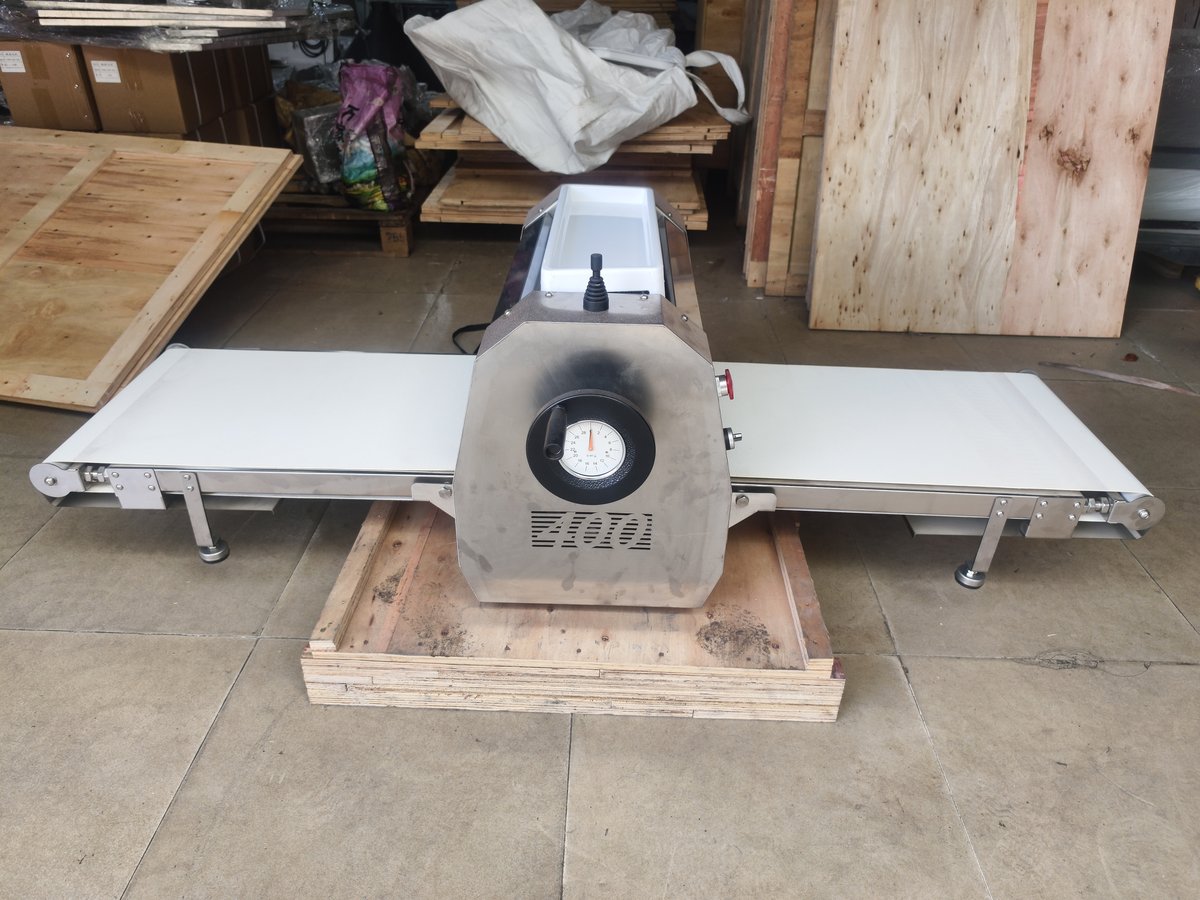
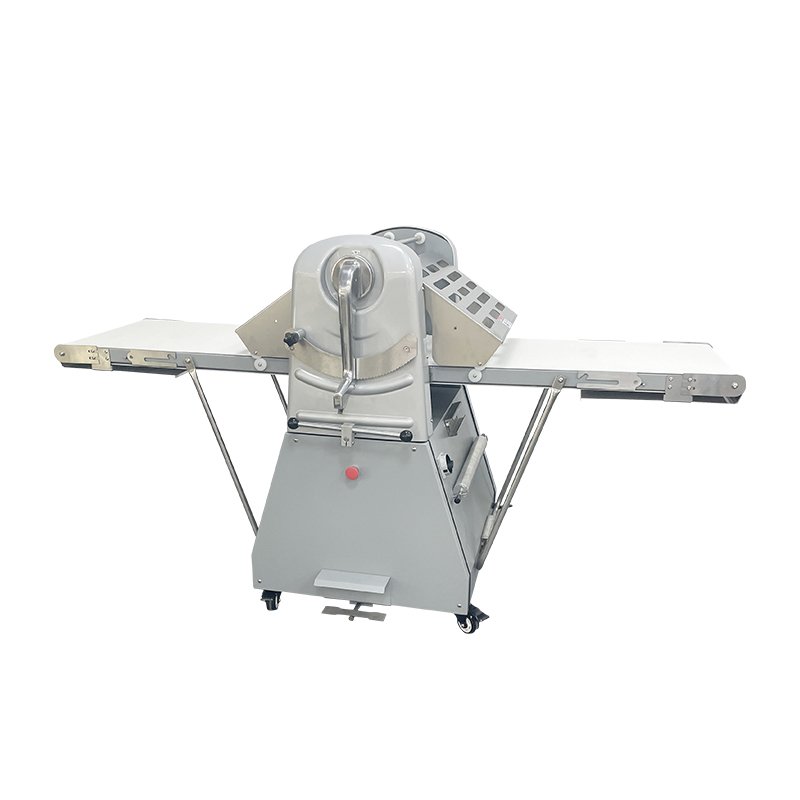
1. What is a Dough Sheeter?
A dough sheeter — also known as a pastry roller, dough roller, dough flattener, or laminator — is one of the most valuable machines in a pastry or croissant bakery. It uses two or more parallel rollers that rotate in opposite directions to press dough into a thin, uniform sheet of precise thickness.
How It Works
The basic operation is simple but highly effective:
- Dough is placed on the infeed tray or conveyor belt
- The thickness gap between the two rollers is set using a hand crank or digital control
- The dough is fed through the rollers, which compress it to the set thickness
- The dough sheet exits on the other side, ready for folding, cutting, or further processing
- For laminated doughs (croissants, puff pastry), this process is repeated with folds between passes (book fold, letter fold, etc.)
Why Hand-Rolling Can't Compete
- Consistency: Hand-rolled dough varies in thickness by ±15-20%; a sheeter achieves ±0.5mm precision. This directly affects baking uniformity and product quality.
- Speed: A skilled pastry chef can hand-roll approximately 10-15kg of dough per hour. A floor sheeter processes 50-100kg per hour — a 5-10x increase.
- Labor: Hand-rolling is physically demanding and leads to worker fatigue, inconsistency later in shifts, and higher injury rates (wrist, shoulder, back).
- Butter temperature: In laminated doughs, slow hand-rolling allows butter to warm and leak out. A sheeter processes dough quickly before butter softens, producing perfect lamination.
- Scalability: As your bakery grows, hand-rolling becomes a bottleneck. A sheeter scales with your business — just run more batches.
Products That Require a Dough Sheeter
- Croissants (butter, chocolate, almond)
- Puff pastry (all types — feuilletée, inversée, rapide)
- Danish pastries (fruit, cream cheese, custard)
- Pie crusts and tart shells
- Pizza dough (especially thin-crust Neapolitan and New York style)
- Flatbreads (naan, lavash, pita)
- Cookies and biscuits (rolled dough types)
- Pasta and noodle dough (some models)
- Phyllo/filo dough (specialized thin-sheet models)
2. Types of Dough Sheeters
2.1 By Operation: Manual vs Electric
Manual Dough Sheeters
Operated by turning a hand crank that rotates the rollers. The operator must also push/pull the dough through the rollers.
Advantages: Low cost ($1,000-$2,500), no electricity required, simple and reliable, easy to clean, portable.
Disadvantages: Slow, physically tiring, limited to small volumes, inconsistent roller speed, only one operator can use it at a time.
Best for: Micro-bakeries, cafes, home bakers upgrading from hand-rolling, test kitchens, low-volume specialty shops.
Electric Dough Sheeters
Motor-driven rollers that automatically pull dough through. The operator simply places dough on the infeed and collects it on the outfeed.
Advantages: Fast, consistent speed, less physical effort, higher volume, reversible rollers (on many models), can be used by less skilled operators.
Disadvantages: Higher cost ($2,000-$15,000+), requires electricity, more complex (motor, gears, belts), heavier and less portable.
Best for: All commercial bakeries producing 20kg+ of laminated dough per day. Electric is the standard for any serious pastry operation.
2.2 By Configuration: Single-Pass vs Conveyor
Single-Pass (Open) Sheeters
Dough is placed on a flat infeed table, passes through rollers once, and exits onto an outfeed table. The operator must manually move dough back to the infeed for additional passes.
Advantages: Lower cost, simpler mechanism, smaller footprint, easy to access dough for folding between passes.
Disadvantages: Requires more operator labor (moving dough back and forth), slower for multi-pass lamination, dough can fall off tables if not careful.
Best for: Small-medium bakeries, operations where folding between passes is frequent (croissants, puff pastry).
Conveyor Belt Sheeters
Dough rides on a continuous conveyor belt that carries it through the rollers and back around, allowing for continuous multi-pass operation without manual dough handling.
Advantages: Much faster for multi-pass lamination, less operator labor, dough stays on belt (no dropping), can run continuously, some models have automatic folding attachments.
Disadvantages: Higher cost ($8,000-$20,000+), larger footprint, belt requires cleaning and maintenance, harder to access dough for manual folds.
Best for: High-volume bakeries, croissant and puff pastry factories, operations running continuous lamination batches.
2.3 By Roller Count: 2-Roller vs 3-Roller vs Multi-Roller
2-Roller Sheeters
The most common configuration — two rollers (top and bottom) that compress dough in one pass. Most tabletop and small floor models use this design.
3-Roller Sheeters
Three rollers arranged in a triangle or S-curve path. Dough passes through two compression zones in a single pass, allowing greater thickness reduction in one go. Used in some higher-end floor models.
Multi-Roller / Calendering Lines
Industrial machines with 4+ rollers in series, each progressively reducing thickness. Used in factory-scale pastry production. Can reduce dough from 50mm to 1mm in a single continuous pass.
2.4 Specialized Types
Reversible Sheeters
Rollers can rotate in both directions, allowing dough to be passed back and forth without removing it from the machine. Saves time in lamination. Common on mid-range and premium floor models.
Automatic Folding Sheeters / Laminators
Combines a sheeter with an automatic folding mechanism that performs book folds or letter folds between passes. Can complete a full lamination sequence (e.g., 3 book folds = 27 layers) automatically. The ultimate in laminated dough production efficiency.
Combination Sheeter + Divider
Some machines combine a sheeter with a dough divider or cutter, allowing you to portion and sheet dough in one continuous process. Useful for pizza and flatbread production.
3. Tabletop vs Floor Models: Which is Right for You?
| Feature | Tabletop Sheeter | Floor Sheeter |
|---|---|---|
| Roller Width | 300 - 500mm | 500 - 700mm+ |
| Price Range | $1,000 - $5,000 | $4,000 - $20,000+ |
| Footprint | Small (sits on counter) | Large (own stand/legs) |
| Weight | 20 - 60kg | 80 - 300kg |
| Daily Capacity | 10 - 50kg dough | 50 - 500kg+ dough |
| Conveyor Belt | Rare (mostly open table) | Common on mid-high end models |
| Reversible Rollers | Some models | Most models |
| Thickness Range | 1 - 30mm | 0.5 - 50mm (wider range) |
| Best For | Small bakeries, cafes, pastry shops | Medium-large bakeries, croissant factories |
When to Choose Tabletop
- You produce under 50kg of laminated dough per day
- Your bakery has limited floor space
- Your budget is under $5,000
- You primarily make small pastries (croissants, danish) that don't need wide sheets
- You are a start-up or micro-bakery testing the market
- You need portability (markets, pop-ups, catering)
When to Choose Floor
- You produce 50kg+ of laminated dough per day
- You need 500mm+ wide dough sheets (full-size puff pastry, large croissant batches)
- You want conveyor-fed continuous operation
- You need reversible rollers for efficient lamination
- You plan to grow production significantly in the next 1-2 years
- You have dedicated floor space in your bakery
- You want a machine that will last 15-20+ years with proper maintenance
4. How to Choose the Right Size
Size is the most important decision when buying a dough sheeter. The two key dimensions are roller width and thickness range.
4.1 Roller Width Selection
The roller width determines the maximum width of your dough sheet. Choose based on your largest product:
| Roller Width | Maximum Dough Sheet Width | Best For | Typical Products |
|---|---|---|---|
| 300mm (12") | 280mm | Micro bakeries, cafes | Small croissants, mini danish, cookies |
| 400mm (16") | 380mm | Small bakeries | Standard croissants, danish, small puff pastry |
| 500mm (20") | 480mm | Medium bakeries (most popular) | Full-size croissants, puff pastry sheets, pizza |
| 600mm (24") | 580mm | Large bakeries | Full baking tray sheets, large batch lamination |
| 650mm (26") | 630mm | Industrial / factory | Full-size industrial pastry sheets, high-volume |
| 700mm+ (28"+) | 680mm+ | Factory production lines | Industrial lamination lines, phyllo, large flatbread |
4.2 Thickness Range Selection
The thickness range determines how thin and how thick you can roll dough. Most sheeters handle 1-40mm, but specialized models offer wider ranges:
- Ultra-thin (0.5-1mm): For phyllo/filo dough, strudel dough, ultra-thin puff pastry. Requires specialized rollers and precise gap control.
- Standard thin (1-3mm): For croissants (final sheet ~2-3mm), puff pastry (final sheet ~2-4mm), danish. Most standard sheeters handle this.
- Medium (3-10mm): For pizza dough, pie crusts, flatbreads, cookie dough. All sheeters handle this range.
- Thick (10-30mm): For bread dough, focaccia, thick pizza, initial passes in lamination. Most sheeters handle up to 30-40mm.
- Extra thick (30-50mm): For very thick dough, initial compression of large dough blocks. Only some floor models handle this.
4.3 Sizing Formula
Roller width = Your widest dough sheet + 20mm margin (dough spreads slightly when rolled)
Example: If your largest puff pastry sheet is 450mm wide, you need at least a 470mm roller → choose 500mm model.
Thickness range = Must cover both your thinnest final product and your thickest initial dough block
Example: Croissants need final sheet of 2.5mm and initial dough block of 30mm → need sheeter with 1-30mm range (standard on most models).
4.4 Common Sizing Mistakes
- ❌ Buying too narrow: "We'll just cut dough to fit." This wastes time and creates scrap. Buy for your widest product, not your average.
- ❌ Ignoring future products: If you plan to add full-size puff pastry or large croissant batches next year, buy a wider sheeter now. Upgrading later means selling the old one at a loss.
- ❌ Confusing roller width with dough width: A 500mm roller does NOT produce 500mm dough sheets. Actual dough width is 10-20mm less than roller width due to edge margins.
- ❌ Not checking minimum thickness: Some budget sheeters only go down to 2mm. If you need 1mm croissant sheets, this won't work. Always verify the minimum thickness specification.
5. Key Specifications to Check
5.1 Roller Material & Finish
Rollers should be made of 304 food-grade stainless steel with a polished, smooth finish. Avoid chrome-plated steel (can chip and contaminate dough) or aluminum (can react with acidic doughs). The roller surface should be perfectly smooth — any scratches or pits will tear dough and collect residue.
5.2 Thickness Adjustment Mechanism
- Hand crank: Simple, reliable, no power needed. But slower and less precise (hard to set exact 0.5mm increments).
- Hand wheel with scale: Most common. A rotating wheel with a thickness scale (mm or inches). Allows precise setting.
- Digital / motorized: Push-button thickness adjustment with digital display. Most precise and fastest, but more expensive and complex.
5.3 Roller Speed
Roller speed affects both production rate and dough quality. Typical speeds: 5-15 meters/minute for tabletop, 10-25 meters/minute for floor models. Too fast and dough can tear or butter can smear (in laminated doughs). Too slow and production is limited. Look for variable speed on premium models.
5.4 Motor Power
Motor power determines how well the sheeter handles stiff, thick, or large batches of dough:
- Tabletop: 0.25-0.5 HP (180-370W)
- Floor 500mm: 0.5-1 HP (370-750W)
- Floor 600-650mm: 1-2 HP (750-1500W)
- Conveyor / industrial: 2-5 HP (1500-3700W)
Tip: If you regularly sheet stiff dough (pizza, bread) or thick blocks (40mm+), size up the motor by 25-50%. Underpowered motors overheat and burn out prematurely.
5.5 Safety Features
- Emergency stop button (large, red, easily accessible from both sides)
- Roller safety guards (finger guards at infeed and outfeed)
- Guard interlock (machine stops if guard is opened)
- Motor overload protection (automatic shutoff if motor overheats)
- Non-slip feet or floor mounting (prevents machine from moving during operation)
- Emergency reverse (some models — rollers reverse if something gets caught)
- Clear safety signage and instructions
5.6 Construction & Materials
- Full 304 stainless steel construction for all food contact surfaces
- Heavy-duty steel frame (welded, not bolted, for stability)
- Food-grade plastic or stainless steel infeed/outfeed tables
- Sealed bearings (no lubrication contamination risk)
- IP-rated motor and electrical components (water-resistant for cleaning)
- Smooth, smooth surfaces (no crevices where dough can accumulate)
5.7 Ease of Cleaning
Dough sheeters can be difficult to clean because dough gets trapped between rollers and in crevices. Look for:
- Quick-release rollers (can be removed for thorough cleaning)
- Scraper blades (removable, easy to clean)
- Smooth surfaces with no crevices
- Drip tray or crumb tray (catches falling dough)
- All parts dishwasher-safe (or easy to wash by hand)
- Sealed electrical components (can be wiped down with wet cloth)
5.8 Certification
Check for relevant certifications: CE (European Union), ETL/UL (United States/Canada), NSF (food equipment safety — US), ISO 9001 (quality management). Certification ensures the machine meets safety and quality standards for your target market.
6. Price Guide: How Much Does a Dough Sheeter Cost?
| Machine Type | Roller Width | Price Range (USD) | Daily Capacity |
|---|---|---|---|
| Manual Tabletop | 300-400mm | $1,000 - $2,500 | 10-30kg |
| Electric Tabletop | 300-500mm | $2,000 - $5,000 | 20-50kg |
| Electric Floor (entry) | 500mm | $4,000 - $7,000 | 50-100kg |
| Electric Floor (mid) | 500-600mm | $6,000 - $10,000 | 80-200kg |
| Electric Floor (premium) | 600-650mm | $9,000 - $15,000 | 150-300kg |
| Floor with Conveyor Belt | 500-650mm | $8,000 - $18,000 | 100-400kg |
| Reversible Floor Sheeter | 500-650mm | $7,000 - $16,000 | 100-300kg |
| Automatic Folding Laminator | 500-650mm | $15,000 - $35,000 | 200-500kg |
| Industrial Lamination Line | 650mm+ | $25,000 - $80,000+ | 500kg+ |
Factors That Affect Price
- Brand: European brands (Rondo, Seewer, RBS, Tekno) cost 2-3x more than Chinese brands (HNH, Sinmag, Yoslon) with similar specifications. Chinese brands offer excellent value for money.
- Roller width: Each size increment (400→500→600→650mm) adds $1,000-$3,000 to the price.
- Conveyor belt: Adds $2,000-$5,000 compared to open-table models.
- Reversible rollers: Adds $1,000-$3,000.
- Digital thickness control: Adds $500-$2,000.
- Automatic folding: Adds $5,000-$15,000 (transforms sheeter into laminator).
- Certification: CE/ETL/NSF certification adds $300-$1,500.
- Special voltage: Custom voltage (e.g., 440V/60Hz) adds $200-$500.
Total Cost of Ownership
Over a 15-year lifespan, the purchase price is only 45-55% of total cost:
- Purchase price: 45-55%
- Energy consumption: 10-15% (electricity — sheeters use less power than mixers/ovens)
- Maintenance & parts: 10-15% (belts, bearings, scrapers, annual service)
- Labor savings: Offsets 50-70% of total cost (a sheeter replaces 1-3 workers doing hand-rolling)
7. Lamination Techniques & Tips
Lamination is the process of creating alternating layers of dough and butter (or fat) that give croissants and puff pastry their characteristic flaky texture. A dough sheeter is essential for consistent, professional lamination.
7.1 The Lamination Process
- Prepare détrempe (dough): Mix flour, water, salt, and a small amount of butter. Shape into a block and chill.
- Prepare beurrage (butter block): Soften butter to 15-18°C, shape into a block between parchment paper, chill until firm but pliable.
- First turn (tour): Roll dough to 2x butter size, place butter in center, fold dough over butter. Seal edges. Roll out to 3x length. Perform letter fold (fold bottom third up, top third down). This is one "turn" = 3 layers.
- Rest: Wrap and chill for 30-60 minutes (prevents butter from softening and leaking).
- Subsequent turns: Repeat rolling and folding. Each turn multiplies layers: 1 turn = 3 layers, 2 turns = 9 layers, 3 turns = 27 layers, 4 turns = 81 layers, 5 turns = 243 layers.
- Final roll: After all turns, roll dough to final thickness (2-4mm for croissants, 2-3mm for puff pastry).
- Cut & shape: Cut into desired shapes, proof, and bake.
7.2 Sheeter-Specific Lamination Tips
- Keep butter at the right temperature: Butter should be 15-18°C (59-64°F) — firm but pliable. If too cold, it cracks and breaks through dough; if too warm, it melts and leaks out. The sheeter processes dough quickly, which helps maintain butter temperature.
- Don't reduce thickness too much in one pass: Reduce by no more than 50% per pass. E.g., from 40mm to 20mm, then 20mm to 10mm, etc. Reducing too much at once causes butter to squeeze out the sides.
- Use flour sparingly: Lightly flour the rollers and dough to prevent sticking, but don't over-flour — excess flour gets incorporated into layers and affects texture. Use a pastry brush to remove excess flour between passes.
- Keep dough square: After each fold, make sure the dough block is square/rectangular with straight edges. Use a bench knife to trim edges if needed. Uneven edges cause uneven rolling.
- Rest between turns: Always chill dough for 30-60 minutes between turns. This relaxes the gluten (prevents shrinking) and re-firms the butter. Skipping rest is the #1 cause of butter leakage.
- Roll in one direction: When using a non-reversible sheeter, always roll dough in the same direction (from infeed to outfeed). This maintains consistent layer orientation. With reversible sheeters, you can roll back and forth.
- Final roll from center outward: For the final roll, start with the seam side down and roll from the center outward. This prevents the layers from separating at the edges.
- Trim edges before cutting: After final rolling, trim the edges of the dough sheet with a sharp knife or pastry wheel. The edges have compressed layers that won't rise properly. Trimming ensures even rising on all pieces.
7.3 Common Lamination Problems & Solutions
| Problem | Cause | Solution |
|---|---|---|
| Butter leaking out | Butter too warm; too much thickness reduction per pass; no rest between turns | Chill butter to 15-18°C; reduce by max 50% per pass; rest 30-60 min between turns |
| Dough shrinking after rolling | Gluten not relaxed; dough too warm | Rest dough longer; keep dough chilled; don't over-work dough |
| Layers not visible after baking | Butter too warm (merged with dough); not enough turns; dough rolled too thin | Keep butter firm; do 3-4 turns (27-81 layers); final roll to 2-4mm |
| Croissants not rising straight | Dough sheet not uniform thickness; rolling tension uneven | Check sheeter thickness calibration; roll dough evenly; keep dough square |
| Dough tearing during rolling | Dough too cold; gluten not developed; rollers too close together | Let dough warm slightly; ensure proper dough mixing; reduce thickness gradually |
| Uneven layers (thick/thin spots) | Butter block not uniform; dough not square; sheeter rollers not parallel | Make butter block uniform thickness; keep dough square; check sheeter roller alignment |
8. Maintenance & Care
Proper maintenance keeps your dough sheeter running smoothly for 15-20 years and prevents costly breakdowns during production.
Daily Maintenance (After Each Use)
- Scrape all dough residue from rollers, tables, and scrapers using a plastic scraper (not metal — metal scratches rollers)
- Wipe rollers with a warm, damp cloth (use food-safe sanitizer if required)
- Clean infeed and outfeed tables
- Empty and clean crumb/drip tray
- Check for dough buildup around roller ends and bearings (dough in bearings causes premature wear)
- Verify emergency stop button works
- Check power cord and connections
- Leave machine open to air dry (do not close wet — moisture causes corrosion)
- Never use abrasive scouring pads or steel wool on rollers — they scratch the surface and tear dough
Weekly Maintenance
- Deep clean rollers (remove if quick-release model) — soak in warm, soapy water, rinse, sanitize, air dry
- Clean scraper blades thoroughly (dough accumulates on blade edges)
- Clean under and around machine (flour and dough buildup attracts pests)
- Check belt tension (if belt-driven) — press belt with finger, should deflect 1-2cm
- Lubricate thickness adjustment mechanism (use food-grade grease or oil)
- Check all safety guards and interlocks
- Inspect power cord for damage
- Check for unusual noises during operation
- Verify thickness calibration (roll dough at set thickness, measure with calipers — should be within ±0.5mm)
Monthly Maintenance
- Inspect motor and gearbox for unusual noises or vibrations
- Check electrical connections and tighten if loose
- Inspect rollers for wear, scratches, or damage (replace if deeply scratched)
- Check roller alignment (rollers must be perfectly parallel — measure gap at both ends and center, should be identical)
- Inspect scraper blades for wear (replace if nicked or not making full contact with roller)
- Verify all safety features are functioning correctly
- Clean motor ventilation vents (dust buildup causes overheating)
- Check floor mounting bolts (tighten if loose — vibration can loosen them)
- Lubricate all moving parts per manufacturer specifications (use only food-grade lubricants on food contact areas)
Annual Professional Service
- Gearbox oil change (if applicable — use manufacturer-recommended oil grade)
- Motor inspection and testing (check winding insulation, bearing play, capacitor)
- Replacement of worn parts (belts, bearings, seals, scrapers)
- Full electrical system inspection and testing
- Roller alignment and thickness calibration
- Safety certification renewal (if required by local regulations)
- Lubrication of all moving parts per manufacturer specifications
- Inspection of frame and structure for cracks or wear
Common Wear Parts to Keep in Stock
- Scraper blades (replace every 3-6 months or when nicked/worn)
- Drive belts (replace every 3-5 years or when cracked/glazed)
- Bearings (replace every 5-8 years or if noisy)
- Seals and gaskets (replace as needed — prevent dough and moisture from entering gearbox)
- Emergency stop button (keep spare)
- Thickness adjustment knob/handle (keep spare)
- Infeed/outfeed table (if damaged — keep spare or repair)
- Carbon brushes (if motor has brushes — replace every 2-3 years)
9. Common Problems & Troubleshooting
Problem 1: Dough Sticking to Rollers
Possible causes:
- Insufficient flour dusting on rollers or dough
- Dough too warm (soft dough sticks more)
- Rollers dirty (dough residue buildup makes surface sticky)
- Rollers scratched or pitted (rough surface catches dough)
- Dough too wet/high hydration (sticky dough)
- Humid environment (moisture in air makes dough sticky)
Solutions: Lightly flour rollers before each batch (use a flour duster or sieve), keep dough chilled (16-20°C), clean rollers thoroughly after each use, inspect rollers for damage (replace if scratched), reduce dough hydration slightly, use a dehumidifier in humid climates.
Problem 2: Uneven Dough Thickness (one side thicker than other)
Possible causes:
- Rollers not parallel (gap wider on one side)
- Thickness adjustment mechanism worn or loose
- Roller bearings worn (allows roller to tilt)
- Dough not centered on infeed (feeds unevenly)
- Machine not level (causes uneven pressure)
- Bent or damaged roller
Solutions: Check roller alignment (measure gap at both ends and center — adjust if not equal), inspect thickness adjustment mechanism, check bearings for play, center dough on infeed, level machine with spirit level, inspect rollers for damage. If rollers are bent or bearings worn, contact technician for repair.
Problem 3: Dough Tearing or Cracking During Rolling
Possible causes:
- Dough too cold (less elastic, more prone to tearing)
- Gluten not fully developed (weak dough structure)
- Too much thickness reduction in one pass
- Rollers too close together (excessive compression)
- Dough rested too long (skin forms on surface, cracks when rolled)
- Dough contains inclusions (fruit, nuts) that tear the dough
- Rollers dirty (dough residue catches and tears dough)
Solutions: Let dough warm to 16-20°C before rolling, ensure proper dough mixing (windowpane test), reduce by max 50% per pass, adjust thickness gradually, don't rest dough longer than necessary (cover to prevent skin), sheet plain dough first then add inclusions, clean rollers thoroughly.
Problem 4: Machine Won't Start
Possible causes:
- Safety guard not properly closed (interlock switch not engaged)
- Emergency stop button pressed (twist to release)
- Power not connected (check plug, circuit breaker, outlet)
- Motor thermal overload tripped (wait 15-30 minutes to cool, press reset button)
- Control panel fault (digital models — check error code display)
- Foot pedal not pressed (if model has foot pedal activation)
- Blown fuse or circuit breaker
Solutions: Check all safety interlocks (guard must be fully closed), release emergency stop, verify power connection, allow motor to cool, check foot pedal (if equipped), check fuse/circuit breaker. If still won't start, contact technician.
Problem 5: Unusual Noises During Operation
Possible causes:
- Loose belt (squealing noise — tighten or replace)
- Worn bearings (grinding/rumbling noise — replace bearings)
- Gearbox issue (clanking/knocking noise — check gear oil, contact technician)
- Motor issue (buzzing/humming — check capacitor, windings)
- Foreign object in rollers (clanking — stop immediately, inspect and remove)
- Loose hardware (rattling — tighten all bolts and screws)
- Dry bearings/bushings (squeaking — lubricate per manufacturer specs)
Solutions: Identify the type of noise and location. Stop machine immediately if noise is severe or accompanied by vibration. Belt noise can be fixed by tensioning/replacing belt. Bearing/gearbox/motor issues require professional service. Always investigate unusual noises promptly — small problems become expensive failures if ignored.
Problem 6: Rollers Not Turning (motor runs but rollers don't move)
Possible causes:
- Broken or slipped drive belt
- Stripped gear in gearbox
- Broken chain (if chain-driven)
- Seized bearing (rollers can't turn)
- Clutch issue (if model has clutch)
- Overloaded (dough too thick or stiff for motor capacity)
Solutions: Turn off machine, inspect drive belt (replace if broken or worn), check gearbox (if stripped gears, contact technician), check chain tension and condition, check if rollers turn freely by hand (if not, bearings may be seized), reduce dough thickness/stiffness. If belt is intact and rollers still don't turn, contact technician for gearbox or motor repair.
10. Our Dough Sheeter Models
HNH Bakery Equipment offers a complete range of dough sheeters for every production volume and budget.
Tabletop Dough Sheeter 400mm
Compact tabletop model, 400mm roller width, 1-30mm thickness, electric, ideal for small bakeries and cafes.
View Details →Tabletop Dough Sheeter 500mm
Tabletop model, 500mm roller width, 1-30mm thickness, electric, reversible rollers available, great for growing small bakeries.
View Details →Floor Dough Sheeter 500mm
Floor model, 500mm roller width, 1-40mm thickness, electric, reversible, the most popular size for medium bakeries.
View Details →Floor Dough Sheeter 600mm
Floor model, 600mm roller width, 0.5-40mm thickness, electric, reversible, digital thickness control, ideal for large bakeries.
View Details →Vertical Dough Sheeter (欧式开酥机)
Vertical European-style sheeter, space-saving design, 500-650mm roller width, conveyor belt, reversible, premium lamination machine.
View Details →Dough Sheeter (Main Category)
Complete range of dough sheeters from tabletop to floor, 300-650mm roller width. Compare all models, specifications, and prices.
View All →