
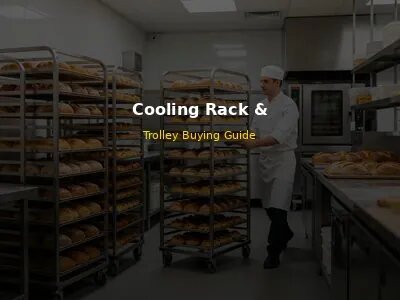
A story from our customer in Sydney, Australia: "When we started our wholesale bakery in 2018, we bought cheap chrome-plated cooling racks from a restaurant supply store, $8 each. We thought a cooling rack is a cooling rack - how different can they be? Within 6 months, the chrome plating started chipping and peeling, and the racks started rusting. We were throwing away racks every month, and the rust was getting on our products - we once had a customer complain about rust spots on their cookies! We also had a problem with capacity: during peak production (we bake 300+ trays a day), we had trays of hot bread sitting on every available surface - countertops, tables, even the floor - because we didn't have enough cooling capacity. This was a food safety hazard and a bottleneck in our production. We finally invested in 4 stainless steel cooling trolleys (16 tiers each, $350 each) and 30 stainless steel cooling racks ($25 each). The difference was night and day: the trolleys hold 64 trays at once, saving us Many floor space and making it easy to move products from the oven to the cooling area to packaging. The stainless steel racks don't rust, are easy to clean (we run them through the dishwasher), and look professional. We spent $2,150 on the trolleys and racks, and 4 years later they are still in perfect condition. The cheap racks ended up costing us more Over time - we went through 50+ cheap racks in the first year ($400+) plus the cost of wasted product from rust and the food safety risk. The lesson: cooling equipment is not something to skimp on. It affects your production efficiency, food safety, product quality, and employee morale. Invest in quality stainless steel cooling racks and trolleys from the start - they will last for years and pay for themselves through improved efficiency and reduced waste."
Cooling racks and cooling trolleys are needed pieces of equipment in any bakery, yet they are often overlooked or treated as an afterthought. When products come out of the oven, they need to cool properly before they can be packaged, decorated, or sold. Proper cooling ensures that products maintain their texture, flavor, and appearance, and it prevents sogginess, mold, and staling that can occur if products are packaged while still warm.
Good cooling equipment does more than just hold products while they cool - it improves production efficiency (allowing you to bake more products per hour by freeing up oven and counter space), ensures food safety (keeping products off the floor and at proper cooling temperatures), saves floor space (vertical storage on trolleys instead of horizontal storage on counters), and makes it easy to move products around the bakery (from oven to cooling area to packaging to delivery).
As our customer in Sydney learned, cheap, flimsy cooling equipment is a false economy. Chrome-plated racks chip and rust, flimsy trolleys bend and break, and insufficient cooling capacity creates bottlenecks and food safety hazards. Investing in quality stainless steel cooling racks and trolleys from the start will save you money, time, and headaches Over time.
What's the one decision that figure outs whether your bakery succeeds or fails? It's not your recipes. It's not your location. It's the equipment you choose — and how well it matches your production needs.
When it comes to commercial cooling, choosing the right equipment is crucial for bakery success. HNH Bakery Equipment provides professional commercial cooling solutions for bakeries worldwide. In this guide, we explore everything you need to know about commercial cooling and how to select the best equipment for your bakery.
1. Cooling Racks vs. Cooling Trolleys: What's the Difference?
As detailed in the FAQ section, cooling racks and cooling trolleys serve different purposes and have different designs. Understanding the difference is the first step in choosing the right cooling equipment for your bakery.
1.1 Cooling Racks (Wire Racks / Cooling Grids)
A cooling rack is a flat, grid-like wire rack that sits inside a baking tray or on a countertop. It is designed to elevate baked goods above the surface, allowing air to circulate underneath and around the products for even cooling.
- Design: Flat, grid-like design with wire mesh or parallel bars, elevated 1-2 cm (0.5-1 inch) above the surface by feet or a frame.
- Size: Available in various sizes to fit standard baking trays (full-size 18x26 inch, half-size 13x18 inch, quarter-size 9x13 inch, and European GN sizes).
- Capacity: One layer of products per rack. Can be stacked (with spacers or by using the feet) for multi-level cooling, but stacking reduces air circulation.
- Mobility: Not mobile - must be carried by hand. Lightweight and easy to handle.
- Price: Inexpensive, typically $5-$30 each depending on material and quality.
- Best for: Cooling individual trays of products, glazing and decorating (place over a baking tray to catch drips), draining fried products, and small-batch cooling. necessary for any bakery, regardless of size.
1.2 Cooling Trolleys (Rolling Racks / Bun Pan Racks / Sheet Pan Racks)
A cooling trolley is a mobile, multi-tiered rack on wheels, designed to hold multiple baking trays or cooling racks at once. It allows you to cool large quantities of baked goods efficiently while saving floor space and making it easy to move products around the bakery.
- Design: Vertical frame with multiple horizontal tiers (slots) that hold standard-size baking trays. Mounted on 4 wheels (2 swivel, 2 fixed, often with brakes) for mobility.
- Size: Designed to hold standard-size baking trays (full-size 18x26 inch or 600x400mm, or GN 1/1 530x325mm). Available in various heights with 10, 16, 20, or more tiers.
- Capacity: High capacity - can hold 10-20+ trays of products at once, depending on the number of tiers. A 16-tier trolley holds 16 trays, which is equivalent to 16 individual cooling racks in a fraction of the floor space.
- Mobility: Highly mobile - rolls easily on wheels, making it simple to move products from the oven to the cooling area to packaging to delivery. Can be pushed by one person even when fully loaded.
- Price: More expensive, typically $100-$500+ each depending on material, size, and quality.
- Best for: High-volume cooling, bulk production, saving floor space, and moving products around the bakery. a must for medium to large bakeries and wholesale operations. Can also be used for proofing (in a proofing room), storage, and transport.
1.3 Which Do You Need?
| Bakery Size | Cooling Racks | Cooling Trolleys | Notes |
|---|---|---|---|
| Small bakery/cafe | 10-20 | 0-1 (if space allows) | Cooling racks are usually sufficient for low volume |
| Medium bakery | 20-40 | 2-4 | Trolleys needed for efficiency and space savings |
| Large bakery/wholesale | 40-80+ | 4-8+ | Trolleys are needed for high-volume production |
| Industrial bakery | 80+ | 8+ | Often with automated cooling systems and conveyors |
Most bakeries use both: cooling trolleys for bulk cooling and transport, and individual cooling racks for specific tasks (glazing, decorating, draining, or cooling products that don't need a full tray). The important is to have enough of each to handle your peak production without creating bottlenecks.
2. Types of Cooling Racks
2.1 By Grid Design
- Wire mesh grid: Fine mesh of intersecting wires, creating small square or rectangular openings. Provides good support for small or delicate products (cookies, pastries) and prevents them from falling through. May leave slight grid marks on quite soft products.
- Parallel bars: Parallel wires running in one direction, with wider spacing. Provides good air circulation and is easier to clean. Better for larger products (bread, cakes) that won't fall through the wider gaps.
- Cross-hatch grid: Intersecting wires creating larger square openings (1-2 cm). A middle ground between mesh and parallel bars, providing good support and air circulation for most products.
2.2 By Shape and Size
- Full-size (18x26 inch / 457x660 mm): Fits full-size baking trays. The most common size for commercial bakeries.
- Half-size (13x18 inch / 330x457 mm): Fits half-size baking trays. Popular for smaller batches and retail bakeries.
- Quarter-size (9x13 inch / 229x330 mm): Fits quarter-size baking trays. For tiny batches or sample testing.
- GN 1/1 (530x325 mm): Fits European Gastronorm trays. Common in European bakeries and commercial kitchens.
- Round: Round cooling racks for cakes, tarts, and pies. Available in various diameters (8, 9, 10, 12 inch).
- Adjustable/expandable: Racks that can be adjusted to fit different tray sizes or expanded for larger products. Less common in commercial use Because of lower durability.
2.3 By Special Features
- Stackable (with feet or spacers): Racks designed to be stacked on top of each other for multi-level cooling. The feet or spacers create space between racks for air circulation. Useful for saving counter space, but stacking more than 2-3 high noticeably reduces air circulation and cooling efficiency.
- Collapsible/folding: Racks that fold flat for storage. Useful for small bakeries with limited storage space, but the folding mechanism can be a point of failure and may reduce durability.
- With handles: Racks with built-in handles for easier carrying and maneuvering. Useful for moving racks of hot products from the oven to the cooling area.
- Non-slip feet: Racks with silicone or rubber feet to prevent slipping on countertops and to protect surfaces from scratches.
3. Types of Cooling Trolleys
3.1 By Configuration
- End-load (front-load): Trays are loaded from the front (the narrow end) of the trolley. The most common configuration, as it allows the trolley to be placed against a wall or in a narrow space. Trays slide in and out from the front.
- Side-load: Trays are loaded from the side (the long side) of the trolley. Allows for wider trays and easier access, but requires more space on the side for loading and unloading. Less common in small bakeries Because of space requirements.
- Double-sided (pass-through): Trays can be loaded from both sides. Useful in high-volume operations where products are loaded on one side (oven area) and unloaded on the other (packaging area). More expensive and requires more space.
3.2 By Number of Tiers
- 10-tier: Holds 10 trays. Compact size, good for small bakeries or as a supplementary trolley. Easy to maneuver in tight spaces.
- 16-tier (most common): Holds 16 trays. The standard size for most commercial bakeries. Provides a good balance of capacity and maneuverability. Usually about 1.6-1.8 meters (5-6 feet) tall.
- 20-tier: Holds 20 trays. Higher capacity for medium to large bakeries. May be too tall for some spaces or for shorter employees to reach the top tiers comfortably.
- Custom (any number of tiers): Some manufacturers offer custom trolleys with any number of tiers to fit your specific space and capacity needs.
3.3 By Mobility Features
- Standard wheels (4 casters): 4 wheels, typically 2 swivel (for steering) and 2 fixed (for stability). The most common configuration. Wheels are typically 10-15 cm (4-6 inch) diameter, made of polyurethane, rubber, or nylon.
- All swivel wheels: All 4 wheels swivel, making the trolley highly maneuverable in tight spaces. Can be less stable when fully loaded or moving at speed.
- With brakes: 2 or 4 wheels have brakes to lock the trolley in place. fundamental for safety, especially when loading/unloading or when the trolley is on a slightly uneven surface. Look for brakes that are easy to engage and disengage with your foot.
- Heavy-duty wheels: Larger diameter wheels (15-20 cm / 6-8 inch) with wider tires for easier rolling over thresholds, uneven floors, or outdoor surfaces. Useful for bakeries that need to move trolleys between rooms or outside for loading/unloading.
- With push handle: A handle on one or both ends for easier pushing and maneuvering. Useful for heavy, fully loaded trolleys.
3.4 Specialized Trolleys
- Proofing trolley (retarder-proofer trolley): A cooling trolley designed to fit inside a proofing cabinet or retarder-proofer. Used for proofing dough as well as cooling baked goods. Must be compatible with the dimensions of your proofing equipment.
- Oven rack trolley: A trolley designed to fit inside a rack oven. The entire trolley (with trays of dough) rolls into the oven for baking. Must be specifically designed for your rack oven model and able to withstand oven temperatures.
- Transport/delivery trolley: A trolley designed for transporting baked goods to customers or between locations. May have enclosed sides, doors, or insulation to protect products during transport.
- Mobile cooling unit (with fan): A cooling trolley with a built-in fan to accelerate cooling by forcing air circulation around the products. Useful for high-volume operations or for products that need to cool quickly. More expensive and requires a power source.
4. Materials: Which is Best?
As detailed in the FAQ section, the material of your cooling racks and trolleys affects their durability, hygiene, ease of cleaning, and price. Here is a summary of the most common materials:
| Material | Durability | Hygiene | Ease of Cleaning | Weight | Cost | Best For |
|---|---|---|---|---|---|---|
| Stainless steel (304) | Great (10-20+ yrs) | Great | Great (dishwasher safe) | Heavy | High | All commercial bakeries |
| Aluminum | Good (3-7 yrs) | Good | Good | Light | Medium | Budget-conscious bakeries |
| Chrome-plated steel | Fair (1-3 yrs) | Fair | Fair (hand wash) | Light | Low | Small bakeries, home use |
| Non-stick coated | Fair (1-2 yrs) | Good | Good | Light | Medium-Low | Delicate products, home use |
Material Recommendation
For commercial bakeries, stainless steel (304 grade) is the best choice for both cooling racks and cooling trolleys Because of its Great durability, hygiene, and ease of cleaning. While it costs more upfront, it lasts much longer (10-20+ years) and is more cost-effective Over time. Stainless steel is also the most hygienic material, which is important for food safety. For individual cooling racks on a tight budget, chrome-plated steel is an acceptable option, but plan to replace them every 1-3 years as the plating wears off and rust develops. At HNH Bakery Equipment, we offer cooling racks and cooling trolleys in 304 stainless steel and aluminum, with heavy-duty construction and high-quality components for long-lasting commercial use.
5. Sizes and Capacities
5.1 Cooling Rack Sizes
| Size Name | Dimensions (inches) | Dimensions (mm) | Fits Tray Size | Common Uses |
|---|---|---|---|---|
| Full-size | 16.5 x 24.5 | 420 x 620 | 18x26 inch full-size | Standard commercial production |
| Half-size | 11.5 x 16.5 | 290 x 420 | 13x18 inch half-size | Small batches, retail bakeries |
| Quarter-size | 8 x 11.5 | 200 x 290 | 9x13 inch quarter-size | Tiny batches, samples |
| GN 1/1 | 12.8 x 20.5 | 325 x 520 | 530x325mm GN 1/1 | European bakeries, combi ovens |
| Round (9 inch) | 9 diameter | 230 diameter | 9 inch cake pan | Cakes, tarts, pies |
| Round (12 inch) | 12 diameter | 305 diameter | 12 inch cake pan | Large cakes, tarts |
Note: Cooling rack dimensions are typically slightly smaller than the corresponding tray dimensions, so the rack fits inside the tray with a small gap around the edges for air circulation.
5.2 Cooling Trolley Sizes and Capacities
| Trolley Type | Tiers | Tray Capacity | Typical Height | Footprint (approx) | Best For |
|---|---|---|---|---|---|
| Compact | 10 | 10 trays | 1.2 m (4 ft) | 0.7 x 0.5 m | Small bakeries, tight spaces |
| Standard | 16 | 16 trays | 1.7 m (5.5 ft) | 0.7 x 0.5 m | Most commercial bakeries |
| High-capacity | 20 | 20 trays | 2.0 m (6.5 ft) | 0.7 x 0.5 m | Large bakeries, high ceilings |
| Extra high-capacity | 24+ | 24+ trays | 2.3+ m (7.5+ ft) | 0.7 x 0.5 m | Industrial bakeries, quite high ceilings |
a priority: When choosing a trolley height, consider the ceiling height in your bakery and the reach of your employees. The top tier should be at a comfortable height for loading and unloading - typically no higher than 1.8-2.0 meters (6-6.5 feet) for most employees. Trolleys that are too tall can be unsafe and difficult to use.
5.3 Tier Spacing
The spacing between tiers (the vertical distance between each tray slot) is an important consideration. Standard spacing is typically 7-10 cm (3-4 inches), which is sufficient for most baked goods (bread, pastries, cookies). However, if you bake tall products (tall cakes, layered cakes, tall bread loaves, decorated products), You can need wider spacing (12-15 cm / 5-6 inches) or adjustable spacing. Some trolleys offer adjustable tier spacing, allowing you to customize the spacing for different products.
6. How Many Cooling Racks and Trolleys Do You Need?
As detailed in the FAQ section, calculating the right number of cooling racks and trolleys depends on your production volume, oven capacity, cooling times, and available space. Here is a quick reference guide:
| Bakery Size | Daily Trays | Cooling Racks | Cooling Trolleys | Total Cooling Capacity |
|---|---|---|---|---|
| Small bakery/cafe | <50 | 10-20 | 0-1 | 10-36 trays |
| Medium bakery | 50-200 | 20-40 | 2-4 | 52-104 trays |
| Large bakery/wholesale | 200-500 | 40-80 | 4-8 | 104-208 trays |
| Industrial bakery | 500+ | 80+ | 8+ | 208+ trays |
These are rough estimates - your actual needs will vary from your specific products, cooling times, schedule, and equipment. The important formula is: Trays in cooling at any time = (trays baked per hour) x (average cooling time in hours), plus a 20-30% buffer for peak periods and unexpected spikes.
Common Mistake: Insufficient Cooling Capacity
The most common mistake bakeries make is not having enough cooling capacity. When you don't have enough cooling racks or trolleys, you end up with: hot trays sitting on every available surface (countertops, tables, even the floor) - a food safety hazard; products stacked on top of each other while still warm - causing damage, sogginess, and deformation; production bottlenecks - ovens backed up because there's no place to put hot trays, reducing your overall production capacity; and reduced product quality - products that don't cool properly can become soggy, stale, or moldy. It's always better to have slightly more cooling capacity than you think you need. When in doubt, add one more trolley or a few more racks.
7. Care and Maintenance
Proper care and maintenance will extend the life of your cooling racks and trolleys and ensure they remain hygienic and functional.
7.1 Cleaning
- Clean regularly: Clean cooling racks after each use (or at least daily) to remove food residue, grease, and crumbs. Cooling trolleys should be wiped down daily and thoroughly cleaned weekly (or more frequently if needed).
- Stainless steel: Wash with warm soapy water and a sponge or scouring pad. Can be run through a commercial dishwasher. For stubborn stains or baked-on residue, use a stainless steel cleaner or a paste of baking soda and water. Rinse thoroughly and dry immediately to prevent water spots.
- Aluminum: Wash with warm soapy water and a soft sponge. Avoid abrasive scouring pads or harsh chemicals (they can scratch or discolor the surface). For baked-on residue, soak in warm soapy water before washing. Rinse thoroughly and dry immediately to prevent oxidation and discoloration.
- Chrome-plated steel: Hand wash with warm soapy water and a soft sponge. Avoid the dishwasher if possible (frequent dishwasher use accelerates plating wear). Avoid abrasive scouring pads (they scratch the plating). Rinse thoroughly and dry immediately to prevent rust, especially if the plating is chipped or scratched.
- Non-stick coated: Hand wash with warm soapy water and a soft sponge. Never use abrasive scouring pads or metal utensils (they scratch the coating). Avoid the dishwasher if possible. Rinse thoroughly and dry immediately.
- Sanitize: For commercial bakeries, sanitize cooling racks after washing, especially if they come into direct contact with ready-to-eat products. Use a food-grade sanitizer (chlorine bleach 50-100 ppm, quaternary ammonium 200-400 ppm, or hot water 77C/170F for 30 seconds). Allow to air dry after sanitizing.
- Clean trolley wheels: Don't forget to clean the wheels and axles of cooling trolleys, as they can accumulate crumbs, grease, and debris. Wipe them down regularly and ensure they roll smoothly.
7.2 Maintenance
- check regularly: check cooling racks and trolleys regularly for signs of damage: rust, corrosion, bent or broken wires, cracked welds, loose or damaged tiers, wobbly wheels, or damaged brakes. Replace or repair damaged equipment promptly.
- Check wheels and brakes: Ensure trolley wheels roll smoothly and brakes engage and disengage properly. Lubricate wheel axles periodically with food-grade lubricant if needed. Replace worn or damaged wheels promptly.
- Check tier stability: Ensure the tiers/slots on cooling trolleys are stable and can hold the weight of loaded trays without bending or sagging. Reinforce or replace any tiers that show signs of bending or weakness.
- Tighten loose fasteners: Check and tighten any loose screws, bolts, or fasteners on cooling trolleys (handles, wheels, tier supports). Loose fasteners can lead to structural failure and safety hazards.
- Store properly: Store cooling racks flat or stacked (with spacers) in a clean, dry area. Store cooling trolleys in a designated area with the brakes engaged. Avoid stacking heavy items on top of cooling racks (they can bend).
- Replace when necessary: Even with proper care, cooling equipment will eventually need to be replaced. Replace cooling racks when: the plating is noticeably chipped or peeling (chrome-plated), there is meaningful rust or corrosion, wires are bent or broken, or the rack no longer sits flat. Replace cooling trolleys when: tiers are noticeably bent or sagging, the frame is cracked or welded joints are failing, wheels are damaged beyond repair, or the trolley is unstable or unsafe to use.
8. Price Comparison and Budgeting
| Item | Chrome-plated Steel | Aluminum | Stainless Steel (304) | Notes |
|---|---|---|---|---|
| Cooling rack (full-size) | $5-$15 | $15-$25 | $20-$40 | Price varies by quality and grid design |
| Cooling rack (half-size) | $4-$10 | $10-$18 | $15-$30 | |
| Cooling rack (round, 9 inch) | $3-$8 | $8-$15 | $10-$20 | |
| Cooling trolley (10-tier) | N/A (not common) | $100-$200 | $200-$350 | Compact size for small bakeries |
| Cooling trolley (16-tier) | N/A (not common) | $150-$300 | $250-$500 | Standard size for most bakeries |
| Cooling trolley (20-tier) | N/A (not common) | $200-$400 | $350-$600 | High-capacity for large bakeries |
| Heavy-duty wheels (upgrade) | N/A | +$20-$50 | +$30-$70 | Larger wheels for rough surfaces |
| Brakes on all 4 wheels (upgrade) | N/A | +$15-$30 | +$20-$40 | For safety and stability |
Note: Prices are approximate and vary by brand, supplier, quantity (volume discounts are common for bulk purchases of 10+ racks or 2+ trolleys), and current market conditions. Shipping costs are additional for online orders.
8.1 Budgeting Tips
- Buy in bulk: Most suppliers offer volume discounts for purchases of 10+ cooling racks or 2+ cooling trolleys. If you need multiple items, buying them all at once can save 10-25%.
- Invest in quality: As our customer in Sydney learned, cheap cooling equipment is a false economy. Invest in quality stainless steel equipment from the start - it will last 10-20+ years and save you money Over time through fewer replacements, less wasted product, and improved efficiency.
- Consider total cost of ownership: When comparing options, consider the total cost of ownership over the equipment's lifespan, not just the upfront price. A $40 stainless steel rack that lasts 15 years costs $2.67/year, while a $10 chrome-plated rack that lasts 2 years costs $5/year. The stainless steel rack is actually cheaper per year of use!
- Standardize: Using standard-size cooling racks and trolleys (full-size 18x26 inch or 600x400mm) ensures compatibility with your baking trays, ovens, and other equipment. It also simplifies purchasing and replacements.
- Buy directly from manufacturers: Buying directly from manufacturers (like HNH Bakery Equipment) can save you money compared to buying through distributors or retailers, as there are fewer middlemen marking up the price.
- Budget for replacements: Plan to replace a portion of your cooling racks each year (typically 10-20% of chrome-plated racks, 5% or less for stainless steel). Include this in your annual equipment budget.
9. Common Mistakes to Avoid
- Buying cheap, low-quality cooling equipment: The most common mistake. Cheap chrome-plated racks chip, peel, and rust within 1-3 years. Flimsy trolleys bend and break. Invest in quality stainless steel equipment from the start.
- Not having enough cooling capacity: The second most common mistake. Insufficient cooling capacity creates production bottlenecks, food safety hazards, and reduced product quality. Calculate your cooling needs carefully and add a 20-30% buffer.
- Using the wrong size racks or trolleys: Cooling racks that don't fit your baking trays properly (too big or too small) are inefficient and can cause products to fall or get damaged. Trolleys that don't fit your trays or your space create operational problems. Always measure your trays and your space before purchasing.
- Not Given ceiling height and employee reach: Trolleys that are too tall for your ceiling or for your employees to reach comfortably are unsafe and inefficient. The top tier should be no higher than 1.8-2.0 meters (6-6.5 feet) for most employees.
- Ignoring wheel quality: Cheap, flimsy wheels make trolleys difficult to maneuver, can damage floors, and can fail unexpectedly, creating safety hazards. Invest in quality wheels (polyurethane or rubber, 10-15 cm diameter) with brakes.
- Not cleaning and maintaining properly: Cooling equipment that is not cleaned regularly can harbor bacteria and food particles, creating food safety risks. Trolleys that are not maintained (wheels not lubricated, loose fasteners not tightened) can fail prematurely. Follow the cleaning and maintenance guidelines in this commercial cooling rack guide.
- Using cooling racks in the oven: Most cooling racks (especially chrome-plated and non-stick coated) are not designed for oven use. Using them in the oven can cause the plating to peel, the non-stick coating to degrade, or the rack to warp. Use oven-safe racks (stainless steel) if You should roast or bake on a rack.
- Stacking cooling racks too high: While some cooling racks are designed to be stacked, stacking more than 2-3 high noticeably reduces air circulation and cooling efficiency, causing uneven cooling and soggy products. Use cooling trolleys for multi-level cooling instead.
- Not Given tier spacing: Trolleys with standard tier spacing (7-10 cm) may not accommodate tall products (tall cakes, layered cakes, tall bread loaves). If you bake tall products, look for trolleys with wider spacing or adjustable tier spacing.
- Overloading trolleys: While cooling trolleys are designed to hold multiple trays, overloading them (exceeding the weight capacity) can cause the frame to bend, wheels to fail, or the trolley to tip over. Check the manufacturer's weight capacity and don't exceed it.
10. How HNH Bakery Equipment Can Help
Every machine we sell comes with a 1-year warranty and lifetime technical support from our engineering team. Our cooling equipment is designed for professional use, with attention to durability, hygiene, and functionality.
Our cooling equipment lineup includes:
- Stainless steel cooling racks: 304 food-grade stainless steel, available in full-size (18x26 inch), half-size (13x18 inch), quarter-size (9x13 inch), GN 1/1 (530x325mm), and round sizes (8, 9, 10, 12 inch). Wire mesh or cross-hatch grid design, with sturdy feet for stability. Dishwasher safe, rust-proof, and built to last 10-20+ years.
- Stainless steel cooling trolleys: 304 food-grade stainless steel construction, available in 10-tier, 16-tier, 20-tier, and custom configurations. End-load or side-load design, with reinforced tiers, sturdy frame, and high-quality polyurethane wheels with brakes. Designed to hold standard full-size baking trays (18x26 inch or 600x400mm) or GN 1/1 trays. Built for heavy-duty commercial use with a weight capacity of 100-200+ kg.
- Aluminum cooling trolleys: Lightweight aluminum construction for bakeries that prefer lighter, more affordable trolleys. Available in 10-tier, 16-tier, and 20-tier configurations. Good durability and corrosion resistance, with quality wheels and brakes.
- Specialized trolleys: Proofing trolleys (compatible with standard proofing cabinets), oven rack trolleys (for rack ovens), transport/delivery trolleys (with enclosed sides or insulation), and custom trolleys designed to your specifications.
- Cooling accessories: Tray spacers, stackable rack connectors, replacement wheels, and other accessories to customize and maintain your cooling equipment.
When you purchase cooling equipment from HNH Bakery Equipment, you receive:
- Factory-direct pricing: As a direct manufacturer, we offer prices that are 20-40% lower than comparable equipment from distributors or retailers, without compromising on quality.
- Volume discounts: We offer large volume discounts for bulk purchases of 10+ cooling racks or 2+ cooling trolleys. The more you buy, the more you save.
- Free consultation: Our bakery equipment specialists can help you figure out the right type, size, material, and quantity of cooling equipment for your specific production volume, oven capacity, product mix, cooling times, and available space. We can help you calculate your exact cooling needs and avoid the common mistake of insufficient capacity.
- Custom manufacturing: We can manufacture custom cooling racks and trolleys to your exact specifications: custom sizes, custom tier counts, custom tier spacing, special features (all swivel wheels, heavy-duty wheels, push handles, enclosed sides), and custom configurations. If You've unique needs, we can build it for you.
- Professional export packaging and shipping: We handle all export packaging (equipment is carefully packed to prevent damage during shipping) and can arrange shipping to your nearest port or deliver to your door (CIF/DDP terms available). We provide all necessary export documentation.
- After-sales support and spare parts: We provide complete after-sales support, including warranty coverage (typically 1-2 years on major components), technical support, and a ready supply of spare parts (wheels, brakes, tier supports, fasteners). We keep common spare parts in stock and can ship them quickly to minimize downtime.
Get Your Questions Answered Today
We have helped hundreds of bakery owners choose the right equipment. We can help you too. Send us your requirements and we will put together a customized solution for your bakery.
Request Free Cooling Equipment Consultation / Quote11. Final Checklist: What to check Before Purchasing
- Material: Have I chosen the right material for my needs? (Stainless steel for commercial durability and hygiene, aluminum for lightweight and affordability, chrome-plated for budget individual racks.)
- Size compatibility: Do the cooling racks fit my baking trays properly? Do the cooling trolleys accommodate my tray size? Have I measured my trays and my space?
- Capacity: Have I calculated how many cooling racks and trolleys I need from my production volume, oven capacity, and cooling times? Have I added a 20-30% buffer for peak periods?
- Trolley height: Is the trolley height appropriate for my ceiling height and my employees' reach? (Top tier should be no higher than 1.8-2.0 meters / 6-6.5 feet.)
- Tier spacing: Is the tier spacing sufficient for my tallest products? (Standard 7-10 cm for most products, 12-15 cm for tall cakes and breads.)
- Wheels and brakes: Do the trolleys have quality wheels (polyurethane or rubber, 10-15 cm diameter) with brakes? Are the wheels suitable for my floor type and any thresholds I need to cross?
- Weight capacity: What is the trolley's weight capacity? Is it sufficient for my heaviest loaded trays? (Check manufacturer specifications.)
- Grid design: Is the cooling rack grid design appropriate for my products? (Fine mesh for small/delicate products, parallel bars or cross-hatch for larger products and easier cleaning.)
- Ease of cleaning: Is the equipment easy to clean? (Stainless steel is dishwasher safe; chrome-plated and non-stick require hand washing.) Can the racks be easily sanitized?
- Durability and warranty: What is the expected lifespan of the equipment? What is the warranty coverage? (Stainless steel should last 10-20+ years; chrome-plated 1-3 years.)
- Budget and total cost: Have I compared prices across multiple suppliers? Have I considered total cost of ownership (purchase price / lifespan = cost per year)? Have I factored in shipping, customs/duties, and volume discounts?
- Supplier reputation: Have I studyed the supplier's reputation? Can they provide references from other bakeries? How long have they been in business? What is their after-sales support like?
- Spare parts availability: Are spare parts (wheels, brakes, tier supports, fasteners) readily available? Can I get replacement parts quickly if something breaks?
- Sample testing: If possible, have I ordered a sample rack or seen a sample trolley before placing a bulk order? (Testing a sample allows you to check quality, size, and functionality before committing to a large purchase.)
12. Conclusion
Cooling racks and cooling trolleys are a must pieces of equipment in any bakery, yet they are often overlooked or treated as an afterthought. As our customer in Sydney learned, the quality and capacity of your cooling equipment directly affects your production efficiency, food safety, product quality, and employee morale. Cheap, flimsy cooling equipment is a false economy - it costs more Over time through replacements, wasted product, and production bottlenecks.
When choosing cooling equipment, the most important factors are: material (stainless steel is the best choice for commercial bakeries Because of its durability, hygiene, and ease of cleaning), size compatibility (ensure racks fit your trays and trolleys fit your space), capacity (calculate your needs from production volume and cooling times, with a 20-30% buffer), and quality (look for sturdy construction, quality wheels with brakes, and reputable suppliers).
For most commercial bakeries, a combination of stainless steel cooling racks (for individual tray cooling, glazing, and decorating) and stainless steel cooling trolleys (for bulk cooling, space savings, and mobility) is the ideal setup. The number of each depends on your production volume, but as a general guideline: small bakeries need 10-20 racks and 0-1 trolleys; medium bakeries need 20-40 racks and 2-4 trolleys; large bakeries need 40-80+ racks and 4-8+ trolleys.
Proper care and maintenance will extend the life of your cooling equipment: clean regularly with appropriate methods for the material, sanitize for food safety, check for damage, maintain wheels and fasteners, and replace equipment when it shows large signs of wear or damage.
Finally, invest in quality from the start. A $40 stainless steel cooling rack that lasts 15 years is cheaper per year of use than a $10 chrome-plated rack that lasts 2 years. Quality cooling equipment will save you money, time, and headaches Over time, and will contribute to a more efficient, safe, and productive bakery operation.
Every machine we sell comes with a 1-year warranty and lifetime technical support from our engineering team. We can help you calculate your exact cooling needs, recommend the right equipment for your bakery, and even manufacture custom sizes and configurations. Contact us today for a free consultation - we would love to help you find the perfect cooling solution for your bakery.
📋 Bakery Equipment Checklist
Download our complete bakery equipment checklist with budget estimates for 5 different bakery types.
Free Bakery Equipment Checklist →📋 Bakery Equipment ROI Calculator
Use our interactive ROI calculator to see how quickly your bakery equipment investment pays off.
Calculate Your Equipment ROI →📋 Bakery Equipment Maintenance Calendar
Get our printable maintenance calendar to keep your bakery equipment running at peak performance.
Printable Maintenance Calendar →📋 Bakery Equipment Energy Cost Calculator
Estimate your bakery equipment energy costs and find ways to reduce your utility bills.
Calculate Energy Costs →Related Articles
Learn More
- 👉 Bakery Equipment Selection Complete Guide: Choose by Output & Product
- 👉 Bakery Equipment Maintenance Schedule: Daily, Weekly, Monthly, Yearly
- 👉 Dough Divider Rounder Troubleshooting: 15 Common Problems & Solutions
- 👉 Small Bakery Equipment ROI & Payback Period Calculator
- 👉 Bakery Equipment Energy Consumption & Energy Saving Guide
- 👉 Bakery Equipment Food Safety & Hygiene Compliance Complete Guide