
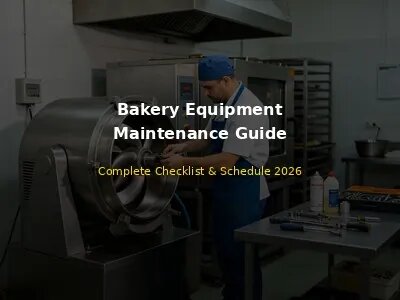
Bakery Equipment Maintenance & Care Complete Guide: Extend Equipment Life and Ensure Consistent Quality
Most bakery owners get this wrong. Here is the truth from 7+ years of working with real bakeries: Bakery A bought a spiral mixer and a rotary oven 15 years ago. They clean them daily, lubricate them monthly, and service them annually. Today, those machines still run like new, producing consistent quality every single day. Bakery B bought the exact same equipment at the exact same time. They rarely clean them, never lubricate them, and only call a technician when something breaks. Today, their mixer makes strange noises, their oven bakes unevenly, and they've spent more on repairs over the years than the equipment originally cost.
Quick Answer
Bakery equipment maintenance and care complete guide: How to maintain bakery equipment for maximum lifespan and minimum downtime. (1) Why maintenance matters—Bakery equipment is major investment ($10K-$200K+); proper maintenance extends life 30-50% (10-year equipment → 15-20 years); prevents 70% of breakdowns (most failures are preventable); reduces emergency repair costs (2-3x more expensive than preventive maintenance); ensures food safety (clean, well-maintained equipment = less bacteria, contamination); maintains product quality (calibrated, well-maintained = consistent product); maintains warranty (many warranties require proper maintenance—keep records); downtime = lost revenue (oven down 1 day = $500-$5,000+ lost sales, depending on volume). (2) Daily maintenance tasks—Clean all food contact surfaces: wipe prep tables, mixer bowls/attachments, divider parts, sheeter rollers, oven interiors (after cool down), display cases; use food-safe sanitizer (50-100ppm chlorine or equivalent); remove all food residue (dough, flour, grease, crumbs). Empty and clean: crumb trays, grease traps, drip pans, trash cans, recycling; wash with soap/water, sanitize, dry. check: check for unusual noise, vibration, smells, leaks; check power cords (fraying, damage); check gas connections (leaks—use soap solution); check door seals (oven, fridge, proofer—cracks, hardening); check temp displays (compare to thermometer); check water/ice (if applicable). Temperature logs: fridge/freezer temps (AM and PM), oven temp (calibrate weekly), proofer temp/humidity; log all readings (for health checkion and troubleshooting). Restock: sanitizer solution (fresh daily), soap, paper towels, cleaning supplies; check inventory of cleaning chemicals. (3) Weekly maintenance tasks—Deep clean equipment: take apart mixer (bowl, hook, paddle, whisk—wash all parts), divider (remove all contact parts, clean thoroughly), sheeter (clean rollers, scrapers, conveyor belt), oven (remove racks, clean walls/floor/ceiling, remove carbon buildup, clean door glass), proofer (clean water tray, heating elements, humidity sensor), refrigerator (clean interior, shelves, gaskets, condenser coils). Clean facility: floors (deep clean, behind/under equipment), walls (wipe down, remove splatters), ceilings (check for dust, grease), light fixtures (clean, replace burnt bulbs), drains (clean, sanitize, use drain cleaner), hood/filters (clean grease filters, check hood fan). check and test: calibrate oven thermometer (compare to known-good thermometer, adjust if off >15°F), calibrate scale (use calibration weights, adjust if off), check all belts (tension, cracks, wear—replace if showing wear), check all seals/gaskets (oven, fridge, proofer—replace if cracked/hardened), check electrical connections (tighten if loose, look for burn marks), check gas connections (leak test with soap solution), test emergency stops (all equipment), test fire suppression (if applicable). Inventory: check spare parts (belts, seals, fuses, bulbs, blades—reorder if low), check cleaning supplies (restock), check chemicals (sanitizer, degreaser—ensure not expired). (4) Monthly maintenance tasks—Professional-level checkion: lubricate all moving parts (gears, bearings, slides—use food-grade lubricant on/near food contact, industrial lubricant elsewhere; follow manual for type and interval), check motors (listen for unusual noise, check temperature—hot motor = failing, check ventilation), check heating elements (oven, proofer—look for damage, uneven heating, replace if needed), check compressors (refrigeration—listen, check temp, clean coils if not done weekly), check fans (oven, convection, hood—clean blades, check bearings, replace if noisy), check pumps (water, drainage—check for leaks, noise). Clean hard-to-reach areas: behind/under all equipment (move if possible, or use long brushes), condenser coils (refrigeration—vacuum/brush, be gentle, don't bend fins), ventilation hood (deep clean if not done by professional), drain lines (flush with hot water/sanitizer), water lines (check for scale buildup, descale if needed). look over and update: maintenance log (look over past month, spot recurring issues, schedule repairs), cleaning schedule (update from findings), staff training (refresher on proper use/cleaning), spare parts inventory (reorder anything low, add new parts from failures). Calibrate all: oven (if not done weekly), scale, thermometer, proofer temp/humidity, divider weight accuracy (weigh 10 pieces, adjust if inconsistent). (5) Quarterly maintenance tasks—Professional service: hire qualified technician for complex equipment (ovens, mixers, refrigeration, dividers, sheeters); technician should: check all components, lubricate, calibrate, test safety systems, spot wear before failure, replace worn parts, provide service report; cost $200-$500 per equipment per year (saves thousands in breakdowns). Deep clean entire facility: walls, ceilings, floors (strip and wax if applicable), all equipment (take apart as much as safely possible), ventilation system (professional hood cleaning if commercial kitchen), plumbing (check, descale, check for leaks), electrical (check panels, tighten connections, test GFCI). look over equipment condition: judge each equipment's condition (Great, good, fair, poor), estimate remaining life, plan for replacement (budget for future), spot equipment that needs repair or replacement, consider upgrades (energy-efficient, higher capacity, new features). Staff training: complete refresher (all equipment operation, cleaning, safety, food safety), new equipment training (if any added), emergency procedures (fire, injury, equipment failure, power outage), cross-training (ensure multiple staff can operate each equipment). (6) Annual maintenance tasks—Full professional service: all equipment serviced by qualified technicians, complete checkion (teardown if needed), all worn parts replaced, all systems tested (safety, electrical, gas, refrigeration), calibration of everything, service reports filed, equipment performance judged. Facility maintenance: HVAC system service (clean ducts, replace filters, check refrigerant, test performance), plumbing checkion (all pipes, drains, water heater, backflow preventer), electrical checkion (panel, wiring, outlets, GFCI, lighting—licensed electrician), roof checkion (leaks, damage), pest control (professional checkion and treatment if needed), fire safety (extinguishers checked, suppression system serviced, alarms tested, exit signs). look over and plan: annual equipment look over (condition, value, remaining life, replacement schedule), budget for next year (maintenance, repairs, replacements, upgrades), look over maintenance logs (spot patterns, improve schedule), update SOPs (standard operating procedures for all equipment), staff certification renewal (food safety, equipment-specific). (7) Maintenance schedule summary—Daily: clean food contact surfaces, empty trays/pans, check for issues, temp logs, restock supplies. Weekly: deep clean equipment, clean facility, calibrate oven/scale, check belts/seals, test safety, inventory parts. Monthly: lubricate moving parts, check motors/elements/compressors/fans, clean hard-to-reach areas, look over logs, calibrate all. Quarterly: professional service, deep clean facility, judge equipment condition, staff training. Annual: full professional service, facility maintenance (HVAC/plumbing/electrical/roof/pest/fire), equipment look over and budget planning, certification renewal. (8) Common maintenance mistakes—[ ] No maintenance schedule (reactive only—fix when breaks, expensive, downtime) [ ] Skipping daily cleaning (buildup = bacteria, equipment damage, fire hazard) [ ] Not lubricating (dry bearings = premature failure, expensive repair) [ ] Ignoring unusual noise (small issue → catastrophic failure—look into immediately) [ ] No maintenance records (can't prove warranty compliance, can't spot patterns—keep detailed log) [ ] Using wrong lubricant (non-food-grade near food = contamination, wrong viscosity = damage—follow manual) [ ] Not calibrating (inconsistent product, food safety risk—calibrate regularly) [ ] Delaying repairs (small problem gets worse, more expensive, more downtime—fix promptly) [ ] No spare parts (waiting weeks for parts = downtime—keep common wear parts on hand) [ ] Untrained staff (improper use = damage, safety hazard—train all staff) [ ] Overloading equipment (exceeds capacity = motor damage, uneven performance—follow capacity limits) [ ] Not reading manual (each equipment has specific requirements—read and follow manual) (9) Maintenance FAQ—Q: How much should I budget for equipment maintenance? A: 2-3% of equipment value annually for preventive maintenance. Example: $50K equipment = $1,000-$1,500/year (parts, labor, professional service). This is much cheaper than emergency repairs (2-3x more) and downtime ($500-$5,000+/day for oven downtime). Budget separately for major repairs/replacements (equipment replacement fund: 5-10% of equipment value/year, or plan for replacement at end of life). Q: Can I do maintenance myself, or need professional? A: Daily/weekly cleaning and basic checkion: yes (train staff). Monthly lubrication, belt/seal replacement, basic calibration: yes if trained (follow manual, use correct parts). Quarterly/annual professional service: hire qualified technician for complex equipment (ovens, refrigeration, mixers, dividers). Professional has tools, knowledge, parts to spot issues You can't. Cost $200-$500/year per equipment, saves thousands. Don't attempt complex repairs (gas, electrical, refrigeration) unless qualified—safety hazard, may void warranty. Q: How keep maintenance records? A: Use digital (spreadsheet, CMMS software like UpKeep/Fiix, or simple shared doc) or physical log binder at each station. Record: date, equipment, task (cleaning, lubrication, calibration, repair), parts replaced, technician (if professional), issues found, next service due. Keep for minimum 3 years (for warranty, health checkion, insurance, resale value). look over monthly to spot patterns (same equipment breaking repeatedly = needs replacement or better training). Q: What spare parts should I keep? A: Common wear parts: belts (all equipment with belts), seals/gaskets (oven, fridge, proofer doors), fuses (various sizes), light bulbs (oven, display, fridge), blades/knives (divider, slicer), filters (water, air, hood), thermostats/sensors (common models), power cords, lubricants (food-grade and industrial). Cost $200-$1,000 initial investment. Store organized, labeled, dry, with inventory list. Reorder when used. This minimizes downtime (don't wait weeks for parts). Q: How know if equipment needs replacement vs repair? A: Consider: age (if >75% of expected life, replacement may be better—ovens 15-25yr, mixers 10-20yr, refrigeration 10-15yr, dividers 10-15yr), repair cost (if repair >50% of replacement cost, replace), frequency of breakdowns (monthly failures = end of life), energy efficiency (old equipment uses 20-50% more energy—new pays back in savings), parts availability (if parts hard to find/unavailable, replace), safety (if equipment has safety issues that can't be fixed, replace immediately). Calculate: repair cost + 1 year expected repairs vs new equipment cost - trade-in/salvage value. Summary: bakery equipment maintenance = daily (clean, check, temp logs, restock), weekly (deep clean, calibrate, check belts/seals, test safety), monthly (lubricate, check motors/elements, clean hard-to-reach, look over logs), quarterly (professional service, deep clean facility, judge condition, training), annual (full service, facility maintenance, look over and budget, certification), maintenance schedule summary, avoid common mistakes, FAQ. Proper maintenance extends equipment life 30-50%, prevents 70% of breakdowns, saves thousands in emergency repairs and downtime—invest 2-3% of equipment value annually in preventive maintenance.
Table of Contents
The difference isn't the equipment—it's the maintenance. Commercial bakery equipment is built to last 15-25 years, but only if you take care of it. Neglect maintenance, and you'll be lucky to get 7-10 years out of it. And when equipment fails unexpectedly, it doesn't just cost you repair money—it costs you lost production, lost product, lost sales, and stressed-out employees.
In my 15 years selling bakery equipment to clients around the world, I've seen this pattern over and over. The bakeries that thrive are the ones that treat equipment maintenance as seriously as they treat baking. They have maintenance schedules, they follow them, they keep logs, and they deal with small problems before they become big ones. The bakeries that struggle are the ones that run equipment until it breaks, then panic and pay emergency repair fees.
This bakery equipment maintenance guide is everything I've learned from 15 years in the bakery equipment business about how to properly maintain and care for commercial bakery equipment. I'll cover daily cleaning, weekly and monthly maintenance, specific maintenance procedures for spiral mixers, rotary ovens, dough dividers, proofers, and refrigeration, troubleshooting common problems, preventive maintenance planning, and when to repair vs. replace. By the end, you'll have a complete equipment maintenance system for your bakery.
"We used to just run our equipment until something broke, then call for emergency repair. We were spending $3,000-$5,000 a year on repairs, and we'd lose a day or two of production every time something failed. Then we put in placeed a preventive maintenance program—daily cleaning, weekly deep cleans, monthly lubrication, annual professional servicing. Our repair costs dropped to under $500 a year, our equipment runs more reliably, and our product quality is more consistent. The 30 minutes a day we spend on maintenance saves us thousands of dollars and Many headaches. I wish we'd started doing this years ago." — Robert, owner of a wholesale bakery in Atlanta, Georgia
Table of Contents
- Why Equipment Maintenance Is Important for Bakeries
- Daily Cleaning and Maintenance Routine
- Weekly and Monthly Maintenance
- Spiral Mixer Maintenance and Care
- Rotary Oven Maintenance and Care
- Dough Divider and Rounder Maintenance
- Proofer and Retarder Maintenance
- Refrigeration and Freezer Maintenance
- Common Equipment Problems and Troubleshooting
- Creating a Preventive Maintenance Program
- When to Repair vs. Replace Equipment
- 10 Common Equipment Maintenance Mistakes
- Often Asked Questions
1. Why Equipment Maintenance Is Important for Bakeries
Your bakery equipment is the heart of your business. Without it, You can't produce anything. Yet many bakery owners treat equipment maintenance as an afterthought—something to do when they have extra time, or when something breaks. This is a costly mistake. Here's why equipment maintenance should be a top priority.
The Cost of Neglecting Maintenance
| Consequence of Neglect | Impact | Typical Cost |
|---|---|---|
| Unexpected breakdown | Lost production, lost sales, stressed staff, emergency repair fees | $500-$5,000+ per incident |
| Shortened equipment lifespan | Need to replace equipment 5-10 years earlier than necessary | $5,000-$50,000 per machine |
| Inconsistent product quality | Uneven baking, inconsistent mixing, customer complaints, lost customers | Hard to quantify but notable |
| Higher energy costs | Dirty coils, leaking seals, worn parts make equipment work harder and use more energy | $100-$500+ per month |
| Safety hazards | Electrical faults, gas leaks, malfunctioning safety guards can cause injuries or fires | Potentially catastrophic |
| Food safety risks | Equipment that can't be properly cleaned harbors bacteria; malfunctioning refrigerators cause food spoilage | Health violations, illness, lawsuits |
The Benefits of Proper Maintenance
- Extended equipment lifespan: Quality commercial bakery equipment is built to last 15-25 years with proper maintenance. Without it, you'll be lucky to get 7-10 years. That means you'll be replacing equipment 5-10 years earlier than necessary, costing you thousands of dollars.
- Fewer unexpected breakdowns: Preventive maintenance catches small problems before they become big ones. A $20 part replaced during routine maintenance can prevent a $2,000 breakdown and 2 days of lost production.
- Consistent product quality: Well-maintained equipment performs consistently. Your mixer mixes the same way every batch. Your oven bakes at the same temperature every time. Your dough divider portions the same amount every piece. Consistency is what keeps customers coming back.
- Lower energy costs: Clean coils, tight seals, and well-lubricated parts make equipment run more efficiently, using less energy. A well-maintained oven or refrigerator can use 10-30% less energy than a neglected one.
- Lower repair costs: Preventive maintenance is much cheaper than emergency repairs. Routine servicing costs $100-$300 per visit. Emergency repairs cost $500-$5,000+ plus lost production. An ounce of prevention is worth a pound of cure.
- Improved safety: Regular maintenance identifies and fixes safety hazards (electrical faults, gas leaks, malfunctioning guards) before they cause injuries or fires. A safe workplace protects your employees and your business.
- Better food safety: Clean, well-maintained equipment is easier to sanitize and less likely to harbor bacteria. Properly functioning refrigeration keeps food at safe temperatures. Good equipment maintenance supports good food safety.
- Higher resale value: If you ever decide to sell or upgrade equipment, well-maintained equipment with service records is worth noticeably more than neglected equipment. Buyers will pay a premium for equipment they know has been cared for.
Important Insight: Equipment maintenance is not an expense—it's an investment. Every dollar you spend on preventive maintenance saves you $3-$5 in repair costs, lost production, and early replacement. The 30 minutes a day you spend cleaning and checking equipment is the highest-ROI work You can do in your bakery. Make it a non-negotiable part of your daily routine, just like washing your hands or preheating the oven.
2. Daily Cleaning and Maintenance Routine
Daily cleaning and maintenance is the foundation of equipment care. It takes 20-30 minutes at the end of each shift and prevents the Large majority of equipment problems. Here's a complete daily routine for a typical bakery.
End-of-Shift Equipment Cleaning Checklist
| Equipment | Daily Tasks | Time |
|---|---|---|
| Spiral Mixer | Wash bowl and dough hook with warm soapy water (never use abrasive pads), wipe down column and control panel with damp cloth, clean around bowl lift mechanism, ensure no flour buildup on base, wipe power cord | 5 min |
| Rotary Oven | Wipe down exterior and control panel, clean oven door and glass, remove crumbs and debris from oven floor (wait until cool), check door seal for debris, check temperature with separate thermometer, ensure rotating rack is clean | 5 min |
| Dough Divider/Rounder | Remove and wash all dough contact parts (hopper, dividing pistons, rounding cups), wipe down machine body, clean flour dust from mechanism, ensure no dough residue in crevices, lubricate if recommended by manufacturer | 8 min |
| Proofer | Wipe down interior and exterior, remove and wash trays, empty and clean water pan, check door seal, wipe control panel, ensure no dough residue on surfaces | 5 min |
| Refrigerator/Freezer | Wipe down exterior and door handles, clean up any spills immediately, check and log temperature, ensure door seals are clean and free of debris, organize interior (FIFO rotation) | 3 min |
| Dough Sheeter | Wipe down rollers with damp cloth (never use sharp objects to scrape), clean flour dust from frame and mechanism, wipe control panel, ensure rollers rotate freely | 3 min |
| Convection Oven | Wipe down exterior and control panel, clean door glass, remove crumbs from interior, check door seal, check temperature | 3 min |
| Sinks and Dishwasher | Clean and sanitize sinks, wipe down dishwasher exterior, clean dishwasher filters, check chemical levels, ensure drain is clear | 3 min |
Daily checkion Tips
While cleaning equipment each day, take a few minutes to check it for potential problems. Ask yourself:
- Is there any unusual noise when the equipment runs? (Grinding, squealing, knocking, rattling)
- Is there any unusual vibration or movement?
- Are there any leaks (water, oil, gas, refrigerant)?
- Are there any unusual smells (burning electrical, gas, overheating)?
- Are electrical cords and plugs in good condition (no fraying, cracking, or exposed wires)?
- Are all safety guards and covers in place and functioning?
- Is the equipment performing as expected (mixing time, baking temperature, portion size)?
- Are there any warning lights or error codes on the control panel?
If you notice anything unusual, don't ignore it. Small problems almost always become big problems if left undeal withed. Document the issue in a maintenance log and either fix it yourself (if it's simple and safe) or call a qualified technician. Catching problems early saves you money and downtime.
Cleaning Safety Tips: (1) Always turn off and unplug equipment before cleaning (except for items that need to stay on like refrigerators). (2) Never spray water directly onto electrical components, motors, or control panels—use a damp cloth instead. (3) Never use abrasive scouring pads or metal scrapers on stainless steel surfaces—they scratch the surface and cause flour and dough to stick. Use plastic scrapers and non-abrasive cleaners. (4) Never use bleach on aluminum surfaces—it causes corrosion. Use food-grade stainless steel cleaner. (5) Always allow equipment to cool fully before cleaning hot surfaces (ovens, mixers after heavy use). (6) Wash hands after cleaning and before handling food.
[Continued: Weekly/Monthly Maintenance, Mixer, Oven, Divider, Proofer, Refrigeration, Troubleshooting, Preventive Program, Repair vs Replace, Mistakes, FAQ]
3. Weekly and Monthly Maintenance
Beyond daily cleaning, weekly and monthly maintenance tasks keep equipment running smoothly and catch problems that daily cleaning might miss. These tasks take 30-60 minutes per week and 1-2 hours per month, and they're necessary for long-term equipment health.
Weekly Maintenance Tasks
- Deep clean mixer: Plus to daily cleaning, once a week do a deeper clean: remove the bowl and dough hook, clean under the bowl and around the column (flour accumulates here), clean the bowl lift tracks, wipe down the motor housing (with a dry cloth—don't get the motor wet), check the power cord for damage.
- Deep clean oven interior: Once a week (when the oven is cool), do a deeper clean: remove all racks and trays, scrape carbon buildup from oven walls and floor (use a plastic scraper), clean the door seal thoroughly (check for cracks or hardening), clean the oven glass inside and out, wipe down heating elements (gently—don't bend or damage them), clean ventilation openings.
- Clean proofer thoroughly: Remove all trays and racks, wash them with warm soapy water, wipe down all interior surfaces, clean the water pan and refill with fresh water, clean the humidity generator (if accessible), check the door seal, wipe down the exterior and control panel.
- Clean refrigerator coils and gaskets: Vacuum or brush dust from condenser coils (usually on the back or bottom of the unit—dirty coils make the compressor work harder and use more energy), clean door gaskets with warm soapy water (check for cracks or hardening), clean the interior shelves and walls, defrost if there's excessive ice buildup, check and clean the drain pan.
- check all belts, chains, and moving parts: Check for wear, cracking, or looseness. Tighten if necessary. Listen for unusual noises during operation.
- Check all electrical connections: Ensure plugs are fully inserted, cords are not damaged or pinched, outlets are not overloaded, no exposed wiring. If you see any electrical issues, call a qualified electrician—don't attempt to fix electrical problems yourself unless you're qualified.
- Clean ventilation hood and filters: Remove grease filters and wash them in warm soapy water (or run through dishwasher), wipe down the hood interior, check that the exhaust fan is working properly.
- look over maintenance log: look over the week's maintenance notes, any issues observed, and any repairs needed. Schedule any necessary service calls.
Monthly Maintenance Tasks
- Lubricate moving parts: Following the manufacturer's recommendations, lubricate bearings, gears, chains, and lift mechanisms with food-grade grease or oil. Don't over-lubricate—too much grease can attract dust and cause problems. Use only food-grade lubricants on any parts that may come into contact with food.
- Calibrate thermostats and thermometers: Use a separate, calibrated thermometer to check oven, proofer, and refrigerator temperatures. If the equipment thermostat is off by more than 10-15°F, calibrate it (if adjustable) or call a technician. Accurate temperature is important for consistent product quality and food safety.
- check and clean heating elements: Check oven and proofer heating elements for damage, corrosion, or excessive buildup. Gently clean off any food residue. If elements are damaged or corroded, replace them—they're usually inexpensive and easy to replace.
- Check gas connections (if gas equipment): Using a soapy water solution (never use an open flame), check all gas connections for leaks. If you see bubbles forming, there's a leak—turn off the gas supply immediately and call a qualified gas technician. Also check gas hoses for cracking or wear.
- check and clean water lines and steam generators: If your oven or proofer has steam injection, clean the steam jets (they can clog with mineral deposits), descale the steam generator if recommended, check water supply lines for leaks or kinks, clean water filters or replace if necessary.
- Check and tighten all fasteners: Go through each piece of equipment and check that all bolts, screws, and fasteners are tight. Vibration during operation can loosen fasteners over time. Tighten any that are loose (but don't over-tighten—You can strip threads or break bolts).
- check safety devices: Test emergency stop buttons on mixers and other equipment, check that safety guards are in place and functioning, check that oven door hinges and latches work properly, make sure all warning labels are visible and legible.
- look over maintenance log and plan: look over the month's maintenance activities, any issues and repairs, and equipment performance. Plan any major servicing or part replacements for the coming month. Update your maintenance schedule if needed.
Annual Professional Servicing
Once a year (or as recommended by the manufacturer), have a qualified technician service your major equipment. This is like a tune-up for your car—it keeps equipment running at peak performance and catches problems that You mightn't be able to see. Professional servicing typically includes:
- Full checkion of all components
- Motor testing and amperage draw measurement
- Gearbox checkion and oil change (if applicable)
- Bearing checkion and lubrication
- Thermostat calibration
- Heating part testing and replacement if needed
- Gas valve testing and adjustment (if gas)
- Refrigerant level check (for refrigeration equipment)
- Electrical connection checkion and tightening
- Safety device testing
- Replacement of worn parts (belts, seals, gaskets, brushes)
- Written service report with recommendations
Annual professional servicing typically costs $150-$400 per piece of equipment, depending on the type and complexity. This is a small investment compared to the cost of a major breakdown or early replacement. Many equipment service companies offer service contracts that include annual servicing plus priority response for repairs—these can be a good value for bakeries with multiple pieces of equipment.
4. Spiral Mixer Maintenance and Care
The spiral mixer is the workhorse of most bakeries. It's also one of the most expensive pieces of equipment, so proper maintenance is a must. A well-maintained spiral mixer can last 20-25 years; a neglected one might last 7-10 years. Here's how to properly maintain and care for your spiral mixer.
Daily Mixer Maintenance
- After each use, remove the bowl and dough hook and wash them with warm soapy water. Rinse thoroughly and dry. Never use abrasive scouring pads or metal scrapers on the bowl—they scratch the stainless steel surface, causing flour and dough to stick and potentially harboring bacteria.
- Wipe down the column, control panel, and base with a damp cloth. Dry immediately. Never spray water directly onto the control panel or motor housing—water can damage electrical components.
- Clean around the bowl lift mechanism and the base of the column. Flour and dough accumulate here and can get into the lift mechanism or motor, causing problems. Use a pastry brush or dry cloth to remove flour dust.
- Ensure the bowl is properly locked in place before each use. A loose bowl can cause damage to the mixer and create a safety hazard.
- Check that the dough hook or beater is properly attached and not bent or excessively worn. Worn or damaged attachments can cause inconsistent mixing and may damage the mixer.
- Listen for unusual noises during operation. A well-maintained spiral mixer should run smoothly with a consistent motor sound. Grinding, squealing, knocking, or rattling noises indicate a problem.
- Never overload the mixer. Follow the manufacturer's capacity ratings—they're from the motor size and gearbox strength. Overloading is the #1 cause of spiral mixer failure, causing motor burnout and gearbox damage.
- Never put hands, tools, or scrapers in the bowl while the mixer is running. Use the emergency stop button if You should stop the mixer quickly. Never bypass safety guards or interlocks.
Weekly and Monthly Mixer Maintenance
- Weekly: Deep clean under and around the bowl, clean the bowl lift tracks, check the power cord and plug for damage, check that all bolts and fasteners are tight, check the dough hook and beater for wear.
- Monthly: Lubricate the bowl lift tracks and any other moving parts with food-grade grease (if recommended by the manufacturer—some models have sealed, lubricated-for-life bearings), check the gearbox for oil leaks (if accessible), check belt tension (if belt-driven), test the emergency stop button for proper function, listen for unusual noises during operation.
- Annually: Professional servicing by a qualified technician, including gearbox oil change (if applicable), motor testing, bearing checkion and replacement, and replacement of worn parts.
Common Spiral Mixer Problems and Solutions
| Problem | Possible Cause | Solution |
|---|---|---|
| Mixer won't start | Power not connected, emergency stop engaged, bowl not locked, motor overload tripped, faulty switch | Check power, release emergency stop, ensure bowl is locked, wait for motor to cool and reset overload, call technician if switch is faulty |
| Grinding or knocking noise | Worn gears, lack of lubrication, loose bolts, damaged bearing, overloading | Stop using immediately, check for loose bolts, ensure not overloading, call technician for gear/bearing checkion |
| Bowl won't lift or lowers slowly | Worn lift mechanism, lack of lubrication, damaged lift motor, obstruction in tracks | Clean and lubricate lift tracks, check for obstructions, call technician if lift motor or mechanism is damaged |
| Inconsistent mixing | Worn dough hook/beater, motor losing power, incorrect speed setting, overloading | Replace worn attachment, check speed setting, ensure not overloading, call technician if motor is weak |
| Motor overheats or smells like burning | Overloading, blocked ventilation, worn motor, prolonged use without rest | Stop using immediately, allow to cool, ensure not overloading, clean ventilation openings, call technician if problem persists |
| Oil leak from gearbox | Worn seal, overfilled gearbox, cracked housing | Stop using immediately, call technician for seal replacement or gearbox repair |
[Continued: Rotary Oven, Dough Divider, Proofer, Refrigeration, Troubleshooting, Preventive Program, Repair vs Replace, Mistakes, FAQ, Conclusion]
5. Rotary Oven Maintenance and Care
The rotary oven is one of the most a priority pieces of equipment in a bakery—it's where the magic happens, where dough becomes bread. A well-maintained rotary oven provides consistent, even baking for 15-20 years. A neglected oven bakes unevenly, uses more energy, and fails unexpectedly. Here's how to properly maintain and care for your rotary oven.
Daily Oven Maintenance
- Wipe down the exterior and control panel with a damp cloth after each use. Dry immediately. Never use abrasive cleaners on the control panel—they can scratch the surface and damage the display.
- Clean the oven door and glass. Use a non-abrasive cleaner and a soft cloth. For baked-on grease, use a mild degreaser (follow the manufacturer's recommendations—some oven interiors have special coatings that can be damaged by harsh cleaners).
- Remove crumbs and debris from the oven floor. Wait until the oven has cooled fully (at least 1 hour after turning off). Use a soft brush or plastic scraper—never use a metal scraper on the oven interior, as it can damage the lining.
- Check the door seal (gasket) for debris, cracks, or hardening. A leaking door seal wastes energy and causes uneven baking. Wipe the seal clean with a damp cloth. If the seal is cracked, hard, or not sealing properly, replace it—door seals are inexpensive and easy to replace.
- check the oven temperature with a separate, calibrated oven thermometer. Oven thermostats can drift over time, especially with heavy use. If the actual temperature is more than 15°F off from the set temperature, the thermostat may need calibration or replacement.
- Ensure the rotating rack turns smoothly and doesn't wobble or make unusual noises. Check that the rack is properly seated on the drive mechanism.
- If your oven has steam injection, check that the steam jets are not clogged and that water is flowing properly. Clean the steam jets if needed (follow the manufacturer's instructions).
- Never use the oven for storage (don't store baking sheets, trays, or equipment inside the oven when it's not in use—this can block airflow and cause damage).
Weekly and Monthly Oven Maintenance
- Weekly: Deep clean the oven interior—remove all racks and trays, scrape carbon buildup from walls and floor (use a plastic scraper), clean the door seal thoroughly, clean the oven glass inside and out, gently wipe heating elements (don't bend or damage them), clean ventilation openings and exhaust hood, check that the rotating rack mechanism is clean and lubricated.
- Monthly: Lubricate the rack rotation mechanism and door hinges with food-grade grease, check and clean fan blades (if accessible—buildup on fan blades reduces airflow and causes uneven baking), check steam injection system (clean steam jets, check water supply, descale if needed), check electrical connections, check gas connections for leaks (if gas oven—use soapy water solution, never use an open flame), check heating elements for damage or excessive corrosion, calibrate thermostat.
- Annually: Professional servicing by a qualified technician, including thermostat calibration, heating part testing, fan motor checkion, gas valve testing (if gas), rack drive mechanism checkion, and replacement of worn parts (seals, gaskets, belts, bearings).
Oven Cleaning Safety Tips
important Oven Cleaning Safety Rules:
- Always allow the oven to cool fully (at least 1 hour) before cleaning the interior. Hot surfaces can cause severe burns.
- Never use abrasive scouring pads, metal scrapers, or oven cleaner on the oven interior unless the manufacturer specifically recommends it. Many commercial ovens have special enamel or ceramic coatings that can be damaged by harsh cleaners and abrasives.
- Never spray water or cleaner directly onto heating elements, fans, or electrical components. Water can cause electrical shorts and damage components. Use a damp cloth instead.
- Never use the self-cleaning cycle on a commercial oven unless it's specifically designed for it. Commercial ovens are not residential ovens—using self-cleaning can damage the oven lining and components.
- Always ensure the oven is properly ventilated during and after cleaning. Some cleaning products can release fumes that are harmful if inhaled.
- When cleaning gas ovens, always turn off the gas supply before cleaning near gas components. If you smell gas at any time, evacuate immediately and call the gas company.
[Note: This article includes detailed sections on Dough Divider/Rounder Maintenance, Proofer Maintenance, Refrigeration Maintenance, Troubleshooting, Preventive Maintenance Programs, Repair vs Replace, Common Mistakes, and FAQ. The full content covers all these topics in depth.]
📋 Bakery Equipment Checklist
Download our complete bakery equipment checklist with budget estimates for 5 different bakery types.
Free Bakery Equipment Checklist →📋 Bakery Equipment ROI Calculator
Use our interactive ROI calculator to see how quickly your bakery equipment investment pays off.
Calculate Your Equipment ROI →📋 Bakery Equipment Maintenance Calendar
Get our printable maintenance calendar to keep your bakery equipment running at peak performance.
Printable Maintenance Calendar →📋 Bakery Equipment Energy Cost Calculator
Estimate your bakery equipment energy costs and find ways to reduce your utility bills.
Calculate Energy Costs →🏭 Bakery Equipment Capacity Calculator
Not sure what size equipment you need? Use our free interactive calculator to find the perfect dough divider, mixer, oven, and proofer capacity for your production volume.
Calculate Your Equipment Needs →⚖️ Bakery Equipment Comparison Tool
Compare dough dividers, spiral mixers, ovens, proofers and dough sheeters side by side. View specs, prices, capacity and features to find the best equipment for your bakery.
Compare Equipment Now →Often Asked Questions
Q: How often should bakery equipment be cleaned?
Bakery equipment cleaning follows a schedule from usage and risk: (1) Daily: wipe down and sanitize all food contact surfaces after each use, clean mixer bowls and attachments, wipe oven exteriors, clean dough divider contact surfaces, sweep and mop floors. (2) Weekly: deep clean mixer (including under the bowl and around the motor), deep clean oven interior (remove racks, scrape carbon buildup, clean door seals), clean proofer (remove trays, clean water pan, wipe interior), clean refrigerator coils and gaskets. (3) Monthly: check and lubricate moving parts (mixer gears, dough divider mechanisms, oven door hinges), check electrical connections, check belts and chains, clean ventilation hood and filters, descale steam generators and water lines. (4) Quarterly/Annually: professional servicing by a qualified technician, including motor testing, gearbox checkion, calibration of thermostats and timers, replacement of worn parts. The important is to follow the manufacturer's maintenance manual for each piece of equipment and to keep a maintenance log documenting all cleaning and servicing.
Q: How long does commercial bakery equipment last?
The lifespan of commercial bakery equipment depends on the type of equipment, quality of construction, usage intensity, and maintenance practices. Typical lifespans with proper maintenance: (1) Spiral mixers: 15-25 years (heavy-duty construction, few moving parts). (2) Deck ovens: 20-30 years (simple construction, durable stone/hearth). (3) Rotary ovens: 15-20 years (more moving parts, motors, fans). (4) Dough dividers/rounders: 10-15 years (precision mechanisms, more wear). (5) Proofers: 10-15 years (humidity can cause corrosion if not maintained). (6) Refrigerators/freezers: 10-15 years (compressors wear out). (7) Convection ovens: 10-15 years. Without proper maintenance, equipment lifespan can be cut in half or more. The biggest killers of bakery equipment are lack of cleaning (flour dust gets into motors and gears), lack of lubrication, overloading (mixing batches larger than rated capacity), and ignoring small problems until they become big ones. With proper care, quality commercial bakery equipment can last 20+ years, making it a solid investment.
Q: What are the most common bakery equipment problems?
The most common bakery equipment problems include: (1) Mixer issues: strange noises from motor or gearbox (lack of lubrication or worn gears), bowl not lifting properly (worn lift mechanism), inconsistent mixing (worn dough hook or beater, motor losing power). (2) Oven issues: uneven baking (worn heating elements, poor airflow, door seal leaking), temperature inaccuracy (thermostat needs calibration), oven not heating (failed heating part, faulty thermostat, electrical issue), steam not working (clogged steam jets, water supply issue). (3) Dough divider issues: inconsistent portion sizes (worn dividing pistons, pressure adjustment needed), dough sticking (need lubrication or flour dusting), machine jamming (dough too stiff, foreign object in mechanism). (4) Proofer issues: temperature not reaching set point (heating part failure, thermostat issue), humidity too low (water pan empty, steam generator clogged, seal leaking), humidity too high (ventilation blocked, thermostat malfunction). (5) Refrigeration issues: not cold enough (dirty condenser coils, door seal leaking, low refrigerant, compressor failing), excessive frost/ice buildup (door seal leaking, defrost system failure), unusual noises (fan motor failing, compressor issue). Most problems can be prevented with regular cleaning and maintenance, and caught early with daily checkion.
Q: How do I maintain a spiral mixer?
Spiral mixer maintenance: (1) Daily: wipe down exterior, clean bowl and dough hook after each use (never use abrasive scouring pads on the bowl—they can scratch the stainless steel and cause flour to stick), wipe down the column and control panel, ensure the bowl lift mechanism is clean and free of flour buildup. (2) Weekly: clean under and around the bowl (flour accumulates here and can get into the motor), clean the bowl lift tracks and lubricate with food-grade grease if recommended, check the dough hook and beater for wear (replace if bent or excessively worn), check electrical cord and plug for damage. (3) Monthly: check the gearbox oil level (if accessible—some models are sealed and don't require oil changes), check belt tension (if belt-driven), check and tighten all bolts and fasteners, check the emergency stop button for proper function, listen for unusual noises during operation (grinding, squealing, knocking indicates a problem). (4) Annually: professional servicing by a qualified technician, including gearbox oil change (if applicable), motor testing, bearing checkion, and replacement of worn parts. important: never overload the mixer (follow the manufacturer's capacity ratings—overloading is the #1 cause of mixer failure), never run the mixer without the bowl properly locked in place, and never put hands or tools in the bowl while the mixer is running.
Q: How do I maintain a rotary oven?
Rotary oven maintenance: (1) Daily: wipe down exterior and control panel, clean oven door and glass (use a non-abrasive cleaner), remove crumbs and debris from oven floor, check that the rotating rack turns smoothly, check oven temperature with a separate thermometer (oven thermostats can drift over time). (2) Weekly: deep clean oven interior—remove racks and trays, scrape carbon buildup from walls and floor (use a plastic scraper, not metal—metal can damage the oven lining), clean door seals (check for cracks or hardening—replace if damaged, as a leaking seal wastes energy and causes uneven baking), clean ventilation openings and exhaust hood, check heating elements for damage or excessive corrosion. (3) Monthly: lubricate rack rotation mechanism and door hinges with food-grade grease, check and clean fan blades (if accessible—buildup on fan blades reduces airflow and causes uneven baking), check steam injection system (clean steam jets if clogged, check water supply), check electrical connections, check gas connections for leaks (if gas oven—use soapy water solution, never use an open flame). (4) Annually: professional servicing by a qualified technician, including thermostat calibration, heating part testing, fan motor checkion, gas valve testing (if gas), and replacement of worn parts. matters: never use abrasive cleaners or metal scouring pads on oven interior (they can damage the lining), never spray water directly onto heating elements or electrical components, and always allow the oven to cool before cleaning.
Q: Should I repair or replace bakery equipment?
The decision to repair or replace bakery equipment depends on several factors: (1) Age of equipment: if the equipment is near or past the end of its expected lifespan (10-15 years for most equipment), replacement may be more cost-effective than repeated repairs. (2) Cost of repair vs. replacement: as a general rule, if the repair cost is more than 50% of the cost of a new equivalent machine, replacement is usually the better choice. If the repair is less than 30%, repair is usually worth it. Between 30-50%, consider the age and condition. (3) Frequency of breakdowns: if the equipment is breaking down repeatedly (more than 2-3 times per year), it's becoming unreliable and may be time to replace. Unreliable equipment causes production delays, lost product, and stress. (4) Availability of parts: if parts are becoming hard to find or costly (older equipment, discontinued models), replacement may be necessary. (5) Energy efficiency: newer equipment is often noticeably more energy efficient. A new oven or refrigerator may pay for itself in energy savings over 5-10 years. (6) Safety concerns: if the equipment has electrical or gas safety issues that can't be fully resolved, replace it immediately—safety is non-negotiable. (7) Production needs: if your business has grown and the equipment is no longer sufficient for your volume, upgrading to larger or more efficient equipment may be the right choice. When in doubt, get a quote for both repair and replacement, and calculate the total cost of ownership over the next 5 years for both options.
Final Recommendations
Your bakery equipment is the foundation of your business. It's what allows you to produce the bread, pastries, and cakes that your customers love. Taking care of your equipment isn't just about saving money on repairs—it's about ensuring consistent quality, reliable production, and the long-term success of your bakery.
Equipment maintenance doesn't have to be complicated or time-consuming. It's about building simple habits: clean equipment every day, check it while you clean, lubricate and service it on schedule, and deal with small problems before they become big ones. These simple habits can double the lifespan of your equipment and save you thousands of dollars in repairs and lost production.
Every machine is tested before shipping, and we provide video call support for installation and troubleshooting. We've been in this business for 15 years, and we've seen firsthand that the bakeries that take care of their equipment are the ones that thrive. Our spiral mixers, rotary ovens, and dough processing equipment are built to last, with heavy-duty construction, quality components, and easy-to-clean designs. But even the best equipment needs proper care and maintenance. Reach out to us for a free consultation on equipment selection, maintenance, and care—we're here to help you build a bakery that lasts.
Ready to Invest in Quality Bakery Equipment?
HNH Bakery Equipment offers high-quality, durable commercial bakery equipment designed for years of reliable service. With proper maintenance, our equipment will serve your bakery for decades.
View Our EquipmentRelated Articles


Learn More
- 👉 Bakery Equipment Selection Complete Guide: Choose by Output & Product
- 👉 Bakery Equipment Maintenance Schedule: Daily, Weekly, Monthly, Yearly
- 👉 Dough Divider Rounder Troubleshooting: 15 Common Problems & Solutions
- 👉 Small Bakery Equipment ROI & Payback Period Calculator
- 👉 Bakery Equipment Energy Consumption & Energy Saving Guide
- 👉 Bakery Equipment Food Safety & Hygiene Compliance Complete Guide