
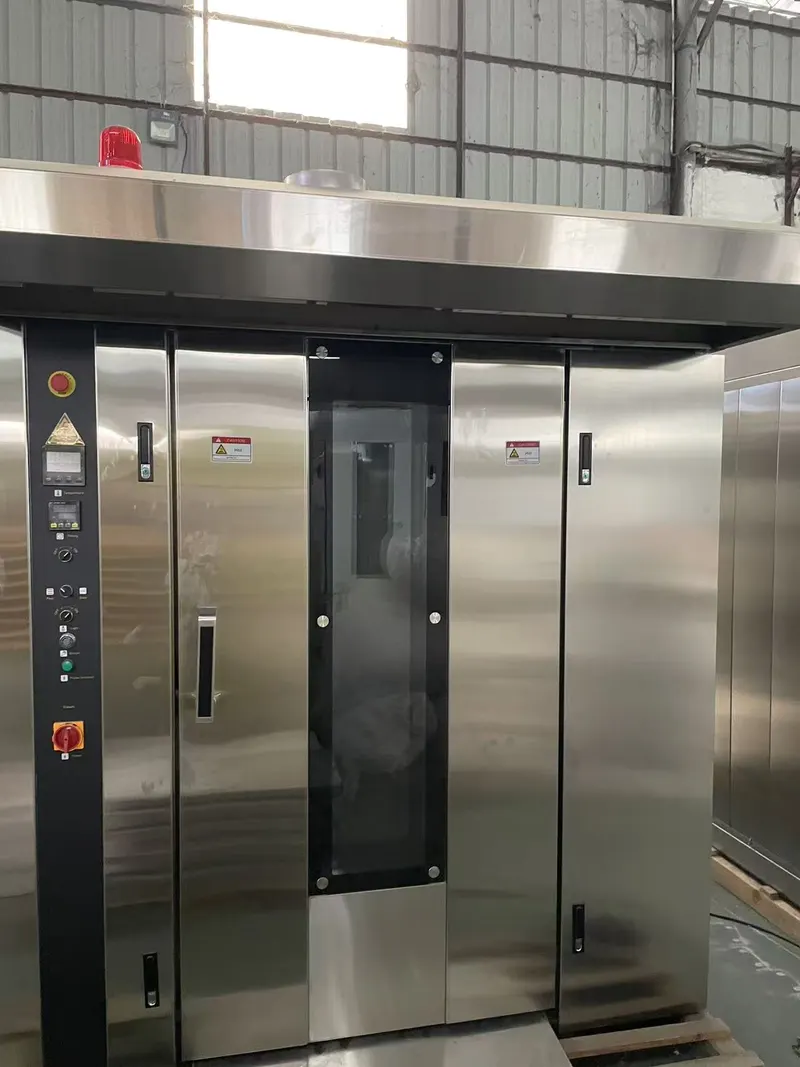
Commercial Rotary Rack Oven (Gas & Electric)
Looking for a commercial rotary rack oven that can handle serious daily volume? We manufacture gas and electric models from 6 to 60 trays, built with even heat circulation and stainless steel construction you can rely on for years. Every unit leaves our Hunan factory tested and ready for export — and because we're the manufacturer, you're buying at factory-direct prices.
Our commercial rotary oven circulates hot air evenly around every tray for consistent browning and crumb structure. As a leading rotary oven manufacturer in China, we offer models from 12 to 84 trays with electric or gas heating options. These industrial rotary ovens are the reliable choice for bread, baguette, cake and pastry production across Africa, Southeast Asia, the Middle East and beyond. Whether you run a small artisan bakery or a large-scale production facility, our rotary rack ovens deliver uniform baking results batch after batch.
Quick Answer
Commercial rotary rack oven: Large-capacity oven holding 32-72 trays with rotating rack for even baking. Electric or gas powered, forced convection, steam injection for bread crust. Price: $5,000-$25,000 depending on capacity and power type. Ideal for medium-high volume bakeries, wholesale operations, food factories. Features: digital controls, programmable recipes, temperature 50-300°C, CE certified, 10-20 year lifespan with proper maintenance.
Table of Contents
- Why Choose Our Commercial Rotary Oven?
- Rotary Oven Applications for Your Bakery
- How to Choose the Right Rotary Oven Size
- You May Also Like
- Customer Success Stories with Our Rotary Ovens
- Commercial Rotary Oven Installation & Commissioning Guide
- Energy Efficiency and Operating Cost Optimization for Rotary Ovens
- Rotary Oven vs Deck Oven vs Convection Oven: Complete Comparison
- Often Asked Questions About Commercial Rotary Ovens
As a leading bakery oven manufacturer, HNH Bakery Equipment provides high-quality bakery oven for bakeries of all sizes. Our bakery oven is designed for professional baking operations, delivering consistent results and reliable performance. Whether you need a bakery oven for your commercial bakery or artisan bread shop, our equipment meets your production requirements.
Why Choose Our Commercial Rotary Oven?
When you invest in a commercial rotary oven, you need reliability, consistency and efficiency. Our rotary rack ovens are engineered with heavy-duty components for 24/7 bakery operation. The rotating rack design ensures every tray receives identical heat exposure, eliminating hot spots and uneven baking. Compared to deck ovens, our industrial rotary ovens offer higher throughput in a smaller footprint, making them ideal for growing bakeries looking to scale production without expanding floor space.
Key Features
- Rotating rack for uniform heat and color on all trays
- 12 / 16 / 32 / 64 / 84 tray options to match your volume
- Electric or gas heating options
- Precise temperature and steam control (where available)
- Stainless steel interior for easy cleaning and food safety
Technical Specifications
| Model | HNH-RO16 / RO32 / RO64 (Reference) |
|---|---|
| Tray quantity | 16 / 32 / 64 trays (40×60cm) (Reference) |
| Heating type | Electric / Gas / Diesel (Reference) |
| Voltage / Power | 380V, 12kW-48kW (electric) (Reference) |
| Dimension (L×W×H) | Varies by model, contact for exact specs (Reference) |
| Weight | 800-2500 kg depending on model (Reference) |
| MOQ | 1 unit |
| Lead Time | 15-30 days |
※ Specifications above will be finalized once confirmed with the factory. Contact us for the latest data sheet and price.
Rotary Oven Applications for Your Bakery
Our commercial rotary ovens are versatile enough to handle many baked goods:
- Artisan bread and sourdough — consistent crust development and crumb structure
- Baguettes and French bread — even baking for uniform shape and color
- Cakes and pastries — gentle heat circulation prevents doming and cracking
- Cookies and biscuits — uniform browning across every tray
- Meat pies and savory items — even heat for thorough cooking
- Wholesale and industrial production — high throughput for large orders
How to Choose the Right Rotary Oven Size
Selecting the correct rotary oven capacity depends on your daily production volume and available space:
| Bakery Type | Recommended Capacity | Typical Daily Output |
|---|---|---|
| Small artisan bakery | 12-16 trays | 50-150 kg dough |
| Medium retail bakery | 32 trays | 150-400 kg dough |
| Large wholesale bakery | 64 trays | 400-1000 kg dough |
| Industrial production | 84+ trays | 1000+ kg dough |
Not sure which size is right for your operation? Contact our bakery equipment experts with your daily production numbers and we'll recommend the perfect rotary oven configuration for your business.
Add products to cart, then submit to get a formal quotation. Pay deposit via XTransfer to start production.
Add products to cart, submit to get a formal quotation. Pay deposit via XTransfer to start production.
Customer Success Stories with Our Rotary Ovens
Lagos, Nigeria — 32-Tray Gas Rotary Oven
"We upgraded from two deck ovens to one 32-tray gas rotary oven and our production doubled while our electricity bill dropped by 40%. The uniform baking means every loaf comes out the same — our customers notice the consistency. Best investment we've made in 5 years."
— Adebayo O., Owner, Golden Crust Bakery
Nairobi, Kenya — 16-Tray Electric Rotary Oven
"The 16-tray electric rotary oven was perfect for our medium-sized bakery. Installation was straightforward with the video guide HNH provided. We bake bread, cakes, and pastries all in the same oven with consistent results. The temperature accuracy is excellent — within ±3°C across all trays."
— Wanjiku M., Operations Manager, Nairobi Bake House
Cairo, Egypt — 64-Tray Gas Rotary Oven
"Our wholesale bakery produces 8,000 loaves daily. The 64-tray gas rotary oven handles our peak production with ease. We run it 16 hours a day and it's been running flawlessly for 18 months. The steam injection feature gives our baladi bread that authentic crust that Egyptian customers demand."
— Mahmoud E., Production Director, Cairo Wholesale Bakery
Commercial Rotary Oven Installation & Commissioning Guide
Proper installation ensures your rotary oven operates at peak efficiency and lasts for years. Here is our step-by-step guide based on hundreds of installations worldwide:
Step 1: Site Preparation
- Space requirements: Allow at least 1 meter (3 feet) of clearance on all sides for ventilation and maintenance access
- Floor loading: Ensure the floor can support the rotary rack oven weight (300-800 kg depending on model). Reinforce if necessary
- Ventilation: Gas models require proper exhaust venting to the outside. Electric models need adequate air circulation
- Power supply: Install a dedicated circuit with proper grounding. Three-phase 380V/415V for most models
- Gas connection: For gas models, install a properly sized gas line with shutoff valve and pressure regulator
Step 2: Unpacking and Placement
- Use a forklift or pallet jack to move the rotary rack oven — never lift by the door handles or control panel
- Remove all packaging materials, including foam, zip ties, and protective film
- Check for shipping damage before signing the delivery receipt. Document any damage with photos
- Level the oven using the adjustable feet. Use a spirit level on the rack rails to ensure proper rotation
- Verify the rotating rack spins freely without binding or rubbing
Step 3: Electrical and Gas Connections
- Electrical: Connect to the dedicated circuit by a qualified electrician. Verify voltage matches the oven specification (220V/380V/415V)
- Gas: Connect the gas line with a flexible connector. Test for leaks using soapy water — never use an open flame
- Exhaust: Connect the exhaust duct to the oven flue. Ensure proper draft for gas combustion
- Grounding: Verify proper grounding to prevent electrical shock and equipment damage
Step 4: Initial Startup and Burn-In
- Run the oven empty at 200°C (390°F) for 1-2 hours to burn off manufacturing oils and residues
- Open windows or use exhaust ventilation during burn-in — some smoke and odor is normal
- Verify the rack rotates smoothly and the door seal is tight when closed
- Check temperature accuracy with an oven thermometer. Allow ±5°C variance during initial warm-up
- Test all control functions: temperature setting, timer, steam injection (if equipped), fan speed
Pro Tip: We provide detailed installation videos and remote video support for every commercial rotary oven purchase. Our technicians can guide you through the entire installation process via WhatsApp video call, typically in under 2 hours. Contact us to schedule your installation support →
Energy Efficiency and Operating Cost Optimization for Rotary Ovens
Energy costs are typically the second-largest expense for bakeries (after labor). Improving your rotary oven energy efficiency can save thousands of dollars annually. Here are proven strategies from our customers worldwide:
1. Batch Loading Optimization
Always run the oven at full capacity. A 32-tray oven running at 16 trays uses nearly the same energy as at full load. Plan your production schedule to maximize each batch. Our customers report 20-30% energy savings simply by improving batch loading.
2. Preheat Only When Needed
Preheating takes 20-30 minutes. Don't preheat at 6 AM if your first batch goes in at 8 AM. Use the programmable timer (if equipped) to start preheating automatically. For gas models, consider a smaller "warm-up" burner if available.
3. Door Opening Discipline
Every time you open the oven door, the temperature drops 30-50°C (54-90°F) and the oven works harder to recover. Train your staff to:
- Load and unload all trays in one door opening — not one at a time
- Keep the door open for less than 30 seconds
- Check baking progress through the window instead of opening the door
- Ensure the door seal is clean and intact — a worn seal can waste 15% more energy
4. Regular Maintenance = Energy Efficiency
A well-maintained rotary oven uses 10-20% less energy than a neglected one. Key maintenance tasks:
- Clean heating elements monthly — grease buildup reduces heat transfer efficiency
- Check and replace door seals annually — a damaged seal wastes energy
- Lubricate rack rotation bearings quarterly — a stiff rack uses more motor power
- Calibrate temperature every 6 months — an oven running 20°C hotter than set wastes energy
- Clean exhaust vents monthly — restricted airflow causes inefficient combustion (gas models)
5. Heat Recovery Options
For high-volume bakeries, consider heat recovery systems that capture waste heat from the oven exhaust to preheat incoming air or water. These systems can reduce overall energy costs by 15-25%. Contact us for information on heat recovery options for your industrial rotary oven.
Real Savings Example: A 32-tray electric rotary oven running 10 hours/day at $0.15/kWh costs approximately $12-18/day in electricity. Implementing all the optimization strategies above can reduce this to $8-12/day — saving $1,200-2,000 per year. The savings pay for the oven in 3-5 years.
Rotary Oven vs Deck Oven vs Convection Oven: Complete Comparison
Choosing the right oven type is critical for your bakery's success. Here is a detailed comparison to help you decide:
| Feature | Rotary Oven | Deck Oven | Convection Oven |
|---|---|---|---|
| Capacity (trays) | 12-84+ | 4-12 per deck | 4-8 |
| Footprint | Compact (vertical) | Wide (horizontal) | Compact |
| Baking uniformity | Excellent | Good | Very Good |
| Individual deck control | No (single chamber) | Yes (each deck independent) | No |
| Best for bread | Yes (high volume) | Yes (artisan) | Limited |
| Best for cakes/pastries | Yes | Limited | Yes (excellent) |
| Price range (USD) | $3,000-20,000+ | $2,000-15,000+ | $1,500-8,000 |
| Energy efficiency | Good | Fair | Very Good |
| Ideal bakery size | Medium to large | Small to medium | Small / cafe |
Which Oven Type Should You Choose?
- Choose a rotary oven if: You produce 200+ loaves daily, need consistent results across all trays, have limited floor space, or plan to scale production. Rotary ovens are the workhorse of wholesale and high-volume retail bakeries.
- Choose a deck oven if: You specialize in artisan bread, sourdough, or products requiring individual deck temperature control. Deck ovens offer the "hearth baking" effect that some premium breads demand. Best for small to medium artisan bakeries.
- Choose a convection oven if: You primarily bake cakes, cookies, pastries, and small batches. Convection ovens are compact, affordable, and excellent for delicate items. Best for cafes, pastry shops, and small bakeries.
- Consider a combination: Many successful bakeries use a rotary oven for bread production and a convection oven for pastries and cakes. This combination offers the best of both worlds. Contact us for a customized equipment configuration →
📋 Bakery Equipment Checklist
Download our complete bakery equipment checklist with budget estimates for 5 different bakery types.
Free Bakery Equipment Checklist →📋 Bakery Equipment ROI Calculator
Use our interactive ROI calculator to see how quickly your bakery equipment investment pays off.
Calculate Your Equipment ROI →📋 Bakery Equipment Maintenance Calendar
Get our printable maintenance calendar to keep your bakery equipment running at peak performance.
Printable Maintenance Calendar →📋 Bakery Equipment Energy Cost Calculator
Estimate your bakery equipment energy costs and find ways to reduce your utility bills.
Calculate Energy Costs →🏭 Bakery Equipment Capacity Calculator
Not sure what size equipment you need? Use our free interactive calculator to find the perfect dough divider, mixer, oven, and proofer capacity for your production volume.
Calculate Your Equipment Needs →⚖️ Bakery Equipment Comparison Tool
Compare dough dividers, spiral mixers, ovens, proofers and dough sheeters side by side. View specs, prices, capacity and features to find the best equipment for your bakery.
Compare Equipment Now →Often Asked Questions About Commercial Rotary Ovens
Q: How much does a commercial rotary oven cost?
A: Rotary oven price depends on capacity, heating type and customization. Our 16-tray electric models start around $3,000-5,000, while 64-tray gas models range from $8,000-15,000. As a direct rotary oven manufacturer in China, we offer factory-direct pricing without middleman markup. Contact us for a detailed quotation based on your specific requirements and destination port.
Q: What is the difference between electric and gas rotary ovens?
A: Electric rotary ovens offer precise temperature control, faster heat-up times and lower installation costs. They are ideal for bakeries with reliable three-phase power. Gas rotary ovens have lower operating costs in regions with cheap natural gas or LPG, and can continue operating during power outages with a gas-powered blower. Both types deliver equally consistent baking results. The choice depends on your local utility costs and infrastructure.
Q: Rotary oven vs deck oven — which is better for my bakery?
A: Rotary ovens offer higher throughput in a smaller footprint, making them ideal for high-volume production and wholesale bakeries. They bake multiple trays simultaneously with uniform results. Deck ovens provide more individual control over each deck, which some artisan bakers prefer for specialty breads. For most growing bakeries, a commercial rotary oven offers the best balance of capacity, consistency and floor space efficiency. Read our complete bakery equipment guide for a detailed comparison.
Q: What voltage and power does a commercial rotary oven require?
A: Our industrial rotary ovens support 220V/380V/415V, 50/60Hz, three-phase power as standard. We can customize the voltage to match your country's electrical standards. Most African countries use 220-240V three-phase, while Southeast Asia typically uses 380V. Smaller 12-16 tray models may operate on single-phase power. Let us know your location and we'll configure the correct voltage for your rotary oven.
Q: How do I maintain and clean my rotary oven?
A: Daily maintenance includes wiping down the interior with food-grade sanitizer after cooling, emptying crumb trays, and checking door seals. Weekly maintenance involves lubricating the rack rotation mechanism and checking fan blades. Monthly maintenance includes inspecting heating elements, calibrating temperature, and checking electrical connections. We provide a detailed maintenance manual with every commercial rotary oven. Proper maintenance can extend the machine's lifespan to 8-12 years. Watch our video guide for step-by-step cleaning instructions.
Q: What is the warranty and after-sales support for your rotary ovens?
A: All our rotary rack ovens come with a 12-month warranty covering manufacturing defects. We provide free spare parts during the warranty period (excluding shipping costs). After warranty, we offer lifetime technical support and spare parts at cost price. Our support team is available via WhatsApp, email, and video call. Most technical issues can be resolved within 24 hours with our remote video support. We also offer optional extended warranty packages for up to 3 years.
Q: Can you customize the rotary oven for my specific needs?
A: Yes, as a professional rotary oven manufacturer, we offer comprehensive customization options including: different voltage configurations, custom tray sizes, special surface treatments, brand labeling (OEM), steam injection systems, programmable controllers, and conveyor integration. Customization typically adds 5-10 days to production time. Tell us your requirements and we'll provide a customized solution with detailed pricing. Many of our clients request custom branding for their retail stores or distribution businesses.
Related Products
Need Help Choosing the Right Equipment?
Our bakery equipment experts can help you find the perfect machine for your production needs.
Looking for Rotary Oven?
Find the best commercial bakery equipment from HNH Bakery Equipment, a leading bakery equipment manufacturer and bakery equipment supplier from China. We offer bakery equipment for sale at competitive bakery equipment price for small businesses, startups, and industrial bakeries. Whether you need bakery equipment wholesale or a single unit, our bakery equipment factory provides reliable equipment with global shipping. Learn how to choose bakery equipment with our expert buying guides.