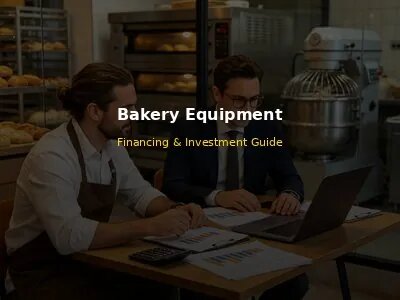
A lesson from a bakery owner in Chicago, Illinois: "When I opened my bakery, I was so excited about equipment that I bought the biggest, fanciest everything. I got a 120-quart mixer even though I only needed 40 quarts. I got a 4-deck oven when I only needed 2. I bought all European brands because I thought they were the best. I spent $150,000 on equipment alone. Six months later, I was struggling to make loan payments. I had bought equipment that was too big, too expensive, and more than I needed. My production was only using 40% of my oven capacity. I was paying for equipment I wasn't using. If I had been smarter, I could have bought the right equipment for $80,000 and had $70,000 left for working capital. The lesson? Equipment is an investment, not a trophy. Buy what you need, not what you want. Calculate the ROI before you buy. Consider financing options carefully. And don't forget that the money you spend on equipment is money You can't spend on marketing, inventory, or surviving slow months. Smart equipment investment is one of the most matters financial decisions you'll make as a bakery owner."
professional bakery machinery is typically the second-largest expense when starting a bakery (after leasehold improvements/buildout), and it's one of the most worth noting investments you'll make. The right equipment can increase your production capacity, improve product quality, reduce labor costs, and drive revenue growth for years to come. The wrong equipment - too big, too small, too expensive, unreliable - can drain your finances, limit your growth, and even contribute to business failure.
As our Chicago customer learned, equipment investment requires careful planning, realistic budgeting, and smart financing decisions.If you're setting up a new bakery or upgrading your existing line, this is the most worth noting thing to get right. Skip the marketing hype and focus on these practical factors that actually figure out your equipment's performance. used, equipment priority, tax benefits, maintenance, depreciation, common mistakes, and a budget template You can use for your own bakery.
At HNH bakery machinery, we've helped hundreds of bakery owners around the world make smart equipment investment decisions. We manufacture professional bakery machinery at competitive prices, provide free layout design and equipment selection consulting, and offer flexible payment terms for qualified buyers. This bakery equipment financing guide shares the knowledge and experience we've gained from working with bakery owners in over 50 countries.
1. Why Equipment Investment Is Important for Bakery Success
Your equipment is the engine of your bakery. It figure outs what You can produce, how much You can produce, how consistent your products are, how much labor you need, and in the end, how profitable your business is. Here's why equipment investment is so important:
1.1 Production Capacity
Your equipment figure outs your maximum production capacity. If your mixer can only handle 40kg of dough per batch and your oven can only bake 200 loaves per hour, that's your ceiling - no matter how much demand You've. Under-sized equipment limits your growth and forces you to turn down orders or work excessive overtime. Over-sized equipment wastes money on capacity you don't need and increases utility costs. The right-sized equipment matches your current and projected production needs.
1.2 Product Quality and Consistency
Commercial equipment is designed for precision and consistency. A good spiral dough mixer develops gluten evenly and consistently batch after batch. A quality deck oven provides even heat and precise temperature control. An automatic divider-rounder produces uniform dough pieces every time. This consistency is important for product quality, customer satisfaction, and your brand reputation. Hand-mixing and home-grade equipment can't match the consistency of commercial equipment, especially at volume.
1.3 Labor Efficiency and Cost Reduction
Commercial equipment automates labor-intensive tasks, reducing the number of employees you need and the physical strain on your team. An automatic divider-rounder can do the work of 3-4 people dividing and rounding dough by hand. A dough rolling machine laminates croissant dough in minutes instead of hours. A spiral dough mixer mixes dough in 10-15 minutes instead of 30+ minutes by hand. Over the life of the equipment, labor savings can far exceed the equipment purchase price.
1.4 Long-Term Asset Value
Quality commercial baking equipment is built to last 10-20+ years with proper maintenance. Unlike many business expenses that are consumed immediately, equipment is a long-term asset that generates revenue year after year. A $10,000 mixer that lasts 15 years costs less than $600/year (excluding maintenance) and enables hundreds of thousands of dollars in production over its life. When calculating equipment costs, always consider the total cost of ownership over the equipment's useful life, not just the purchase price.
1.5 Business Value and Resale
Well-maintained commercial equipment retains notable resale value, especially for reputable brands. If you ever need to sell equipment, upgrade, or sell your business, quality equipment is an asset that adds value. A bakery with a full set of well-maintained commercial equipment is worth noticeably more than one with outdated or home-grade equipment. Equipment is part of your business's balance sheet and contributes to its overall value.
2. How Much Does Commercial baking equipment Cost?
Equipment costs vary widely depending on type, size, capacity, brand, and whether new or used. Here's a realistic breakdown of equipment costs for a typical retail bakery:
| Equipment Type | Capacity/Size | New Cost Range | Used Cost Range | Useful Life |
|---|---|---|---|---|
| Spiral Mixer | 20kg-120kg | $3,000-$15,000 | $1,500-$8,000 | 15-20+ years |
| Planetary Mixer | 20qt-80qt | $2,000-$10,000 | $1,000-$5,000 | 15-20 years |
| dough portioning machine-Rounder | 60-300 pcs/hr | $5,000-$25,000 | $2,500-$12,000 | 10-15 years |
| dough rolling machine | Tabletop/Floor | $2,000-$15,000 | $1,000-$7,000 | 10-15 years |
| Proofer/Retarder | Single/Roll-in | $3,000-$25,000 | $1,500-$12,000 | 10-15 years |
| Deck Oven | 1-4 decks | $5,000-$25,000 | $2,500-$12,000 | 15-25 years |
| Convection Oven | Full-size | $3,000-$10,000 | $1,500-$5,000 | 10-15 years |
| Rotary Rack Oven | Single/Double rack | $15,000-$50,000 | $8,000-$25,000 | 15-20 years |
| Walk-in Cooler/Freezer | Custom size | $8,000-$25,000 | $4,000-$12,000 | 15-20 years |
| Reach-in Refrigerator | Single/Double door | $2,000-$6,000 | $1,000-$3,000 | 10-15 years |
| Display Case | 4-8 ft | $3,000-$15,000 | $1,500-$7,000 | 10-15 years |
| Work Tables/Stands | Various | $500-$3,000 | $200-$1,500 | 20+ years |
| Smallwares/Tools | Full set | $2,000-$8,000 | $500-$3,000 | 5-10 years |
| Sinks/Dishwashing | 3-compartment | $1,000-$5,000 | $500-$2,500 | 15-20 years |
| POS System | Hardware+software | $1,000-$5,000 | $500-$2,000 | 5-7 years |
2.1 Typical Total Equipment Budgets by Bakery Type
| Bakery Type | Equipment Budget (New) | Equipment Budget (Used/Mix) | Important Equipment |
|---|---|---|---|
| Home/Cottage Bakery | $5,000-$15,000 | $3,000-$8,000 | Home oven, stand mixer, proofing box, small tools |
| Counter-only/Kiosk | $30,000-$60,000 | $20,000-$40,000 | Compact mixer, small oven, proofer, display case, refrigeration |
| Retail Bakery w/ Seating | $60,000-$120,000 | $40,000-$80,000 | Full production: mixer, divider-rounder, sheeter, proofer, deck oven, refrigeration, display cases |
| Large Bakery/Cafe | $120,000-$250,000 | $80,000-$150,000 | High-capacity equipment, multiple ovens, rotary rack oven, full kitchen, espresso machine |
| Wholesale/Commercial | $200,000-$500,000+ | $150,000-$350,000 | Industrial mixers, automatic lines, rotary ovens, large proofers, packaging equipment, delivery vehicles |
Cost-Saving Tip
We do not push the most expensive machine — we recommend the right machine for your budget, volume, and growth plans. Our equipment is used by bakeries in over 50 countries. We also provide free equipment selection consulting and bakery layout design to help you maximize your budget and choose the right equipment for your specific needs. Buying direct from the manufacturer removes middleman markups and can save you thousands of dollars. Contact us for a free quote and equipment recommendation.
3. Equipment Financing Options
Few bakery owners have enough cash to buy all their equipment outright. Financing allows you to get the equipment you need while preserving working capital for other important expenses (inventory, marketing, rent, payroll). Here are the main financing options available:
3.1 Equipment Loans (Bank/Credit Union)
Traditional term loans specifically for equipment purchase. The equipment itself is collateral, which can make approval easier than unsecured loans.
- Terms: 3-7 years, interest rates 6-15% depending on credit and term
- Down payment: Usually 10-20%
- Requirements: Good personal credit (650+), business plan, financial statements, tax returns
- Best for: Established businesses with good credit, buying core equipment with long useful life
- Pros: Own equipment outright, lower total cost than leasing, fixed payments, build business credit
- Cons: Higher upfront cost (down payment), stricter qualification, longer approval process, personal guarantee often required
3.2 SBA Loans (U.S. Small Business Administration)
SBA 7(a) loans can be used for equipment purchase. The SBA guarantees up to 85% of the loan, making banks more willing to lend to small businesses and startups.
- Terms: Up to 10 years for equipment, interest rates 6-13% (from prime rate + margin)
- Down payment: Usually 10-20%
- Requirements: Strong business plan, good credit, down payment, personal guarantee, collateral
- Best for: Startups and small businesses that may not qualify for conventional bank loans
- Pros: Lower down payments, longer terms, lower monthly payments, more flexible qualification
- Cons: Longer processing time (30-90 days), more paperwork, SBA fees, personal guarantee required
3.3 Equipment Financing Companies
Specialized lenders that focus exclusively on equipment financing. They often have faster approval and more flexible qualification than traditional banks.
- Terms: 2-5 years, interest rates 8-20%
- Down payment: 0-20% (some offer 0% down for qualified buyers)
- Requirements: Less strict than banks, some work with credit scores as low as 550, startups may qualify
- Best for: Startups, borrowers with less-than-perfect credit, need fast approval
- Pros: Fast approval (24-48 hours), flexible qualification, equipment is collateral, less paperwork
- Cons: Higher interest rates than banks, shorter terms, may require personal guarantee, watch for hidden fees
3.4 Equipment Leasing
Lease equipment from a leasing company rather than buying. Two main types: Fair Market Value (FMV) lease (lower payments, return or buy at end for market value) and $1 Buyout lease (higher payments, own equipment for $1 at end).
- Terms: 2-5 years
- Down payment: Usually 0-2 months' payments
- Requirements: Similar to equipment financing companies
- Best for: Preserving working capital, equipment that changes frequently, uncertain long-term needs, startups
- Pros: Low upfront cost, predictable payments, tax benefits (payments deductible), flexibility to upgrade, some include maintenance
- Cons: Higher total cost over time, no ownership (unless buyout), binding contract, early termination penalties, usage restrictions
3.5 Supplier/Manufacturer Financing
Some equipment manufacturers offer direct financing or payment plans. At HNH Bakery Equipment, we offer flexible payment terms for qualified buyers, including deposits with balance on delivery, and can connect you with financing partners.
- Terms: Vary by manufacturer
- Best for: International buyers, buyers who want a one-stop solution, qualified buyers with good payment history
- Pros: Convenient (financing and equipment from same source), may be more flexible, manufacturer understands equipment value, can simplify international transactions
- Cons: May require larger deposit, terms may be less favorable than banks, limited to that manufacturer's products
3.6 Business Line of Credit
A revolving credit line You can draw from as needed. Good for equipment purchases if You've an existing line, and provides flexibility for other business needs.
- Terms: Revolving, interest only on amount borrowed, rates 8-18%
- Requirements: Good credit, established business (usually 2+ years), strong revenue
- Best for: Established businesses with good credit, need flexibility for multiple purchases
- Pros: Flexibility, interest only on borrowed amount, reusable, fast access to funds
- Cons: Harder to qualify for, may require personal guarantee, variable rates, lower limits for startups
3.7 Personal Savings and Investment
Using your own money or bringing in investors/partners. No debt, no interest, but requires capital and may dilute ownership.
- Best for: Buyers with sufficient savings, those who want to avoid debt, partnerships
- Pros: No debt, no interest, no payments, full ownership (if using own money), no qualification requirements
- Cons: Ties up personal capital, reduces working capital, may require bringing in partners (dilution), risk of losing personal savings if business fails
3.8 Other Options
- Crowdfunding: Platforms like Kickstarter, Indiegogo, or community-supported models. Can raise capital while building customer base. Best for unique concepts with strong community support. Requires large marketing effort.
- Microloans/CDFIs: Small loans ($500-$50,000) from non-profit lenders. Easier to qualify for, may include business training. Good for startups and minority-owned businesses.
- Credit cards: Can be used for smaller purchases, but high interest rates (15-25%) make this expensive. Only for short-term financing of small items, and only if You can pay off quickly.
Financing Qualification Tips
1. Check your credit score and fix errors before applying. 2. Prepare a solid business plan with realistic financial projections. 3. Have at least 10-20% down payment saved. 4. Keep business and personal finances separate. 5. Build relationships with lenders before you need financing. 6. Compare offers from multiple lenders - rates and terms vary noticeably. 7. Don't apply for too many loans at once (multiple credit inquiries can lower your score). 8. At HNH Bakery Equipment, we can provide equipment quotes and supplier letters to support your loan application.
4. Buy vs. Lease: Which Is Right for You?
The buy vs. lease decision is one of the most common questions bakery owners ask. The answer depends on your financial situation, business stage, and long-term plans.
| Factors | Buying | Leasing |
|---|---|---|
| Upfront cost | Higher (down payment 10-20%) | Lower (0-2 months' payments) |
| Monthly payment | Higher (paying full price + interest) | Lower (paying for use, not ownership) |
| Total cost (3-5 years) | Lower | Higher (20-40% more) |
| Ownership | Yes - asset on balance sheet | No (unless buyout at end) |
| Tax benefits | Section 179 deduction (full purchase price), depreciation, interest deduction | Lease payments 100% deductible as business expense |
| Maintenance | Your responsibility | May be included (some leases) |
| Flexibility/upgrade | Less flexible - own equipment, must sell to upgrade | More flexible - can upgrade at end of lease |
| End of term | Own equipment, can use for 10-20+ years | Return equipment or buy at market value/$1 |
| Best for | Established businesses, 5+ year horizon, core equipment, good credit | Startups, limited capital, uncertain growth, fast-changing technology |
4.1 When Buying Makes Sense
- You've the capital for a down payment and can afford monthly payments
- You plan to use the equipment for 5+ years (core production equipment typically lasts 10-20+ years)
- You've good credit and qualify for favorable loan terms
- You want to build equity in your business
- You can take advantage of Section 179 tax deductions
- The equipment is core production equipment (mixers, ovens, dividers) that won't become obsolete quickly
4.2 When Leasing Makes Sense
- You've limited capital and need to preserve working capital
- You're a startup and don't qualify for traditional loans
- You're uncertain about your long-term equipment needs or growth trajectory
- The equipment is technology that changes frequently (POS systems, software, some digital controls)
- You want predictable monthly payments and no large upfront cost
- You want the option to upgrade to newer equipment at the end of the term
- The lease includes maintenance and service, reducing your risk
a priority: Calculate Total Cost of Ownership
Before deciding to buy or lease, calculate the total cost of ownership over 5 years for both options. For buying: down payment + total loan payments (principal + interest) + maintenance/repairs - residual value (what You might sell it for). For leasing: total lease payments + end-of-lease buyout (if you plan to buy) + any maintenance not included. Compare the two totals. In most cases, buying is 20-40% cheaper over 5 years for core equipment. But if leasing preserves working capital that You should survive the first year, it may be worth the extra cost. Always consider your cash flow situation, not just the total cost.
5. New vs. Used Equipment
Buying used equipment can save you 30-60% compared to new, but it comes with risks. Here's how to decide:
5.1 When to Buy New
- Important production equipment: Mixers, ovens, divider-rounders - equipment that, if it breaks, stops your entire production. New equipment comes with warranties and reliable performance.
- Safety-important equipment: Ovens, gas equipment, electrical equipment - safety is paramount, and new equipment meets current safety standards.
- Equipment with high repair costs: If repair parts and service are expensive, the savings of used may be erased by one major repair.
- When you need specific features/capacity: Used equipment may not have the exact features or capacity you need.
- When financing is available: New equipment is easier to finance, and manufacturer warranties add value.
- For your first set of core equipment: When starting out, reliability is more matters than saving money. A breakdown in your first year could be catastrophic.
5.2 When to Buy Used
- Non-important equipment: Work tables, racks, sheet pans, mixing bowls, small tools - items that are simple and easy to check.
- Backup equipment: A backup mixer or oven that you'll only use occasionally - if it breaks, you still have your primary equipment.
- When You can check thoroughly: If you or a technician can check the equipment before purchase, check for wear, test operation, and check maintenance history.
- From reputable sources: Used equipment dealers that offer warranties, or from bakeries you know and trust (ask why they're selling).
- When budget is quite tight: If buying used is the only way to get the equipment you need, and you've checked it thoroughly, it can be a viable option.
- For expansion/second location: When adding capacity and you already have reliable primary equipment, used can be cost-effective.
5.3 Tips for Buying Used Equipment
- check in person: Never buy used equipment sight unseen. Visit the seller, check the equipment, and test it if possible.
- Check maintenance history: Ask for service records, maintenance logs, and repair history. Well-maintained equipment is worth more.
- Check for wear and damage: Look for rust, dents, leaks, unusual noises, worn bearings, damaged cords, and signs of heavy use.
- Test operation: Run the equipment through a full cycle if possible. Check temperatures, speeds, timers, and all functions.
- check age and usage: Ask how old the equipment is and how many hours it's been used. Commercial equipment is built for heavy use, but quite high usage can indicate shorter remaining life.
- Check parts availability: Make sure replacement parts are still available for the equipment model. Discontinued models can be difficult and expensive to repair.
- Consider warranty: Some used equipment dealers offer 30-90 day warranties. This adds cost but provides peace of mind.
- Calculate total cost: Used price + checkion/transport + any needed repairs + lost warranty. Compare to new price to make sure the savings are worth the risk.
- Be cautious with electrical/gas equipment: Used ovens and gas equipment can have hidden safety issues. Have a qualified technician check these before purchase.
- Get it in writing: Get a bill of sale, any warranty in writing, and check the seller has clear title to the equipment (no Great liens).
6. Equipment Investment Priority: What to Buy First
When budget is limited, focus on equipment from impact on production, revenue, and ROI. Here's a recommended priority order for a typical retail bakery:
6.1 Priority 1: Core Production Equipment (Must-Have)
These are the items you surely cannot operate without. Invest in quality here - breakdowns stop production fully.
- Mixer (Spiral or Planetary): The heart of your production. A good mixer is core for consistent dough development. Choose capacity from your largest batch size. For most retail bakeries, a 40-60kg spiral mixer is ideal. ROI: Enables all production, consistent quality, labor savings.
- Oven (Deck or Convection): The second most important piece. Your oven figure outs baking capacity and product quality. Deck ovens are best for bread and artisan products; convection ovens are more versatile for pastries, cookies, and cakes. Choose capacity from your peak baking needs. ROI: Enables all finished product, product quality, baking capacity.
- Refrigeration (Walk-in or Reach-in): fundamental for ingredient storage, dough retardation, and finished product storage. A walk-in cooler is ideal for production bakeries; reach-in refrigerators work for smaller operations. ROI: Food safety, ingredient preservation, dough quality, waste reduction.
- Work Tables and Smallwares: Stainless steel work tables, sheet pans, mixing bowls, dough scrapers, proofing baskets, rolling pins, cooling racks. These are relatively inexpensive but a must for daily operations. ROI: Enables all handwork and production tasks.
6.2 Priority 2: Labor-Saving Equipment (High ROI)
These items aren't strictly necessary (You can do the work by hand), but they save meaningful labor and improve consistency. They typically pay for themselves in labor savings within 1-3 years.
- dough portioning machine-Rounder: Automates dividing and rounding dough, doing the work of 3-4 people. Important if you produce high volumes of uniform rolls, buns, or bread dough. ROI: Labor savings (3-4 people), consistency, increased production capacity. Usually pays for itself in 1-2 years.
- pastry sheeter: Automates dough rolling and laminating, fundamental for croissants, danishes, puff pastry, and pie crusts. Saves hours of manual rolling. ROI: Labor savings, consistent thickness, product quality, enables laminated products. Pays for itself in 1-2 years.
- Proofer/Retarder: Controlled temperature and humidity for dough proofing, and retardation (slow cold fermentation) for scheduling flexibility. Important for consistent product quality and production scheduling. ROI: Product consistency, scheduling flexibility, waste reduction, labor scheduling.
- Second Mixer or Larger Capacity: If your single mixer is a bottleneck, adding a second mixer or upgrading to larger capacity can noticeably increase production. ROI: Increased production capacity, reduced bottlenecks, ability to take more orders.
6.3 Priority 3: Growth and Convenience Equipment (Buy as Needed)
These items improve efficiency, expand product offerings, or improve customer experience. Buy them when You've the demand and cash flow to justify them.
- Additional Oven Capacity: Add a second oven or upgrade to a larger/deck oven when your single oven is at capacity. ROI: Increased baking capacity, ability to handle more volume, reduced production bottlenecks.
- Rotary Rack Oven: For high-volume production (wholesale, large retail). Bakes entire racks at once, saving labor and increasing consistency. ROI: High-volume production, labor savings, consistency. Only justified at high production volumes.
- Convection Oven (if not already): Versatile for pastries, cookies, cakes, and savory items. Complements a deck oven. ROI: Product versatility, even baking for delicate items.
- Bread Slicer: Automates bread slicing, saves time, and provides uniform slices. Good if you sell Many sliced bread. ROI: Labor savings, consistency, customer convenience.
- Espresso/Coffee Machine: If you plan to serve coffee, a commercial espresso machine is core. Coffee has quite high margins (70-85%) and drives customer traffic. ROI: High-margin revenue, increased customer traffic, average transaction increase.
- Display Cases: Beautiful display cases showcase your products and drive impulse purchases. Refrigerated cases for perishable items, dry cases for bread and non-perishable items. ROI: Increased sales, product presentation, customer experience.
- Dough Molder/Former: For specific products (baguettes, hot dog buns, hamburger buns). Automates shaping for high-volume production. ROI: Labor savings, consistency, specific product capacity.
Priority Principle
When budget is limited, follow this principle: Buy the best quality You can afford for Priority 1 (core production) equipment - these are important and breakdowns are costly. For Priority 2 (labor-saving), calculate the labor savings and buy when the ROI is clear (typically 1-2 year payback). For Priority 3 (growth/convenience), buy only when You've proven demand and the cash flow to support it. Don't buy equipment "just in case" - buy it when you need it and can justify the investment. At HNH Bakery Equipment, we provide free equipment selection consulting to help you choose the right equipment for your specific production needs and budget.
7. How to Calculate Equipment ROI
Before making any major equipment purchase, calculate the return on investment (ROI) to ensure the equipment will pay for itself and generate positive returns. Here's how:
7.1 Simple ROI Calculation
Formula: ROI = (Annual Net Benefit / Total Equipment Cost) × 100
Annual Net Benefit = Annual Labor Savings + Annual Revenue Increase + Annual Cost Savings - Annual Maintenance Cost - Annual Financing Cost (interest)
Example: You're Given an automatic divider-rounder that costs $12,000.
- Annual labor savings: Replaces 2 part-time employees at $15/hour × 20 hours/week × 50 weeks = $30,000/year
- Annual revenue increase: Enables 20% more production = $15,000/year additional profit
- Annual maintenance cost: $1,200/year
- Annual financing cost (if financed at 10% for 5 years): ~$1,300/year interest
- Annual Net Benefit = $30,000 + $15,000 - $1,200 - $1,300 = $42,500
- ROI = ($42,500 / $12,000) × 100 = 354% per year
- Payback period = $12,000 / $42,500 = 0.28 years = ~3.4 months
This equipment has an Great ROI and pays for itself in less than 4 months. It's a clear "buy."
7.2 What to Include in ROI Calculation
- Labor savings: Number of employees/hours replaced × wage rate (including payroll taxes and benefits - typically 1.2-1.4x base wage)
- Increased production capacity: Additional units produced × profit margin per unit. Be realistic about whether You can sell the additional production.
- Reduced waste: Less product waste Because of consistency and precision × cost of wasted ingredients/product
- Improved product quality: Higher prices or increased sales Because of better quality (harder to quantify, but consider)
- Energy savings: Newer equipment may be more energy-efficient than older equipment × utility cost savings
- Maintenance and repair costs: Annual preventive maintenance + expected repairs. New equipment has warranty (lower cost); used equipment may have higher repair costs.
- Financing costs: Interest on loans or lease payments (if financing)
- Training costs: Initial training for employees to use the equipment
- Installation costs: Delivery, installation, electrical/plumbing modifications
7.3 ROI Benchmarks for Bakery Equipment
| Equipment | Typical Payback Period | Annual ROI (Typical) | Important Benefit |
|---|---|---|---|
| dough cutting machine-Rounder | 6-18 months | 100-300%+ | Labor savings (3-4 people), consistency |
| Dough Sheeter | 12-24 months | 50-150% | Labor savings, enables laminated products |
| Spiral Mixer | 12-24 months | 50-100% | Consistency, labor savings, capacity |
| Proofer/Retarder | 12-24 months | 50-100% | Consistency, scheduling flexibility, waste reduction |
| Deck Oven | 18-36 months | 30-80% | Product quality, baking capacity |
| Convection Oven | 12-24 months | 50-100% | Versatility, even baking, labor savings |
| Rotary Rack Oven | 18-36 months | 30-80% | High-volume production, labor savings |
| Bread Slicer | 12-24 months | 50-100% | Labor savings, consistency |
| Espresso Machine | 3-12 months | 100-400%+ | High-margin revenue, customer traffic |
| Display Cases | 6-18 months | 100-300%+ | Increased sales, product presentation |
ROI Rule of Thumb
As a general rule, equipment with a payback period of less than 2 years is usually a good investment. Equipment with a payback period of 2-3 years is worth Given if You've the capital and the equipment is core to your operation. Equipment with a payback period of more than 3 years should be carefully judged - it may still be worth it for quality or capacity reasons, but the financial return is longer. Always calculate ROI before purchasing, and be conservative in your estimates - it's better to underestimate benefits and be pleasantly surprised than to overestimate and be disappointed.
8. Tax Benefits of Equipment Investment
Equipment investment comes with large tax benefits that can quite a bit reduce the effective cost. Here are the main tax benefits for U.S. businesses (consult your accountant for your specific situation and country):
8.1 Section 179 Deduction
Section 179 of the U.S. tax code allows businesses to deduct the full purchase price of qualifying equipment (up to $1.16 million in 2024) in the year of purchase, rather than depreciating it over several years. This can provide a large tax benefit in the first year.
- Deduction limit: $1.16 million (2024), indexed for inflation
- Phase-out threshold: $2.89 million in equipment purchases (deduction reduces dollar-for-dollar above this)
- Qualifying equipment: Most tangible business equipment including bakery equipment, vehicles, computers, software, and furniture
- Financed equipment qualifies: You can deduct the full purchase price even if you finance the equipment (If you're responsible for the debt)
- Example: You buy $80,000 of bakery equipment in 2024. You can deduct the full $80,000 from your taxable income. If you're in the 25% tax bracket, that's $20,000 in tax savings. Your effective equipment cost is $60,000 ($80,000 - $20,000 tax savings).
8.2 Bonus Depreciation
Plus to Section 179, bonus depreciation allows additional first-year depreciation on qualifying equipment. The bonus depreciation percentage is phasing down: 100% in 2022, 80% in 2023, 60% in 2024, 40% in 2025, 20% in 2026, and 0% in 2027 and beyond (unless extended by Congress).
- Can be used in combination with Section 179
- Applies to new and used equipment
- No dollar limit
- Can create or increase a net operating loss
8.3 Regular Depreciation (MACRS)
If you don't use Section 179 or bonus depreciation, equipment is depreciated over its useful life using the Modified Accelerated Cost Recovery System (MACRS). Most bakery equipment falls into the 5-year or 7-year property class, meaning you deduct a portion of the cost each year over 5-7 years.
8.4 Lease Payment Deductions
If you lease equipment, your lease payments are typically 100% tax-deductible as a business expense in the year paid. This can be simpler than depreciation and provides a steady tax benefit over the lease term. However, you don't get the large first-year deduction that Section 179 provides for purchased equipment.
8.5 Interest Deduction
If you finance equipment with a loan, the interest portion of your loan payments is tax-deductible as a business expense. This reduces the effective cost of borrowing.
Consult Your Accountant
Tax laws change frequently, and the specific tax benefits available to you depend on your business structure, income level, equipment type, and country/jurisdiction. Always consult with a qualified accountant or tax professional before making equipment purchase decisions from tax benefits. The information in this bakery equipment financing guide is for educational purposes only and does not constitute tax advice. At HNH Bakery Equipment, we can provide equipment quotes and documentation to support your tax filings, but we recommend working with a professional for tax planning.
9. Equipment Maintenance and Total Cost of Ownership
The purchase price is only part of the total cost of equipment ownership. Maintenance, repairs, energy costs, and downtime can add noticeably to the total cost over the equipment's life. Understanding and planning for these costs is necessary for smart equipment investment.
9.1 Preventive Maintenance
Regular preventive maintenance is the best investment You can make to extend equipment life, reduce breakdowns, and minimize repair costs. A typical bakery should budget 2-5% of equipment value annually for preventive maintenance.
- Mixers: Check and lubricate bearings, check belts/chains, check motor, tighten connections, clean thoroughly. Monthly checkion, annual professional service.
- Ovens: Calibrate thermostats, check door seals, clean burners/elements, check ventilation, check gas connections. Monthly cleaning, quarterly calibration, annual professional service.
- Divider-Rounders: Lubricate moving parts, check knives/drums, check pressure, clean thoroughly, check electrical connections. Daily cleaning, weekly lubrication, quarterly professional service.
- Sheeters: Lubricate rollers, check belt tension, check bearings, clean rollers, check alignment. Daily cleaning, weekly checkion, annual professional service.
- Refrigeration: Clean condenser coils, check door seals, monitor temperatures, check compressors, defrost as needed. Monthly coil cleaning, quarterly checkion, annual professional service.
- Proofers: Calibrate temperature/humidity sensors, clean heating elements, check water supply, check fans. Monthly cleaning, quarterly calibration, annual service.
9.2 Energy Costs
industrial bakery equipment is energy-intensive, especially ovens and proofers. Energy costs can be 3-5% of revenue for a typical bakery. When evaluating equipment, consider energy efficiency:
- Ovens: The largest energy consumer. Deck ovens use less energy than convection for bread baking. Rotary ovens use more energy but handle higher volume. Look for energy-efficient models with good insulation and precise controls.
- Proofers: Use electricity for heating and water for humidity. Energy-efficient models with good insulation and digital controls use less energy.
- Refrigeration: Walk-in coolers/freezers use notable energy. Look for energy-efficient compressors, good insulation, LED lighting, and efficient defrost systems. Proper maintenance (clean coils, good door seals) noticeably reduces energy use.
- Mixers: Relatively low energy use compared to ovens. Larger mixers use more energy but handle more capacity per batch.
- Energy-saving tips: Turn off equipment when not in use, preheat only when needed, keep oven doors closed, maintain equipment properly, use energy-efficient lighting, consider solar panels for high-energy operations.
9.3 Downtime Costs
Equipment breakdowns don't just cost repair money - they cost production downtime, lost sales, missed deadlines, and customer dissatisfaction. A single oven breakdown during a busy weekend can cost thousands in lost sales and damage customer relationships. This is why investing in reliable equipment and preventive maintenance is so important.
- Calculate downtime cost: Lost production per hour × profit margin per unit + overtime costs to catch up + rush shipping/repair costs + customer dissatisfaction/long-term impact
- Example: If your bakery produces $500/hour in profit and an oven breakdown stops production for 8 hours, that's $4,000 in lost profit, plus repair costs, plus overtime to catch up, plus potential lost customers. A $2,000 annual maintenance contract that prevents this breakdown is a bargain.
- Mitigation: Preventive maintenance, reliable equipment, backup equipment for important items, good relationship with repair technician, spare parts for common failures, cross-trained staff who can troubleshoot.
9.4 Total Cost of Ownership (TCO) Calculation
When comparing equipment options (new vs. used, brand A vs. brand B, buy vs. lease), always calculate the total cost of ownership over the equipment's expected life, not just the purchase price.
TCO Formula: Purchase Price + Installation + Financing Costs (interest) + Annual Maintenance × Years + Annual Repairs × Years + Annual Energy Costs × Years - Resale Value (at end of ownership)
A cheaper piece of equipment with high maintenance costs, poor energy efficiency, and short lifespan may have a higher TCO than a more expensive, reliable, energy-efficient model with a long lifespan. Always compare TCO, not just sticker price.
10. Common Equipment Investment Mistakes to Avoid
- Buying more capacity than you need: The #1 mistake. Buying a 120kg mixer when you only need 40kg, or a 4-deck oven when 2 decks suffice. Over-sized equipment costs more to buy, more to operate (energy), and wastes money on capacity you don't use. Buy for your current and 1-2 year projected needs, not your 10-year dream. You can always add capacity later.
- Buying from brand name alone: European brands are Great but expensive. Many Chinese manufacturers (including HNH) produce comparable quality at 30-50% lower prices. judge equipment from specifications, quality, warranty, and service, not just brand name. Read look overs, talk to other bakery owners, and check equipment before buying.
- Ignoring total cost of ownership: Focusing only on purchase price and ignoring maintenance, energy, repair, and downtime costs. A cheap oven that breaks down frequently and uses excessive energy may cost more over 5 years than a more expensive, reliable, efficient model. Always calculate TCO.
- Not calculating ROI before purchasing: Buying equipment because it's "nice to have" or because you want the latest gadget, without calculating whether it will pay for itself. Every major equipment purchase should have a clear ROI calculation and payback period. If the payback is more than 3 years, carefully judge whether it's worth it.
- Skimping on core equipment to save money: The opposite of over-buying. Buying cheap, low-quality mixers or ovens to save money upfront, only to have them break down frequently, produce inconsistent quality, and need replacement in 2-3 years. Core production equipment (mixer, oven) is where You should invest in quality - breakdowns stop your entire operation. Buy the best quality core equipment You can afford.
- Not planning for installation costs: Equipment purchase price doesn't include delivery, installation, electrical modifications, plumbing, ventilation, or gas connections. These can add 10-30% to the equipment cost. Always budget for installation when planning equipment purchases. For ovens and large equipment, installation can be large (electrical upgrades, ventilation hoods, gas lines).
- Buying used equipment without thorough checkion: Buying used equipment sight unseen or without professional checkion can lead to costly surprises. Hidden mechanical issues, safety hazards, and discontinued parts can turn a "bargain" into a money pit. Always check used equipment in person, test it if possible, check maintenance history, and have a qualified technician check important equipment (ovens, gas equipment, electrical).
- Not Given future growth: While you shouldn't over-buy capacity, You should consider whether equipment can be upgraded or expanded later. Modular equipment (add-on decks, additional mixer bowls) can be more cost-effective than buying all capacity upfront. Also consider whether your space and utilities (electrical, gas) can support additional equipment later.
- Ignoring warranty and after-sales service: A warranty is only as good as the company behind it. A cheap piece of equipment with a 1-year warranty from a company that doesn't respond to service calls is worth less than a more expensive piece with a 3-year warranty from a responsive company. When evaluating equipment, consider warranty terms, availability of service technicians, parts availability, and supplier responsiveness. At HNH Bakery Equipment, we provide complete warranty and after-sales support for all our equipment.
- Financing without comparing options: Taking the first financing offer without shopping around can cost thousands in extra interest. Different lenders offer different rates, terms, and requirements. Compare offers from banks, credit unions, equipment financing companies, and SBA lenders. Also consider supplier financing. A 2% difference in interest rate on a $50,000 loan over 5 years is about $2,600 in extra interest.
- Not budgeting for maintenance: Buying equipment but not budgeting for regular maintenance is a false economy. Preventive maintenance costs 2-5% of equipment value annually but prevents costly breakdowns and extends equipment life. Budget for maintenance in your ongoing operating expenses, and schedule it regularly (don't wait for something to break).
- Letting emotion drive purchasing decisions: Falling in love with a shiny, fancy piece of equipment at a trade show or online, without doing the ROI calculation or Given whether you actually need it. Equipment is a business investment, not a status symbol. Make purchasing decisions from data (ROI, TCO, production needs), not emotion.
11. Equipment Investment Budget Template
Use this template to plan and budget your equipment investment. Fill in your specific numbers to create a realistic equipment budget.
| Equipment Item | Qty | New Cost | Used Cost | Installation | Annual Maint. | Priority | Financing |
|---|---|---|---|---|---|---|---|
| Spiral Mixer (___kg) | $_____ | $_____ | $_____ | $_____ | 1 | [ ]Buy [ ]Lease | |
| Planetary Mixer (___qt) | $_____ | $_____ | $_____ | $_____ | 1 | [ ]Buy [ ]Lease | |
| Deck Oven (___ decks) | $_____ | $_____ | $_____ | $_____ | 1 | [ ]Buy [ ]Lease | |
| Convection Oven | $_____ | $_____ | $_____ | $_____ | 2 | [ ]Buy [ ]Lease | |
| Dough Divider-Rounder | $_____ | $_____ | $_____ | $_____ | 2 | [ ]Buy [ ]Lease | |
| Dough Sheeter | $_____ | $_____ | $_____ | $_____ | 2 | [ ]Buy [ ]Lease | |
| Proofer/Retarder | $_____ | $_____ | $_____ | $_____ | 2 | [ ]Buy [ ]Lease | |
| Walk-in Cooler/Freezer | $_____ | $_____ | $_____ | $_____ | 1 | [ ]Buy [ ]Lease | |
| Reach-in Refrigerator | $_____ | $_____ | $_____ | $_____ | 1 | [ ]Buy [ ]Lease | |
| Display Case(s) | $_____ | $_____ | $_____ | $_____ | 2 | [ ]Buy [ ]Lease | |
| Work Tables/Stands | $_____ | $_____ | $_____ | $_____ | 1 | [ ]Buy [ ]Lease | |
| Sinks/Dishwashing | $_____ | $_____ | $_____ | $_____ | 1 | [ ]Buy [ ]Lease | |
| Smallwares/Tools | $_____ | $_____ | $_____ | $_____ | 1 | [ ]Buy [ ]Lease | |
| POS System | $_____ | $_____ | $_____ | $_____ | 2 | [ ]Buy [ ]Lease | |
| Espresso Machine (if applicable) | $_____ | $_____ | $_____ | $_____ | 3 | [ ]Buy [ ]Lease | |
| Other: __________ | $_____ | $_____ | $_____ | $_____ | [ ]Buy [ ]Lease | ||
| TOTAL | $_____ | $_____ | $_____ | $_____ |
Financing Summary:
- Total equipment cost (including installation): $_____
- Down payment (10-20%): $_____
- Amount to finance: $_____
- Financing option: [ ]Bank loan [ ]SBA [ ]Equipment finance co. [ ]Lease [ ]Supplier financing [ ]Personal savings [ ]Other
- Interest rate: _____% | Term: _____ years | Monthly payment: $_____
- Total interest paid over term: $_____
- Estimated tax savings (Section 179 + depreciation): $_____
- Effective equipment cost (after tax savings): $_____
- Annual maintenance budget: $_____
- Annual energy cost estimate: $_____
- Annual total cost of ownership: $_____
12. Conclusion
Equipment investment is one of the most worth noting financial decisions you'll make as a bakery owner. The right equipment - properly sized, reliable, energy-efficient, and well-maintained - can drive your production, improve your product quality, reduce your labor costs, and generate strong returns for years to come. The wrong equipment - over-sized, under-sized, cheap, unreliable - can drain your finances, limit your growth, and contribute to business failure.
Important takeaways from this bakery equipment financing guide:
- Plan your equipment investment carefully - it's the second-largest expense when starting a bakery (after buildout). Create a detailed equipment list and budget before you start purchasing.
- Buy the right size, not the biggest - over-sized equipment wastes money on capacity you don't need and increases operating costs. Buy for your current and 1-2 year projected needs. You can always add capacity later.
- Invest in quality core equipment - your mixer and oven are the heart of your production. Breakdowns stop your entire operation. Buy the best quality core equipment You can afford.
- Calculate ROI before every major purchase - if the payback period is more than 3 years, carefully judge whether it's worth it. Equipment with a payback of less than 2 years is usually a clear "buy."
- Consider total cost of ownership, not just purchase price - include maintenance, energy, repairs, downtime, and resale value. A cheaper piece of equipment may cost more over its lifetime.
- look at all financing options - compare bank loans, SBA loans, equipment financing companies, leasing, supplier financing, and personal savings. Different options have different rates, terms, and requirements. A 2% rate difference can save thousands.
- Take advantage of tax benefits - Section 179 deduction, bonus depreciation, and lease payment deductions can noticeably reduce the effective cost of equipment. Consult your accountant to maximize your tax benefits.
- Budget for preventive maintenance - 2-5% of equipment value annually. Regular maintenance prevents costly breakdowns, extends equipment life, and ensures consistent performance.
- Consider used equipment for non-important items - but check thoroughly before buying. Used equipment can save 30-60%, but comes with risks. For core production equipment, new is usually worth the investment.
- Buy direct from manufacturers when possible - at HNH Bakery Equipment, we manufacture industrial bakery equipment at prices 30-50% lower than comparable European brands, with complete warranty and after-sales support. We provide free equipment selection consulting and bakery layout design to help you make the right equipment decisions for your specific needs and budget.
Smart equipment investment is a skill that will serve you throughout your bakery ownership journey. As your business grows, you'll make many equipment purchasing decisions - adding capacity, upgrading technology, expanding product lines. By applying the principles in this guide - careful planning, ROI calculation, TCO analysis, smart financing, and preventive maintenance - you'll make equipment investments that pay off and contribute to your bakery's long-term success.Most bakery owners don't realize how much money they're losing until they look over their equipment. Here's what we've learned from working with bakeries across 27 countries. We will judge your needs and recommend the best equipment for your operation and budget.
View Our Complete Equipment Line📋 Bakery Equipment Checklist
Download our complete bakery equipment checklist with budget estimates for 5 different bakery types.
Free Bakery Equipment Checklist →📋 Bakery Equipment ROI Calculator
Use our interactive ROI calculator to see how quickly your bakery equipment investment pays off.
Calculate Your Equipment ROI →📋 Bakery Equipment Maintenance Calendar
Get our printable maintenance calendar to keep your bakery equipment running at peak performance.
Printable Maintenance Calendar →📋 Bakery Equipment Energy Cost Calculator
Estimate your bakery equipment energy costs and find ways to reduce your utility bills.
Calculate Energy Costs →Related Articles
Learn More
- 👉 Bakery Equipment Selection Complete Guide: Choose by Output & Product
- 👉 Bakery Equipment Maintenance Schedule: Daily, Weekly, Monthly, Yearly
- 👉 Dough Divider Rounder Troubleshooting: 15 Common Problems & Solutions
- 👉 Small Bakery Equipment ROI & Payback Period Calculator
- 👉 Bakery Equipment Energy Consumption & Energy Saving Guide
- 👉 Bakery Equipment Food Safety & Hygiene Compliance Complete Guide