Commercial Flour Sifter Machine Buying Guide 2026
By Lucas Yang, Founder & CEO · Updated October 21, 2026 · HNH Bakery Equipment Blog
⚡ Quick Answer
A commercial flour sifter removes lumps, aerates the flour and blends dry ingredients before they reach the mixer — a step that directly affects dough consistency and finished-product quality. FOB China prices in 2026 start at US$99-260 for a tabletop vibrating sifter, US$400-1,700 for a bakery-scale electric sifter, US$2,000-5,980 for a rotary vibro sifter, and US$8,300-17,000 for high-end industrial units. Most bakeries processing 200-500 kg of flour per day need a stainless-steel vibrating sifter with a 20-40 mesh screen and 200-500 kg/h capacity. The six mistakes that hurt buyers most are choosing mesh too fine for the throughput, buying single-use machines that cannot handle sugar and starch, ignoring stainless-steel grade, skipping a dust-proof design, under-sizing for peak season, and buying from suppliers without food-contact certification.
Table of Contents
- Why Sifting Matters in Commercial Bakeries
- The 4 Types of Commercial Flour Sifters
- Mesh Size: Matching Screen to Product
- Key Specs: Capacity, Motor, Stainless Steel & Dust Control
- Where the Sifter Fits in Your Production Line
- Capacity Guide: Matching Sifter to Output
- 2026 Price Guide (FOB China)
- The 6 Costly Mistakes to Avoid
- Factory vs. Trading Company: Where to Buy
- Customer Story: A Pastry Kitchen Doubles Output
- Maintenance Tips for 10+ Years of Service
- Frequently Asked Questions
Why Sifting Matters in Commercial Bakeries
Flour sifting is one of the most under-rated steps in commercial baking. When flour sits in storage, it packs, forms lumps and picks up foreign matter — and a 25kg sack of flour will contain natural variations in particle size that change how it absorbs water. Sifting fixes all of these at once: it breaks up lumps, removes impurities, aerates the flour so it mixes more evenly, and blends dry ingredients like flour, sugar, salt and baking powder into a uniform pre-mix.
The impact shows up directly in product quality. Unsifted flour produces dough that develops unevenly, white bread and pastry with visible specks, and batch-to-batch variation in absorption that forces bakers to constantly adjust recipes. In high-volume production, that inconsistency is costly: a batch that absorbs differently changes yield, proof time and final texture. Industry media such as Baking Business and World Grain regularly cover how processors invest in screening and ingredient handling to protect finished-product consistency — the same logic applies at bakery scale.
For a bakery producing cakes, bread, pastries or fried dough, a sifter is a relatively small investment that protects every downstream process. It also pays for itself through ingredient savings: consistent sifting means less flour wasted on rework and fewer failed batches.
The 4 Types of Commercial Flour Sifters
Commercial flour sifters divide into four families, each suited to a different scale and product mix.
1. Manual / Hand-Crank Sifter (Small Batch & Specialty)
The hand-crank sifter is the classic tool for small bakeries and pastry kitchens that sift a few kilograms at a time. It is inexpensive, takes almost no space, and gives total control for finishing tasks like dusting icing sugar or cocoa. But it is labor-intensive: a baker can sift roughly 10-30 kg per hour by hand, which makes it impractical as the main sifting solution for any bakery above very small scale.
2. Tabletop Vibrating Sifter (Small Commercial, 100-200 kg/h)
A tabletop vibrating sifter sits on a bench and uses an electric vibrator motor to move powder across a mesh screen. It is the entry-level commercial machine — food-grade stainless steel, 100-200 kg/h throughput, and a footprint small enough for a bakery counter or prep bench. Prices in 2026 start around US$99-260, which makes it an easy first purchase for a bakery adding a sifting step for the first time.
3. Floor-Standing Commercial Vibrating Sifter (Bakery Standard, 200-500 kg/h)
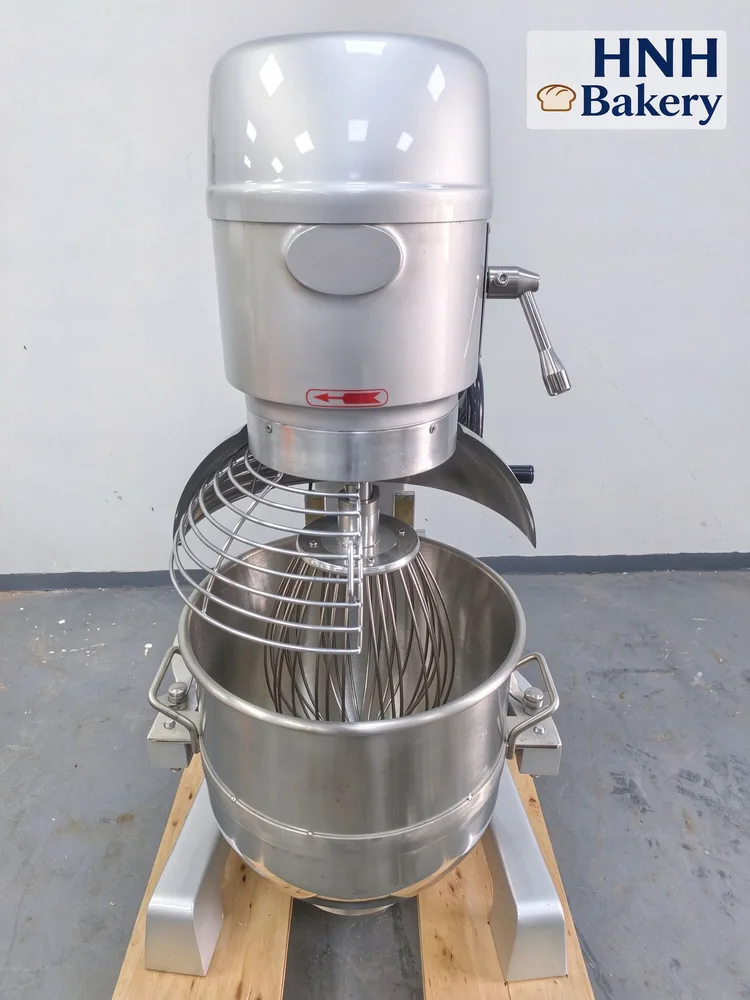
The floor-standing vibrating sifter is the workhorse of mid-size bakeries. It handles 200-500 kg/h, runs on 220V/110V single-phase or three-phase power, and is built from food-grade stainless steel with a removable screen for cleaning. This is the machine most buyers mean when they search for a "commercial flour sifter" — and the one we recommend for bakeries producing 300-1,000 kg of flour-based goods per day. It pairs naturally with a planetary mixer or spiral mixer, sifting straight into the mixing bowl.
4. Rotary (Tumbler) Sifter & Multi-Deck Industrial Sifter (High Volume, 500-2,000+ kg/h)
Rotary sifters use a gyratory, circular motion that gently moves material across the screen, giving higher capacity with less mesh wear than vibration. They handle 500-2,000 kg/h and are the standard choice for central production plants and industrial bakeries. Multi-layer (multi-deck) versions screen several fractions at once — for example, separating fine flour, coarse bran and oversized particles in a single pass. At the top of the range, plan sifters used in flour mills screen thousands of kilograms per hour across a large multi-deck box. For a bakery, a rotary or multi-deck sifter is justified when output passes roughly 1,000 kg of dry ingredients per day.
Mesh Size: Matching Screen to Product
Mesh number describes the screen openings per inch — the higher the number, the finer the screen. The right mesh depends on what you are sifting and how much throughput you need:
| Product | Recommended Mesh | Notes |
|---|---|---|
| Standard wheat flour | 20-40 | Removes lumps and impurities, keeps good throughput |
| Bread flour / strong flour | 20-30 | Finer screens slow the flow; 20-30 is the practical range |
| Icing sugar, cocoa, starch | 60-120 | Fine powders need finer mesh to remove agglomeration |
| Spice mixes, gluten-free flours | 80-120 | Fine, dry powders with high moisture sensitivity |
| Corn starch, very fine powders | 120-200 | Available but throughput drops sharply |
Two practical rules: first, size the machine for your finest product, because mesh below 60 reduces throughput noticeably. Second, buy a sifter with interchangeable screen frames if you plan to sift different products — a 30-mesh screen for flour and an 80-mesh frame for sugar lets one machine cover the whole bakery.
Key Specs: Capacity, Motor, Stainless Steel & Dust Control
- Capacity (kg/h): match rated throughput to your peak-day flour usage, not average volume. If you sift 400 kg per day in two shifts, a 200-300 kg/h sifter leaves little buffer; a 400-500 kg/h unit gives comfortable headroom.
- Motor & power: check voltage compatibility for your market (220V/110V), whether single-phase or three-phase is required, and the motor brand. ABB and Siemens motors are common quality marks in Chinese industrial screens — a branded motor is worth the premium for 10+ years of service.
- Stainless steel grade: insist on food-grade 304 stainless steel for all contact surfaces, including the hopper, screen frame and body. 201 steel corrodes in humid bakery environments and can contaminate product over time.
- Dust control: flour dust is an explosion hazard and a hygiene problem. Choose a sifter with sealed joints, a dust cover on the discharge outlet, and check whether a dust collection port can be connected to your extraction system.
- Screen change: screens clog and wear — a tool-free or quick-release screen frame cuts cleaning time from 30 minutes to under five, which matters when you switch products mid-shift.
Where the Sifter Fits in Your Production Line
A sifter is not a standalone machine — it belongs at the start of the dry-ingredient handling chain:
- Storage — flour in sacks or bulk silos.
- Sifting — the sifter removes lumps and aerates, discharging into a bin, trolley or directly into the mixer bowl.
- Mixing — sifted flour goes into the planetary mixer (batters, cakes, pastry) or spiral mixer (bread, pizza dough).
- Downstream — dough or batter proceeds to dividing, shaping and baking.
In larger plants, a sifter is often mounted above the mixer or on a mezzanine so sifted flour feeds by gravity — the single biggest labor saver in ingredient handling. For a complete view of where the sifter fits among all the machines in a bakery, read our complete bakery equipment guide and the startup equipment checklist.
Capacity Guide: Matching Sifter to Output
| Operation Size | Flour Per Day | Recommended Sifter | Rough Investment |
|---|---|---|---|
| Small pastry kitchen | 50-150 kg | Manual sifter or tabletop vibrating (100-200 kg/h) | US$20-260 |
| Bakery café | 150-400 kg | Commercial floor vibrating sifter (200-300 kg/h) | US$400-1,000 |
| Mid-size bakery | 400-1,000 kg | Commercial sifter (300-500 kg/h) + spare screens | US$1,000-2,000 |
| Central plant / industrial | 1,000+ kg | Rotary or multi-deck sifter (500-2,000 kg/h) | US$2,000-9,500 |
If your bakery makes multiple product lines — bread, cakes and pastries — size the sifter for the total dry-ingredient flow, not the largest single batch. A single 300-500 kg/h commercial sifter typically covers a full mid-size bakery's needs with one operator managing the feed.
2026 Price Guide (FOB China)
These are realistic FOB China price ranges observed in 2026 supplier listings for commercial flour sifters and sieving machines. Freight, customs and installation are additional.
| Equipment | Spec | FOB China Price (US$) |
|---|---|---|
| Hand-crank flour sifter | Stainless steel, 20-40 cm | 2 - 20 |
| Tabletop vibrating sifter | 100-200 kg/h, single layer | 99 - 260 |
| Commercial electric sifter | 200-500 kg/h, floor standing | 400 - 1,700 |
| Rotary vibro sifter | 500-1,500 kg/h, gyratory | 2,000 - 5,980 |
| Multi-layer industrial sifter | 2-5 decks, 1,000-2,000 kg/h | 3,200 - 9,500 |
| High-end industrial sifter | ABB motor, large capacity, food-grade | 8,300 - 17,000 |
| Plan sifter (mill grade) | Multi-deck box, 2+ bins | 9,500 - 23,900 |
Prices vary mainly with stainless-steel grade, motor brand, number of decks and screen size. Most Chinese sifter manufacturers are concentrated in Xinxiang, Henan — the country's vibrating-screen industrial cluster — which means competitive pricing and a deep spare-parts ecosystem. Always request an itemized quote listing the mesh size, motor brand and steel grade, so you can compare suppliers on the same specification.
The 6 Costly Mistakes to Avoid
- Choosing mesh too fine for the throughput. A 100-mesh screen on a bakery flour line cuts throughput by half or more. Match the mesh to the product — 20-40 for flour — and keep fine screens for sugar and specialty powders.
- Buying a single-use machine. A sifter that only handles flour is a wasted asset. Buy one with interchangeable screen frames so it also covers sugar, cocoa, starch and spice blends.
- Ignoring stainless-steel grade. 201 steel looks similar to 304 at a glance and costs less, but it corrodes in humid bakeries. Specify food-grade 304 stainless steel in writing.
- Skipping dust control. Flour dust is a hygiene and safety issue. A machine with open joints or no dust cover spreads powder into the bakery and risks contamination between products.
- Under-sizing for peak season. Buyers size for average daily volume and discover the sifter is the bottleneck during Ramadan, Christmas or other peaks. Size for your highest sustained week, not the annual average.
- Buying without food-contact certification. Confirm the sifter meets food-contact standards for your market and ask for the material certificate. Suppliers that cannot document food-grade construction should be crossed off the list — see our bakery food safety guide for the full checklist.
Factory vs. Trading Company: Where to Buy
The sifter market has many small resellers, so the factory-versus-trader distinction matters more than in most equipment categories. The practical checks are the same as for any bakery machine:
- A factory (especially in the Xinxiang cluster) can show you the workshop, run a test with your actual product, and stock genuine screen frames and motors. Ask for a video call from the production floor and a test-run video sifting flour.
- A trading company may offer a wider catalogue and easier logistics, but you are buying its sourcing service. Verify which factory actually makes the unit, its export record, and whether after-sales support is direct or via the trader.
Before signing, request the manufacturer's name, ISO 9001 status — check ISO's quality management standard — and CE or equivalent certification for your market. A factory acceptance test or third-party inspection before shipment is strongly recommended for sifters, because screen alignment and motor quality are hard to verify from photos.
Customer Story: A Pastry Kitchen Doubles Output
A pastry kitchen in Southeast Asia — a mid-size operation producing cakes, croissants and layered pastries for a chain of coffee shops — contacted us in 2024 with a bottleneck nobody had diagnosed. Their two planetary mixers were running fine, but batches kept coming out inconsistent, and the head baker was spending two hours each morning hand-sifting flour for the day's production.
We recommended a commercial floor-standing vibrating sifter (300 kg/h, 30-mesh screen, food-grade 304 stainless steel) mounted on a small stand above the mixing area, feeding sifted flour straight into the mixer bowl by gravity. The change removed the two-hour manual sifting shift, and because every batch now started from consistently aerated, lump-free flour, their absorption stayed stable across the day — the head baker stopped adjusting recipes batch by batch.
Within three months the kitchen added a second sifter with an 80-mesh frame for icing sugar and cocoa, and output per shift roughly doubled without adding staff. The owner's summary: "We thought the bottleneck was the mixers. It was the flour."
Maintenance Tips for 10+ Years of Service
- Daily: shake out and brush the screen after each shift; a clogged screen changes throughput and screening quality. Empty the discharge and clean the hopper.
- Weekly: remove and inspect the screen frame for tears or stretching — a damaged screen lets lumps and impurities through. Check tension and replace if the mesh sags.
- Monthly: lubricate the vibrator motor bearings per the manual, check the rubber mounts and springs, and inspect the discharge seal for dust leaks.
- Every 6 months: deep-clean all contact surfaces, verify the motor's electrical connections, and confirm the screen mesh size still matches your spec.
- Spare parts: keep one spare screen frame per mesh size plus a spare motor if your line depends on the sifter daily. Screen frames are consumables — budget for annual replacement.
For maintenance routines covering the whole line, see our bakery equipment maintenance guide.
Frequently Asked Questions
FOB China prices in 2026 range from US$99-260 for a small tabletop vibrating sifter, US$400-1,700 for a medium commercial electric flour sifter, US$2,000-5,980 for a rotary vibro sifter, and US$3,200-9,500 for a large multi-layer industrial sifter. High-end units with premium motors and multi-deck configurations run from US$8,300 to US$17,000. A bakery-scale sifter that handles 200-500 kg per hour typically lands at US$400-1,700.
A vibrating sifter uses high-frequency vibration to move powder across the mesh, which suits fine screening of flour, sugar and starch at 100-500 kg per hour — it is the standard choice for bakeries. A rotary sifter (tumbler) uses a gyratory motion that moves material in a circular path across the screen, which gives gentler, higher-capacity screening with less mesh wear; it suits larger operations screening 500-2,000 kg per hour. A plan sifter is a multi-deck box used mainly in flour mills for grading several fractions at once.
Flour sifting removes lumps and foreign matter, aerates the flour for better mixing, and standardizes particle size before dough or batter production. Unsifted flour produces uneven dough development, visible specks in white bread and pastry, and inconsistent absorption. A sifter also lets you blend dry ingredients (flour, sugar, salt, baking powder, spices) evenly before they reach the mixer, which improves product consistency in every batch.
For standard wheat flour, a 20-40 mesh screen removes lumps and impurities while keeping good throughput. For fine powders like icing sugar, cocoa, starch and spice mixes, choose 60-120 mesh. For very fine screening such as corn starch or specialty gluten-free flours, 120-200 mesh screens are available, but throughput drops as mesh gets finer — size the machine capacity with your finest product in mind.
A bakery producing 100-300 kg of flour-based products per day can run a small tabletop vibrating sifter (100-200 kg/h). A mid-size bakery doing 300-1,000 kg per day needs a commercial electric sifter at 200-500 kg/h. A central production plant or industrial bakery handling 1,000+ kg per day should use a rotary sifter or multi-layer industrial unit at 500-2,000 kg/h.
The Bottom Line
Flour sifting is a small machine with an outsized effect on bakery quality. It removes lumps and impurities, aerates flour for consistent mixing, and blends dry ingredients into a uniform pre-mix — all for a fraction of the cost of the mixers and ovens it protects. Match the type and mesh to your product mix, size the capacity for your peak week, specify food-grade 304 stainless steel with dust control, and buy from a factory that can document its food-contact certification.
For related reading, see our cake production equipment guide, the pretzel machine buying guide and the complete bakery equipment price guide.
Need Help Choosing a Flour Sifter?
Tell us your daily flour volume and product mix, and we will recommend the exact sifter model — mesh size, capacity and motor spec — with an itemized FOB quote. We also supply the mixers, ovens and dividers that complete your line.
Chat with Us on WhatsAppWhatsApp: +86 137 5500 7928 · Contact page · Factory in Changsha, China
Lucas Yang is the Founder & CEO of HNH Bakery Equipment, a commercial bakery equipment manufacturer in Changsha, China. He has helped 200+ bakeries across Africa, the Middle East, Southeast Asia and the Americas choose and set up production lines since 2015.