
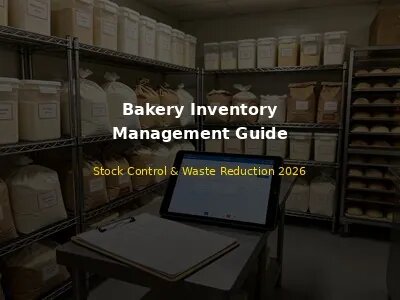
A story from our customer in Ho Chi Minh City, Vietnam: "When we first started our bakery, inventory management was chaos. We'd run out of flour in the middle of a busy day, or find a bag of butter that had expired 2 weeks ago hidden behind the flour sacks. We were throwing away hundreds of dollars worth of ingredients every month, and losing sales when we ran out of important items. Then we put in placeed a simple inventory system: we labeled everything with receive dates, started using FIFO, set reorder points for our top 20 ingredients, and did a weekly inventory count. Within 2 months, our waste dropped by 60%, we never ran out of important ingredients, and we saved enough to buy a new dough divider. The lesson? Inventory management isn't glamorous, but it's one of the highest-ROI things You can do for your bakery."
Inventory management is one of the most overlooked — yet most impactful — aspects of running a profitable bakery. Poor inventory management causes stockouts (lost sales and production stoppages), overstocking (tied-up cash and increased waste), expired ingredients (pure loss), and inconsistent product quality. Good inventory management, on the other hand, ensures you always have the right ingredients in the right quantities, reduces waste to a minimum, and frees up cash for growing your business.What's the one decision that figure outs whether your bakery succeeds or fails? It's not your recipes. It's not your location. It's the equipment you choose — and how well it matches your production needs. Whether you're a small bakery just starting out or a large operation looking to improve, these strategies will help you take control of your inventory and boost your bottom line.
When it comes to bakery inventory, choosing the right equipment is crucial for bakery success. HNH Bakery Equipment provides professional bakery inventory solutions for bakeries worldwide. In this guide, we explore everything you need to know about bakery inventory and how to select the best equipment for your bakery.
1. Bakery Inventory Basics: What You should Track
Before put in placeing any system, You should understand what inventory You've and how to categorize it.
1.1 Types of Bakery Inventory
| Category | Examples | Shelf Life | Storage |
|---|---|---|---|
| Dry ingredients | Flour, sugar, salt, yeast, baking powder, spices, grains | 2-12 months | Cool, dry, sealed containers |
| Perishable ingredients | Butter, eggs, milk, cream, cheese, fresh fruit, meat | 1-7 days (refrigerated) | Refrigerator 1-4°C |
| Frozen ingredients | Frozen fruit, frozen dough, butter, meat, puff pastry | 1-6 months | Freezer -18°C or below |
| Packaging supplies | Bags, boxes, labels, tissue paper, ribbons, containers | Indefinite | Dry storage, organized by type |
| Cleaning supplies | Detergent, sanitizer, gloves, sponges, trash bags | 6-12 months | Separate from food storage |
| Finished products | Bread, pastries, cakes, cookies (unsold) | 1-3 days | Display case, storage racks |
| Work-in-progress | Dough in fermentation, shaped dough, products in proofing | Hours | Production area |
1.2 The ABC Inventory Classification
Not all inventory items are equal. Use the ABC classification to focus on your management efforts:
- A items (High value, 70-80% of inventory cost): Usually 10-20% of your items. These are your most expensive and important ingredients (butter, specialty flours, chocolate, nuts). Manage these tightly: frequent counts, tight reorder points, minimal waste.
- B items (Medium value, 15-20% of inventory cost): Usually 30% of your items. Moderate management: weekly counts, standard reorder points.
- C items (Low value, 5-10% of inventory cost): Usually 50-60% of your items. These are low-cost, high-volume items (salt, sugar, packaging). Less frequent management: monthly counts, larger safety stock.
Focus 80% of your inventory management effort on A items, since they represent most of your inventory cost and waste risk.
2. FIFO: The Golden Rule of Bakery Inventory
FIFO (First In, First Out) is the most a priority principle of bakery inventory management. It means using the oldest ingredients first, before newer ones. This ensures ingredients are used while fresh, reduces waste from expired items, and maintains consistent product quality.
2.1 How to put in place FIFO
- Date everything: Label every ingredient container with the receive date and, if applicable, the expiration date. Use a permanent marker or labels.
- Rotate stock: When receiving new inventory, place new items behind or below older items. Always pull from the front/top (oldest) first.
- Organize storage: Designate specific locations for each ingredient. Use shelves with front-to-back depth so older items are at the front. Use bins that allow access from the front.
- Train staff: Make FIFO a non-negotiable rule. Train every staff member on proper rotation. Post FIFO reminders in storage areas.
- look over regularly: During inventory counts, check that items are properly rotated. Move older items to the front if they've been buried.
2.2 Date Labeling System
Use a consistent date labeling system for all ingredients and prepared items:
| Item Type | Label Information | Example |
|---|---|---|
| Dry ingredients (bulk) | Receive date, expiration date | Received: 09/01/26, Exp: 03/01/27 |
| Transferred ingredients | Transfer date, original expiration | Transferred: 09/05/26, Exp: 03/01/27 |
| Prepared dough/batter | Prep date, use-by date | Prepped: 09/07/26, Use by: 09/09/26 |
| Prepared fillings/toppings | Prep date, use-by date | Prepped: 09/07/26, Use by: 09/08/26 |
| Finished products | Bake date, use-by date | Baked: 09/07/26, Use by: 09/08/26 |
FIFO Tip: Use the "Shelf Life" Label Method
For ingredients with short shelf lives (butter, eggs, cream), use color-coded labels by day of week: Monday=blue, Tuesday=green, Wednesday=yellow, Thursday=red, Friday=purple, Saturday=orange, Sunday=white. When you receive items, put the corresponding color label on them. Staff can quickly spot which items to use first by color. This is faster than reading dates and reduces mistakes.
3. Reorder Points and Par Levels
Running out of important ingredients halts production and loses sales. Overstocking ties up cash and increases waste. Reorder points and par levels help you find the sweet spot.
3.1 How to Calculate Reorder Points
Components explained:
- Average Daily Usage: How much of the ingredient you use per day, averaged over 2-4 weeks. Track usage by recording starting inventory, receipts, and ending inventory.
- Lead Time: Number of days from placing an order to receiving delivery. Varies by supplier and ingredient.
- Safety Stock: Extra inventory to cover unexpected demand spikes, supplier delays, or production issues.
Simplified: Safety Stock = 20-30% of Lead Time Usage
Example: Flour reorder point calculation
- Average daily usage: 10kg/day
- Lead time: 3 days
- Lead time usage: 10kg × 3 = 30kg
- Safety stock (25% of lead time usage): 7.5kg
- Reorder point: 30kg + 7.5kg = 37.5kg
When flour stock reaches 37.5kg, place a new order. This ensures you receive the new shipment before running out, even with unexpected demand or delays.
3.2 Par Levels
Par level (or "periodic automatic replacement") is the standard quantity of an item you want to have on hand at any given time. It's simpler than reorder points and works well for items with stable usage.
Example: Butter par level
- Average daily usage: 2kg/day
- Order frequency: Every 3 days
- Lead time: 1 day
- Usage period: 2kg × (3 + 1) = 8kg
- Safety stock: 2kg (25% of 8kg)
- Par level: 8kg + 2kg = 10kg
When you order butter, order enough to bring stock back to 10kg. If You've 4kg on hand, order 6kg.
3.3 Reorder Point vs. Par Level: When to Use Which
| Method | Best For | Advantages | Disadvantages |
|---|---|---|---|
| Reorder point | High-value, important items with variable usage | Precise, minimizes stockouts, adapts to usage changes | Requires ongoing tracking, more complex to calculate |
| Par level | Stable, low-value items with consistent usage | Simple, easy to put in place, works with scheduled ordering | Less precise, may overstock if usage drops |
Most bakeries use a combination: reorder points for A items (important, high-value) and par levels for B and C items (stable, lower-value).
4. Inventory Counting: How Often and How to Do It
Regular inventory counting is needed for accurate stock levels, waste identification, and financial reporting. But counting everything every day is impractical. Use a cycle counting system instead.
4.1 Cycle Counting Schedule
| Item Category | Count Frequency | Method |
|---|---|---|
| A items (high value) | Weekly | Count all A items once per week, same day each week |
| B items (medium value) | Bi-weekly / Monthly | Count all B items every 2-4 weeks |
| C items (low value) | Monthly / Quarterly | Count all C items every 1-3 months |
| Full inventory | Quarterly / Annually | Count everything for financial reporting and tax purposes |
4.2 How to Conduct an Inventory Count
- Prepare: Print count sheets or use a mobile counting app. Ensure storage areas are organized. Assign counters to specific areas.
- Count: Count each item by weight, volume, or units. Record actual quantities, not what the system says. Be precise — estimate partial bags/boxes.
- Record discrepancies: Note any differences between actual count and system count. Flag expired, damaged, or unusable items.
- look into discrepancies: For meaningful discrepancies (>5%), look into causes: unrecorded usage, receiving errors, theft, spillage, measurement errors.
- Adjust system: Update inventory records to match actual counts. Record adjustments with reasons.
- look at: look over waste, discrepancies, and stock levels. spot trends and areas for improvement.
4.3 Common Causes of Inventory Discrepancies
- Unrecorded usage: Staff using ingredients without recording in the system
- Receiving errors: Incorrect quantities logged when receiving deliveries
- Spills and waste: Unrecorded spills, dropped items, mistakes
- Theft: Staff or customers taking items without payment
- Measurement errors: Inaccurate scales or estimation errors
- Unit confusion: Mixing up units (kg vs. lbs, pieces vs. kg)
- Storage issues: Items stored in wrong locations, missed during counting
5. Waste Reduction: The Highest-ROI Inventory Practice
Waste is pure profit loss. The average bakery wastes 5-15% of its ingredients and finished products. Reducing waste by even 5% can increase net profit by 10-20%. Here's how to systematically reduce waste in your bakery.
5.1 Track and Categorize All Waste
You can't reduce what you don't measure. put in place a waste tracking system:
- Weigh all waste: Use a dedicated scale for waste. Weigh and record everything that gets thrown away.
- Categorize waste:
- Preparation waste: Trimmings, peels, spillage during prep
- Baking waste: Burnt items, misshapen products, baking mistakes
- Unsold products: Day-old bread, pastries, cakes not sold
- Expired ingredients: Ingredients past their use-by date
- Spoilage: Ingredients that went bad before use
- Customer returns: Products returned by customers
- Record daily: Have staff record waste at the end of each shift. Use a simple log or waste tracking app.
- look at weekly: look over waste data weekly. Calculate waste as a percentage of ingredient cost. spot the biggest waste sources.
- Set targets: Set waste reduction goals (e.g., "reduce unsold product waste by 20% this month"). Track progress.
5.2 Demand Forecasting: Bake the Right Amount
The biggest source of bakery waste is overproduction — baking more than You can sell. Accurate demand forecasting helps you bake the right quantities.
How to forecast demand:
- Track historical sales: Record daily sales by product for at least 4 weeks. Note day of week and any special events.
- spot patterns:
- Day of week patterns: Weekends may be 50% busier than weekdays
- Weather patterns: Rainy days may reduce foot traffic; cold days may increase soup/bread sales
- Seasonal patterns: Holiday seasons, summer vs. winter
- Special events: Local festivals, paydays, school holidays
- Calculate average sales: For each product, calculate average sales for each day type (weekday, weekend, holiday).
- Adjust for known factors: Adjust forecasts for upcoming events, weather predictions, promotions, or changes in your business.
- Start conservative: When in doubt, bake slightly less than your forecast. You can always bake more, but You can't un-bake wasted products.
5.3 Batch Baking: Fresh Products, Less Waste
Instead of baking all products once in the morning, bake in smaller batches throughout the day. This ensures:
- Products are fresh throughout the day (customers prefer fresh bread)
- You can adjust quantities from actual sales (if it's a slow day, bake less)
- Less end-of-day waste (you're not stuck with 50 unsold croissants at closing)
- Better product quality (products don't sit around for 8 hours)
Batch baking schedule example:
- 5:00 AM: First batch (60% of expected daily sales)
- 9:00 AM: Second batch (20% of expected daily sales, from morning sales)
- 1:00 PM: Third batch (15% of expected daily sales, from midday sales)
- 4:00 PM: Final batch (5% of expected daily sales, only for fast-selling items)
5.4 Turn Waste into Revenue
Even with perfect forecasting, you'll have some unsold products. Turn them into revenue instead of throwing them away:
- Day-old discounts: Sell day-old bread and pastries at 30-50% off. Many customers specifically look for day-old bargains.
- Repurpose:
- Day-old bread → croutons, breadcrumbs, bread pudding, stuffing, French toast
- Day-old croissants → bread pudding, croissant French toast
- Day-old cake → cake pops, trifle, milkshakes
- Overbaked cookies → cookie crumbs for toppings, cookie butter
- Donate: Donate unsold, still-safe products to food banks, shelters, or community organizations. This provides a tax deduction and builds goodwill. Check local laws about food donation liability protection.
- Feed animals: If products are safe for animal consumption, donate to local farms or pet rescue organizations.
- Compost: For products that can't be used or donated, compost them instead of sending to landfill. This is environmentally responsible and can provide compost for gardens.
6. Supplier Management: The Other Half of Inventory
Good inventory management isn't just about what's in your bakery — it's also about managing your suppliers and the flow of goods into your bakery.
6.1 Supplier Evaluation Criteria
When choosing and evaluating suppliers, consider:
| Criterion | What to Look For | Why It Matters |
|---|---|---|
| Product quality | Consistent, high-quality ingredients that meet your specifications | Your product quality depends on ingredient quality |
| Reliability | On-time deliveries, accurate orders, consistent supply | Late or incorrect deliveries cause stockouts and production delays |
| Price | Competitive pricing, volume discounts, stable pricing | Ingredient costs are 30-50% of your total cost |
| Lead time | Short, consistent lead times | Shorter lead times mean less safety stock and lower inventory costs |
| Minimum order | Reasonable minimum order quantities | High minimums force you to overstock, increasing waste |
| Payment terms | Net 15/30 terms, flexible payment options | Better cash flow management |
| Customer service | Responsive, helpful, easy to reach | Quick resolution of issues (wrong items, damaged goods) |
| Delivery flexibility | Ability to adjust orders, emergency deliveries | Handle unexpected demand spikes or supply issues |
6.2 Best Practices for Supplier Management
- Build relationships: Get to know your suppliers. A good relationship can lead to better prices, priority service, and flexibility when you need it.
- Have backup suppliers: For important ingredients (flour, butter, yeast), maintain at least 2 suppliers. If one has a shortage or delay, You've a backup.
- Consolidate orders: Order from fewer suppliers to reduce delivery fees and simplify receiving. But don't consolidate so much that you lose use or backup options.
- Negotiate volume discounts: If you order large quantities, ask for volume discounts. Even a 5% discount on flour adds up noticeably over a year.
- look over suppliers annually: judge each supplier's performance (quality, reliability, price, service) at least once a year. Don't be afraid to switch suppliers if someone else offers better value.
- Communicate forecast: Share your demand forecast with important suppliers, especially for large or unusual orders. This helps them plan and ensures they can meet your needs.
- check deliveries: Always check deliveries for quality, quantity, and temperature (for refrigerated/frozen items). Reject damaged or incorrect items immediately.
7. Inventory Software and Tools
While manual inventory management (spreadsheets, count sheets) works for tiny bakeries, inventory software saves time, reduces errors, and provides valuable analytics as you grow.
7.1 Inventory Software Options
| Software | Best For | Important Features | Price Range |
|---|---|---|---|
| Toast POS | Bakeries with retail counter | POS + inventory, recipe costing, auto-deduction, sales analytics | $69-$165/mo |
| Square for Restaurants | Small to medium bakeries | POS + basic inventory, recipe management, low stock alerts | Free-$69/mo |
| MarketMan | Inventory-focused management | Inventory counting, recipe costing, waste tracking, supplier ordering | $150-$300/mo |
| Upserve by Lightspeed | Full-service bakeries/cafes | POS + inventory, recipe costing, waste tracking, supplier mgmt | $99-$249/mo |
| ChefTec | Large bakeries/food service | complete inventory, recipes, production planning, nutrition | Custom $100-$500/mo |
| Excel/Google Sheets | Tiny bakeries, tight budget | Flexible, free, customizable | Free |
7.2 Important Features to Look For
- POS integration: Inventory automatically deducted when items are sold. This is the #1 feature to look for.
- Recipe management: Build recipes with ingredient quantities, calculate food cost per recipe, and track recipe profitability.
- Waste tracking: Record and categorize waste, look at waste patterns, set waste reduction targets.
- Supplier management: Track supplier prices, generate purchase orders, manage delivery schedules.
- Low stock alerts: Automatic notifications when items reach reorder point.
- Mobile access: Count inventory on a tablet or phone, no need to print count sheets.
- Reporting and analytics: Inventory value, waste reports, cost of goods sold, usage trends, supplier performance.
- Batch/lot tracking: Track ingredient batches for quality control and recall management.
Software Tip: Start Simple, Upgrade When Needed
Don't over-invest in complex inventory software when you're just starting out. A well-organized spreadsheet with proper formulas can handle inventory for a small bakery. As you grow (more products, more staff, higher volume), upgrade to POS-integrated inventory software. The important is to have a system — any system — and use it consistently. A simple system used well beats a complex system used poorly.
8. Storage Organization: The Foundation of Good Inventory
You can't manage inventory You can't find. Proper storage organization makes inventory counting faster, reduces waste from lost or expired items, and improves food safety.
8.1 Storage Organization Principles
- Designated locations: Every item has a specific, labeled location. No "just put it anywhere."
- Zone storage: Separate storage into zones: dry storage, refrigeration, freezer, packaging, cleaning supplies. Keep cleaning chemicals separate from food.
- Label everything: Label shelves, bins, and containers with item names. Label all transferred ingredients with contents, date received, and use-by date.
- FIFO-friendly layout: Use shelves that allow front access. Place new items behind older items. Use "first in, first out" labels or color coding.
- Easy access: Often used items at eye level and easy reach. Heavy items on lower shelves. Light, rarely used items on high shelves.
- Proper containers: Use food-grade, airtight containers for dry ingredients. Clear containers allow you to see stock levels at a glance. Stackable containers maximize space.
- Temperature control: Monitor refrigerator and freezer temperatures daily. Refrigerator: 1-4°C (34-40°F). Freezer: -18°C (0°F) or below.
- Pest prevention: Keep storage areas clean and dry. Seal all containers. Regularly check for signs of pests. Keep food off the floor (at least 15cm/6 inches).
8.2 Storage Temperature Guide
| Storage Area | Temperature | Humidity | Items Stored |
|---|---|---|---|
| Dry storage | 10-21°C (50-70°F) | 50-60% | Flour, sugar, salt, canned goods, packaging |
| Refrigerator | 1-4°C (34-40°F) | High | Butter, eggs, milk, cream, cheese, fresh fruit, prepared dough |
| Freezer | -18°C (0°F) or below | Low | Frozen fruit, frozen dough, butter, meat, puff pastry |
| Cool/dark storage | 10-15°C (50-59°F) | Low | Chocolate, nuts, spices (light-sensitive items) |
9. Inventory Metrics: Track What Matters
To know if your inventory management is working, track these important metrics regularly.
9.1 Important Inventory Metrics
| Metric | Formula | Target | Why It Matters |
|---|---|---|---|
| Inventory turnover ratio | Cost of Goods Sold ÷ Average Inventory Value | 12-24 times/year (monthly turnover 1-2) | Measures how quickly you use inventory. Higher = more efficient. Too high = frequent stockouts. |
| Inventory value as % of revenue | (Average Inventory Value ÷ Monthly Revenue) × 100 | 5-15% | Too high = overstocked, tied-up cash. Too low = frequent stockouts. |
| Waste as % of ingredient cost | (Total Waste Cost ÷ Total Ingredient Cost) × 100 | Under 5% | Measures waste reduction effectiveness. Directly impacts profit margins. |
| Stockout rate | (Number of stockout incidents ÷ Total items) × 100 | Under 2% | Measures how often you run out of important items. Stockouts = lost sales and production delays. |
| Order accuracy rate | (Correct deliveries ÷ Total deliveries) × 100 | Over 95% | Measures supplier reliability. Incorrect deliveries cause inventory discrepancies. |
| Average days to sell (finished products) | Average time from bake to sale | Under 1 day for most products | Measures product freshness and demand forecasting accuracy. |
9.2 How to Use These Metrics
- Calculate monthly: Compute these metrics at the end of each month using your POS and inventory data.
- Track trends: Compare metrics month over month. Are they improving or declining?
- Set targets: Set realistic improvement targets (e.g., "reduce waste from 8% to 5% in 3 months").
- look into outliers: If a metric suddenly worsens, look into why (new supplier? staff change? seasonal shift?).
- Share with team: Share metrics with your staff. Make inventory management a team effort with visible goals.
10. Common Inventory Mistakes and How to Avoid Them
- No system at all: "I just eyeball it" or "I know what we have." This causes stockouts, overstocking, and waste. Fix: put in place even a simple spreadsheet system.
- Only counting when You've time: Irregular counting means inventory records are always out of date. Fix: Schedule regular cycle counts and stick to the schedule.
- Ignoring small discrepancies: "It's just a kg of flour, no big deal." Small discrepancies add up and may indicate bigger problems (theft, waste, receiving errors). Fix: look into all discrepancies over 5%.
- No FIFO: New items get placed in front, old items get buried and expire. Fix: put in place strict FIFO with date labeling and staff training.
- Overordering to get bulk discounts: Buying 6 months of flour to save 10% — but half of it goes stale or gets infested. Fix: Calculate the actual cost of storage and waste vs. the discount. Only bulk-buy non-perishable items with adequate storage.
- No backup suppliers: Relying on one supplier for important ingredients. If they have a shortage or delay, You can't bake. Fix: Maintain at least 2 suppliers for all important ingredients.
- Poor storage organization: Can't find items, items expire, inventory counts take forever. Fix: Invest time in organizing storage with labeled locations and proper containers.
- Not tracking waste: Throwing things away without recording. You don't know how much you're wasting or why. Fix: put in place a waste tracking system and look over weekly.
- Ignoring seasonal changes: Using the same reorder points year-round. You run out during holiday season and overstock during slow season. Fix: Adjust reorder points and par levels seasonally.
- Not training staff: Only the owner knows the inventory system. When the owner is away, chaos ensues. Fix: Train all staff on inventory procedures, FIFO, and waste tracking. Make it part of onboarding.
Speak with Our Engineering Team
Ready to upgrade your bakery? Get in touch with our team for a free consultation. We will judge your needs and recommend the best equipment for your operation and budget.
Get Equipment Advice →11. Conclusion: Inventory Management Is a Profit Center
Inventory management is often seen as a tedious, back-office task. But when done well, it's one of the highest-ROI activities in your bakery. Every dollar of waste reduced is a dollar of pure profit. Every stockout prevented is a sale saved. Every dollar of overstock removed is a dollar freed up for growing your business.
Here's a quick summary of the important takeaways:
- Know your inventory: Categorize items by type and value (ABC classification). Focus on high-value A items.
- put in place FIFO: Date everything, rotate stock, use oldest first. This is the #1 rule for reducing waste and ensuring freshness.
- Set reorder points and par levels: Calculate from usage, lead time, and safety stock. This prevents stockouts while avoiding overstocking.
- Count regularly: Use cycle counting — weekly for A items, monthly for B and C items. look into discrepancies.
- Track and reduce waste: Weigh and categorize all waste. Use demand forecasting and batch baking to reduce overproduction. Turn waste into revenue (day-old sales, repurposing, donations).
- Manage suppliers: Build relationships, have backups, negotiate discounts, check deliveries, look over performance annually.
- Use the right tools: Start with spreadsheets, upgrade to POS-integrated software as you grow. The system matters more than the tool.
- Organize storage: Designated locations, clear labels, FIFO-friendly layout, proper temperature control, pest prevention.
- Track metrics: Inventory turnover, waste percentage, stockout rate, order accuracy. Set targets and monitor progress.
- Train your team: Inventory management is everyone's job. Train all staff on FIFO, waste tracking, and proper storage.
keep in mind that inventory management is not a one-time project — it's an ongoing practice. Start with the basics (FIFO, date labeling, regular counting), then add more advanced techniques (reorder points, demand forecasting, waste tracking) as you build momentum. Even small improvements in inventory management can have a big impact on your profitability.
Take control of your inventory today, and watch your profits grow.
📋 Bakery Equipment Checklist
Download our complete bakery equipment checklist with budget estimates for 5 different bakery types.
Free Bakery Equipment Checklist →📋 Bakery Equipment ROI Calculator
Use our interactive ROI calculator to see how quickly your bakery equipment investment pays off.
Calculate Your Equipment ROI →📋 Bakery Equipment Maintenance Calendar
Get our printable maintenance calendar to keep your bakery equipment running at peak performance.
Printable Maintenance Calendar →📋 Bakery Equipment Energy Cost Calculator
Estimate your bakery equipment energy costs and find ways to reduce your utility bills.
Calculate Energy Costs →Related Articles
Learn More
- 👉 Bakery Equipment Selection Complete Guide: Choose by Output & Product
- 👉 Bakery Equipment Maintenance Schedule: Daily, Weekly, Monthly, Yearly
- 👉 Dough Divider Rounder Troubleshooting: 15 Common Problems & Solutions
- 👉 Small Bakery Equipment ROI & Payback Period Calculator
- 👉 Bakery Equipment Energy Consumption & Energy Saving Guide
- 👉 Bakery Equipment Food Safety & Hygiene Compliance Complete Guide