
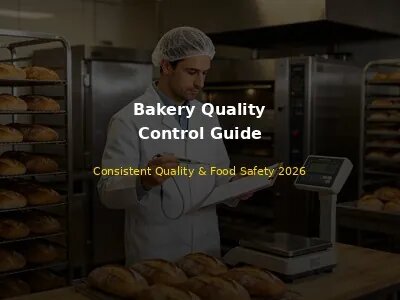
A story from our customer in Jakarta, Indonesia: "We had a problem — our bread was inconsistent. Some days it was perfect, other days it was dense and heavy. Customers started complaining, and we were losing regulars. We couldn't figure out why — we were using the same recipe, the same ingredients, the same oven. Then we started tracking everything: dough temperature, mixing time, proofing time, oven temperature, product weight. We discovered the problem: our oven temperature was off by 25°C! On days when the oven was 'calibrated' by the morning baker, the bread was fine. On other days, it wasn't. We bought a separate oven thermometer, started checking the oven temperature every morning, and calibrated it monthly. Within 2 weeks, our bread was consistently perfect. The lesson? Quality control isn't about checking finished products — it's about controlling the process so that every product is perfect, every time."
Quality is the foundation of a successful bakery. Customers return because your bread is consistently delicious, your pastries are consistently fresh, and your cakes are consistently beautiful. One bad batch can lose a customer forever — but consistent quality builds loyalty, generates positive word-of-mouth, and commands premium prices.
Yet many bakeries treat quality control as an afterthought — they check finished products occasionally, but don't systematically control the production process.There's a common misconception in the bakery industry that more expensive = better. After installing equipment in 27 countries, we can tell you that's simply not true. The right equipment is the one that matches your specific production needs.
1. The Foundations of Bakery Quality Control
Quality control in a bakery is not just about checking finished products — it's about preventing problems before they occur. A good quality control system covers every stage of production, from ingredient receiving to finished product distribution.
1.1 What Is Quality Control?
Quality control (QC) is the systematic process of ensuring that products meet consistent standards of quality, safety, and consistency. It involves:
- Quality assurance (QA): Preventive measures to ensure quality — standardized recipes, proper procedures, staff training, equipment maintenance
- Quality control (QC): checkion and testing to check quality — ingredient checkion, in-process monitoring, finished product testing
- Continuous improvement: Regular look over of quality data, identification of trends, put in placeation of improvements
1.2 The Goals of Bakery Quality Control
| Goal | Why It Matters |
|---|---|
| Food safety | Prevent contamination, ensure proper temperatures, remove hazards. A food safety incident can destroy your business. |
| Product consistency | Every product should taste, look, and weigh the same, batch after batch. Consistency builds customer trust. |
| Customer satisfaction | Meet or exceed customer expectations for taste, texture, appearance, and freshness. Happy customers return and refer others. |
| Regulatory compliance | Meet local, national, and international food safety standards and regulations. Non-compliance can result in fines or closure. |
| Waste reduction | Catch problems early before they result in wasted ingredients or rejected products. Less waste = higher profit. |
| Reputation building | Consistent quality builds a strong reputation, allows premium pricing, and creates competitive advantage. |
1.3 Build a Quality Management System
A quality management system (QMS) is the structure that ensures consistent quality. It includes:
- Quality policy: A written statement of your commitment to quality. Post it in the bakery and share it with all staff.
- Quality standards: Define what "quality" means for each product — appearance, weight, size, color, texture, taste, shelf life. Create a product specification sheet for every item.
- Standard operating procedures (SOPs): Written, step-by-step instructions for every task — recipes, equipment operation, cleaning, sanitation, receiving, storage.
- Monitoring procedures: Define what to monitor, how often, and by whom — temperatures, times, weights, visual checks.
- Corrective action procedures: Define what to do when something doesn't meet standards — who to notify, how to fix it, how to prevent recurrence.
- Documentation: Records of all quality activities — monitoring logs, calibration records, training records, corrective actions, customer complaints.
- Training: Train all staff on quality standards, SOPs, and their role in maintaining quality.
- Management look over: Regularly look over quality data, spot trends, and put in place improvements.
2. Ingredient Quality Control
Quality starts with ingredients. You can't make great products with poor-quality ingredients. Controlling ingredient quality is the first and most important step in bakery quality control.
2.1 Ingredient Specifications
Create written specifications for every ingredient you purchase. Include:
- Product name and description
- Brand/supplier (preferred and backup)
- Grade/quality standard (e.g., bread flour with 12-14% protein)
- Packaging size and type
- Storage requirements (temperature, humidity, shelf life)
- Acceptance criteria (what you check when receiving)
- Allergen information
- Certifications required (organic, kosher, halal, non-GMO, etc.)
2.2 Receiving checkion
check every delivery before accepting it. Check:
| Check | What to Look For | Action if Fails |
|---|---|---|
| Temperature | Refrigerated items ≤4°C (40°F), frozen items ≤-18°C (0°F) | Reject if temperature is too high |
| Packaging | Intact, no damage, no tears, no leaks, proper sealing | Reject damaged packages |
| Expiration date | Within acceptable shelf life (at least 75% of shelf life remaining) | Reject if too close to expiration |
| Quantity | Matches order — count items, check weights | Note discrepancy, adjust payment |
| Quality | Visual checkion — color, texture, smell, no signs of spoilage | Reject if quality is poor |
| Pest signs | No signs of insects, rodents, or pest damage | Reject and notify supplier |
| Allergen labeling | Proper allergen labeling, correct ingredient list | Reject if labeling is incorrect |
Record all receiving checkions on a receiving log. Note the date, supplier, item, quantity, temperature, condition, and checkor name. This creates a traceability record if problems arise later.
2.3 Storage Control
Proper storage maintains ingredient quality and prevents spoilage:
- Dry storage: Cool (10-21°C / 50-70°F), dry (50-60% humidity), well-ventilated, away from direct sunlight. Keep ingredients 15cm (6 inches) off the floor and 5cm (2 inches) away from walls.
- Refrigeration: Maintain ≤4°C (40°F). Check temperature twice daily. Store raw items below ready-to-eat items. Keep items covered and labeled.
- Freezer: Maintain ≤-18°C (0°F). Check temperature twice daily. Use FIFO. Keep items well-wrapped to prevent freezer burn.
- FIFO (First In, First Out): Always use the oldest ingredients first. Label all items with receive date and expiration date.
- Allergen segregation: Store allergen-containing ingredients separately from allergen-free items. Use color-coded containers and utensils for allergen-free products.
- Pest prevention: Keep storage areas clean and dry. Seal all containers. Regularly check for signs of pests.
3. Process Control: Ensuring Consistency
The important to consistent products is controlling every variable in the production process. If you control the process, the products will be consistent — every time.
3.1 Standardized Recipes
Every recipe should be written, precise, and measurable:
- Weigh everything: Use weight (grams/kilograms), not volume (cups/spoons). Volume measurements are inaccurate — 1 cup of flour can vary by 20%.
- Precise quantities: Even small ingredients like salt, yeast, and additives should be weighed, not "pinched" or "a little."
- Mixing instructions: Exact mixing times, speeds, and techniques. Note desired dough temperature and consistency.
- Fermentation/proofing: Exact times, temperatures, and humidity levels. Note desired dough volume increase.
- Baking: Exact oven temperature, baking time, steam amount, and tray position. Note desired internal temperature and color.
- Cooling: Exact cooling time and method (rack, room temperature, refrigerator).
- Yield: Expected number of units and weight per unit.
- Quality standards: What the finished product should look, taste, and feel like.
3.2 Important Process Parameters to Monitor
| Process Step | Parameters to Monitor | Frequency |
|---|---|---|
| Weighing | Ingredient weights, scale accuracy | Every batch |
| Mixing | Mixing time, mixing speed, dough temperature, dough consistency | Every batch |
| Bulk fermentation | Time, temperature, dough volume increase | Every batch |
| Dividing/rounding | Piece weight, weight variation, roundness | Every batch (check 5-10 pieces) |
| Shaping | Shape consistency, size, sealing | Visual check every batch |
| Proofing | Time, temperature, humidity, volume increase | Every batch |
| Baking | Oven temperature, baking time, steam, internal temperature, color | Every batch |
| Cooling | Cooling time, final temperature | Every batch |
| Packaging | Package integrity, labeling, date coding | Every batch |
3.3 Dough Temperature Control
Dough temperature is one of the most important — and most often overlooked — factors in bread quality. Dough temperature affects fermentation rate, dough consistency, and final product quality.
Target dough temperatures:
- White bread: 24-26°C (75-79°F)
- Whole wheat bread: 26-28°C (79-82°F)
- Sourdough: 24-26°C (75-79°F)
- Sweet dough/rich dough: 24-26°C (75-79°F)
- Laminated dough (croissants): 20-22°C (68-72°F)
How to control dough temperature:
- Measure flour temperature, water temperature, and room temperature
- Adjust water temperature to achieve target dough temperature
- Use the formula: Desired Dough Temperature × 3 = Flour Temp + Water Temp + Room Temp (for straight dough method)
- Use ice water in hot weather, warm water in cold weather
- Monitor dough temperature after mixing — if it's off, adjust next batch
3.4 Environmental Control
The bakery environment affects dough behavior and product quality:
- Kitchen temperature: Ideal 20-24°C (68-75°F). Hot kitchens cause dough to ferment too fast; cold kitchens slow fermentation.
- Humidity: Ideal 50-65%. High humidity can make dough sticky; low humidity can dry out dough surfaces.
- Airflow: Avoid direct drafts on dough — they can cause skin formation and uneven proofing.
- Seasonal adjustments: Adjust fermentation times, water temperatures, and proofing times from seasonal changes in temperature and humidity.
4. Equipment Calibration and Maintenance
Your equipment is the foundation of consistent quality. Uncalibrated or poorly maintained equipment produces inconsistent products — no matter how good your recipes and staff are.
4.1 Calibration Schedule
| Equipment | Calibration Frequency | Method | Acceptable Tolerance |
|---|---|---|---|
| Oven thermometer | Monthly | Compare with separate oven thermometer at 180°C | ±5°C (±9°F) |
| Digital scales | Every 3-6 months | Use certified calibration weights (1kg, 5kg, 10kg) | ±1g (small), ±5g (large) |
| Probe thermometers | Monthly | Ice point (0°C) or boiling point (100°C) | ±1°C (±2°F) |
| Proofing cabinet | Every 1-3 months | Compare with separate thermo-hygrometer | ±2°C, ±5% RH |
| Refrigerator/freezer | Daily check, 3-6 month calibration | Compare with separate thermometer | ±1°C (±2°F) |
| Timers | Every 6-12 months | Compare with smartphone timer | ±5 seconds/hour |
| Dough divider | Weekly check | Weigh 10-20 divided pieces | ±5% variation |
| pH meter (if used) | Before each use | Calibrate with pH 4.0 and 7.0 buffers | ±0.1 pH |
Calibration Tip: The Oven Is the #1 Culprit
Oven temperature drift is the most common cause of inconsistent baking in bakeries. Oven thermostats can drift by 10-30°C over time — and You can not notice until products start burning or coming out underbaked. Invest in a good-quality separate oven thermometer ($20-$50) and check your oven temperature every morning before baking. If the oven is off by more than 5°C, recalibrate it (follow manufacturer instructions) or have it serviced. Keep a log of oven temperature checks — this helps spot gradual drift over time. A $30 thermometer can save you thousands in wasted ingredients and lost customers.
4.2 Preventive Maintenance
Regular maintenance prevents equipment breakdowns and ensures consistent performance:
- Daily: Clean equipment, check for damage, check lubrication levels, remove flour dust from motors and vents
- Weekly: Deep clean ovens and mixers, check belt tension, check electrical connections, clean ventilation filters
- Monthly: Lubricate moving parts, check motors and bearings, check gas connections for leaks, test safety devices, calibrate thermometers
- Quarterly: Professional checkion, replace worn belts and seals, calibrate oven, check electrical panel, service ventilation system
- Annually: Full equipment service, replace major wear parts, deep clean exhaust system, safety checkion
Keep a maintenance log for each piece of equipment — record date, tasks performed, parts replaced, and any issues found. This helps track equipment health and plan for replacements.
5. Finished Product Quality Control
Even with the best process control, You should check finished products to check quality and catch any problems before products reach customers.
5.1 Finished Product checkion Checklist
check every batch of products before they go on display or out for delivery:
| Check | What to Look For | Standard |
|---|---|---|
| Appearance | Color, shape, size, symmetry, surface texture | Matches product specification, consistent within batch |
| Weight | Weigh 5-10 random units from each batch | Within ±5% of target weight |
| Size | Measure dimensions (height, width, length) | Within specification, consistent |
| Color | Crust color, crumb color, evenness of browning | Matches standard sample, no raw or burnt spots |
| Texture | Crust crispness, crumb softness, moisture level | Matches product specification |
| Taste | Flavor, sweetness, saltiness, freshness, no off-flavors | Matches standard, no rancid or stale tastes |
| Aroma | Fresh baked smell, no off-odors | Fresh, appetizing aroma |
| Internal structure | Crumb structure, hole distribution, no large holes or dense spots | Even crumb structure appropriate for product type |
| Packaging | Package integrity, labeling, date coding, allergen labeling | Intact package, correct label, readable date |
5.2 Create Standard Samples
Create a "gold standard" sample for each product — a photo or physical sample that represents perfect quality. Display these in the production area so staff know exactly what each product should look like. Update standard samples regularly (monthly or quarterly) to ensure they represent current quality standards.
5.3 Taste Testing Program
Regular taste testing ensures flavor consistency:
- Daily: Head baker or manager tastes at least one sample of each product line
- Weekly: Team taste testing — all staff taste products and provide feedback. This builds quality awareness and catches problems early.
- Monthly: Formal taste panel — compare products against standard samples, score on flavor, texture, appearance, and overall quality.
- Blind testing: Occasionally conduct blind taste tests (remove labels) to remove bias and get honest feedback.
Record all taste test results — date, product, taster, scores, comments, and any corrective actions. This creates a quality history and helps spot trends over time.
6. Food Safety and HACCP
Food safety is the most important part of bakery quality control. A food safety incident can make customers seriously ill, result in legal action, and destroy your bakery's reputation. HACCP (Hazard Analysis and Important Control Points) is the internationally seed system for ensuring food safety.
6.1 The 7 Principles of HACCP
- Conduct a hazard analysis: spot all potential food safety hazards (biological, chemical, physical) at every step of your process.
- figure out important control points (CCPs): spot the points where hazards can be prevented, removed, or reduced to safe levels. In a bakery, common CCPs include: ingredient receiving, cold storage, cooking/baking, cooling, allergen control, sanitation.
- Establish important limits: Set measurable standards for each CCP (e.g., refrigerator ≤4°C, bread internal temp ≥93°C, cooling from 60°C to 21°C within 2 hours).
- Establish monitoring procedures: Define how, when, and by whom each CCP will be monitored.
- Establish corrective actions: Define what to do when a important limit is not met.
- Establish verification procedures: Confirm the HACCP system is working — look over records, calibrate equipment, conduct look overs, test products.
- Establish documentation: Maintain records of all HACCP activities — hazard analysis, CCP monitoring, corrective actions, verification, calibration, training.
6.2 Important Food Safety Practices for Bakeries
- Personal hygiene: Handwashing (before starting work, after breaks, after using restroom, after touching face/hair), clean uniforms, hair restraints, no jewelry, no working when ill (vomiting, diarrhea, fever, sore throat with fever, jaundice).
- Cross-contamination prevention: Separate raw and ready-to-eat foods, color-coded cutting boards and utensils, proper storage order (raw below ready-to-eat), thorough cleaning between tasks.
- Temperature control: Keep cold foods cold (≤4°C), keep hot foods hot (≥60°C), cool foods properly (60°C→21°C within 2 hours, then →4°C within 4 more hours), avoid the temperature danger zone (4°C-60°C).
- Allergen management: Know the top allergens (milk, eggs, fish, crustacean shellfish, tree nuts, peanuts, wheat, soybeans), prevent cross-contact, proper labeling, dedicated equipment for allergen-free products, staff training.
- Cleaning and sanitation: Daily cleaning schedules, proper cleaning procedures (wash → rinse → sanitize → air dry), food-grade sanitizers, correct sanitizer concentration, cleaning of food contact surfaces every 4 hours or between tasks.
- Pest control: Regular pest checkions, sealed doors and windows, proper food storage, clean premises, professional pest control service.
- Water quality: Safe drinking water for all food contact, regular water testing if using private well.
- Waste management: Proper garbage handling, covered bins, regular removal, recycling, no waste accumulation.
7. Documentation and Record-Keeping
Documentation is the backbone of a quality control system. If it isn't written down, it didn't happen. Records provide traceability, show compliance, and help spot problems and trends.
7.1 necessary Quality Records
| Record | What to Record | Frequency | Retention |
|---|---|---|---|
| Receiving log | Date, supplier, item, quantity, temperature, condition, checkor | Every delivery | 1-2 years |
| Temperature log | Refrigerator, freezer, and proofing cabinet temperatures | Twice daily | 1-2 years |
| Batch record | Recipe, ingredient lot numbers, mixing time, dough temp, proofing time, baking time, oven temp, product weight, baker name | Every batch | 1-2 years |
| Calibration log | Date, equipment, method, results, corrective action, technician | Per calibration schedule | 2-3 years |
| Cleaning log | Date, area/equipment, cleaning task, sanitizer concentration, cleaner name | Daily/weekly | 1 year |
| Maintenance log | Date, equipment, tasks performed, parts replaced, issues found, technician | Per maintenance schedule | Life of equipment |
| Training records | Date, employee, training topic, trainer, judgement results | Per training session | Duration of employment + 1 year |
| Corrective action log | Date, problem description, root cause, corrective action, preventive action, responsible person, verification | As needed | 2-3 years |
| Customer complaint log | Date, customer, product, complaint description, investigation, resolution, follow-up | As needed | 2-3 years |
| Product recall log | Date, product, lot number, reason, recall scope, customer notifications, effectiveness check | As needed | 3-5 years |
7.2 Traceability
Traceability is the ability to track a product from raw ingredients to finished product to customer. In the event of a food safety issue, traceability allows you to quickly spot affected products and recall them if necessary.
Important traceability elements:
- Record ingredient lot numbers and supplier information for every batch
- Assign batch/lot numbers to every production batch
- Record which batches went to which customers/orders
- Maintain records for at least 1-2 years (check local regulations)
- Conduct mock recalls periodically to test your traceability system
8. Common Quality Problems and Troubleshooting
Even with the best quality control system, problems will occur. The important is to spot them quickly, find the root cause, fix it, and prevent recurrence.
8.1 Common Bread Quality Problems
| Problem | Possible Causes | Solutions |
|---|---|---|
| Bread too dense/heavy | Insufficient kneading, too little yeast, too much flour, low proofing temp, under-proofing, oven too cool, old flour | Check kneading time, check yeast freshness, check recipe ratios, increase proofing time/temp, calibrate oven, use fresh flour |
| Bread too crumbly/dry | Too much flour, too little water, over-baking, stale ingredients, improper storage | Check hydration level, check recipe, reduce baking time, use fresh ingredients, store properly |
| Uneven browning | Oven hot spots, uneven tray loading, improper rack position, inconsistent dough size | Calibrate oven, rotate trays, check rack position, ensure consistent dividing |
| Bread doesn't rise | Dead/old yeast, water too hot, too much salt, under-kneaded, proofing temp too low | Test yeast, check water temp, check salt quantity, check kneading, increase proofing temp |
| Large holes in crumb | Improper shaping (trapped air), over-proofing, uneven dough handling | Check shaping technique, reduce proofing time, ensure consistent handling |
| Crust too thick/hard | Over-baking, oven too hot, too much steam, improper storage | Reduce baking time/temp, adjust steam, store properly |
8.2 Troubleshooting Method
When a quality problem occurs, use a systematic troubleshooting way:
- Define the problem: What exactly is wrong? When did it start? Which products are affected? How severe is it?
- Check ingredients first: Are they fresh? Correct? Properly stored? Did you change suppliers? Check lot numbers and expiration dates.
- Check the process: Did anything change? Times? Temperatures? Techniques? Check batch records for deviations.
- Check equipment: Is it calibrated? Working properly? When was it last serviced? Check calibration records.
- Check environment: Did temperature or humidity change? Is there a draft? Did weather change?
- Check staff: Did a new person make the product? Was training adequate? Did someone deviate from the SOP?
- put in place a fix: From your investigation, put in place a corrective action. Make one change at a time so you know what fixed it.
- check the fix: Make another batch and check the problem is resolved. If not, continue investigating.
- Prevent recurrence: Update SOPs, add monitoring, provide additional training, or make other changes to prevent the problem from happening again.
- Document everything: Record the problem, investigation, root cause, corrective action, and verification. This creates a knowledge base for future problems.
9. Staff Training and Quality Culture
Quality control is not just about systems and procedures — it's about people. Your staff are the ones who make the products, monitor the process, and catch problems. Building a quality culture is necessary for long-term success.
9.1 Quality Training Program
- New employee orientation: Quality policy, quality standards, food safety, personal hygiene, SOPs, their role in quality
- On-the-job training: Hands-on training for each task, supervised practice, competency verification
- Food safety training: HACCP, allergens, cross-contamination, temperature control, cleaning, illness reporting. Required by law in many countries.
- Equipment training: Safe operation, cleaning, basic maintenance, calibration awareness
- Refresher training: Annual refreshers on all topics, plus additional training when procedures change or problems occur
- Cross-training: Train employees on multiple positions so they understand the full process and can cover absences
9.2 Building a Quality Culture
A quality culture means every employee takes ownership of quality, not just the manager or quality control person. Build a quality culture by:
- Leading by example: Management must show commitment to quality — follow SOPs, use proper techniques, don't cut corners
- Communicating quality standards: Make quality standards visible — post product specs, display standard samples, share quality data
- Involving employees: Ask for their input on quality improvements, involve them in problem-solving, give them ownership of their work
- Recognizing quality: Praise employees who produce quality work, see teams with low waste, celebrate quality improvements
- Empowering employees: Give employees the authority to stop production if they see a quality problem, encourage them to report issues without fear of blame
- Providing the right tools: Give employees calibrated equipment, proper tools, clean workspaces, and the resources they need to do quality work
- Continuous improvement: Regularly look over quality data together, spot improvement opportunities, put in place changes, measure results
- No-blame culture: When problems occur, focus on finding the root cause and fixing the system, not blaming individuals. Employees should feel safe reporting problems.
Speak with Our Engineering Team
Whether You're just starting out or looking to upgrade your existing line, we have the equipment and the expertise to help you succeed. Contact us for a free quote today.
Get Equipment Advice →10. Conclusion: Quality Is a Journey, Not a Destination
Quality control is not something you do once and forget about — it's an ongoing process of monitoring, measuring, improving, and refining. The bakeries with the best quality are the ones that are constantly looking for ways to improve, even when things are going well.
Here's a quick summary of the important takeaways:
- Build a quality management system: Quality policy, standards, SOPs, monitoring, corrective actions, documentation, training, management look over.
- Control ingredient quality: Written specifications, receiving checkion, proper storage, FIFO, allergen segregation.
- Control the process: Standardized recipes (weigh everything), monitor important parameters (times, temperatures, weights), control dough temperature, control the environment.
- Calibrate and maintain equipment: Regular calibration (ovens monthly, scales every 3-6 months, thermometers monthly), preventive maintenance (daily, weekly, monthly, quarterly, annually).
- check finished products: Appearance, weight, size, color, texture, taste, aroma, internal structure, packaging. Create standard samples. Conduct regular taste testing.
- put in place HACCP for food safety: 7 principles — hazard analysis, CCPs, important limits, monitoring, corrective actions, verification, documentation.
- Document everything: Receiving logs, temperature logs, batch records, calibration logs, cleaning logs, maintenance logs, training records, corrective actions, customer complaints. If it isn't written down, it didn't happen.
- Maintain traceability: Track ingredients from supplier to finished product to customer. Conduct mock recalls.
- Troubleshoot systematically: Define problem → check ingredients → check process → check equipment → check environment → check staff → put in place fix → check → prevent recurrence → document.
- Train staff and build quality culture: complete training program, lead by example, communicate standards, involve employees, see quality, empower employees, provide tools, continuous improvement, no-blame culture.
keep in mind that quality is the most powerful marketing tool You've. Consistent, high-quality products create loyal customers, generate positive word-of-mouth, allow premium pricing, and build a strong reputation. Invest in quality control, and it will pay for itself many times over in increased sales, reduced waste, and customer loyalty.
Start small — pick one area (oven calibration, standardized recipes, temperature logs) and put in place it well. Then add another, and another. Over time, you'll build a complete quality control system that ensures every product you produce is consistently Great.
Quality is not expensive — it's priceless.
📋 Bakery Equipment Checklist
Download our complete bakery equipment checklist with budget estimates for 5 different bakery types.
Free Bakery Equipment Checklist →📋 Bakery Equipment ROI Calculator
Use our interactive ROI calculator to see how quickly your bakery equipment investment pays off.
Calculate Your Equipment ROI →📋 Bakery Equipment Maintenance Calendar
Get our printable maintenance calendar to keep your bakery equipment running at peak performance.
Printable Maintenance Calendar →📋 Bakery Equipment Energy Cost Calculator
Estimate your bakery equipment energy costs and find ways to reduce your utility bills.
Calculate Energy Costs →Related Articles
Learn More
- 👉 Bakery Equipment Selection Complete Guide: Choose by Output & Product
- 👉 Bakery Equipment Maintenance Schedule: Daily, Weekly, Monthly, Yearly
- 👉 Dough Divider Rounder Troubleshooting: 15 Common Problems & Solutions
- 👉 Small Bakery Equipment ROI & Payback Period Calculator
- 👉 Bakery Equipment Energy Consumption & Energy Saving Guide
- 👉 Bakery Equipment Food Safety & Hygiene Compliance Complete Guide