
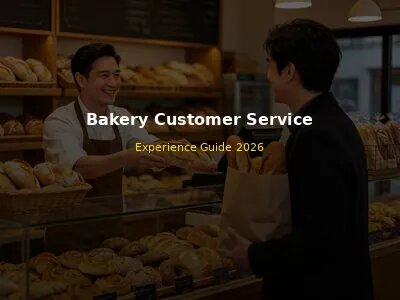
Bakery Customer Service & Experience Complete Guide: Build Loyalty and Word-of-Mouth
Here is what bakery owners ask us about more than anything else: Bakery A has friendly staff who greet every customer by name, remember their usual orders, and always have a warm smile. The bakery is clean, welcoming, and smells like fresh bread. Customers leave feeling good and come back again and again—they bring their friends, they post about it on social media, they're loyal for life. Bakery B has indifferent staff who rarely look up from their phones, never greet customers, and seem annoyed when asked questions. The bakery is messy, the display case is half-empty, and the atmosphere is cold. Customers buy once and never come back—they tell their friends to avoid it, they leave negative look overs online. Bakery A thrives. Bakery B struggles. The difference isn't the products—it's the customer service and experience.
Quick Answer
Bakery customer service experience complete guide: Great bakery customer service drives 30-50% higher revenue through repeat business and word-of-mouth. The complete guide covers 8 areas: (1) Customer Service Philosophy—adopt the mindset that every customer interaction is an opportunity to build a relationship, not just a transaction. Your bakery is not just selling bread—it's selling warmth, comfort, and a moment of joy. Train every staff member to understand this. Core principles: greet every customer within 3 seconds, make eye contact, smile, use their name when known, offer samples proactively, thank them by name when leaving. (2) Staff Training—invest in complete training: product knowledge (every staff member should know ingredients, baking process, storage tips, allergens, pairing suggestions—e.g., 'Our sourdough uses a 12-year-old starter, fermented 36 hours, pairs perfectly with salted butter and smoked salmon'), customer service skills (greeting, active listening, empathy, problem resolution, upselling without being pushy), food safety and hygiene (handwashing, cross-contamination, allergen handling, temperature control), POS system operation, and emergency procedures. Conduct role-playing exercises for difficult situations (complaints, out-of-stock items, rush hour). Provide a training manual and refresh quarterly. (3) In-Store Experience—design your bakery for customer delight: entrance (welcoming aroma—bake bread during opening hours so the smell draws customers in, clear door signage, easy access), display (bakery cases at eye level, clear labels with product name, price, important ingredients, allergens; rotate products to look full; use natural lighting; keep cases clean and spotless), ordering flow (clear queue system, separate pickup and ordering lines during rush, self-service options for quick items), seating (if space allows—comfortable seating, free Wi-Fi, power outlets, water station, this turns a quick stop into a longer visit and higher spend), ambiance (warm lighting, background music at conversational level, clean restrooms, seasonal decorations), and checkout (fast, friendly, offer to slice bread, suggest pairing, mention loyalty program, thank by name). (4) Complaint Resolution—handle complaints with the L.A.S.T. method: Listen (let customer fully explain without interrupting, show empathy 'I understand why you're frustrated'), Apologize (sincerely, even if not your fault—'I'm sorry this happened, that's not the experience we want you to have'), Solve (offer solution: refund, replacement, discount, future free item—empower staff to resolve up to $20 without manager approval), Thank (thank customer for bringing it to your attention, follow up if appropriate). Statistics: 95% of unhappy customers will return if their complaint is resolved quickly and satisfactorily; a dissatisfied customer tells 9-15 people about their bad experience; acquiring a new customer costs 5-25x more than retaining an existing one. Never argue with a customer, never make excuses, never blame someone else. (5) Customer Loyalty Program—put in place a structured loyalty program: points system (1 point per $1 spent, 100 points = $5 off, or buy 10 get 1 free—simpler is better), tiered rewards (Bronze: 0-500 points = 5% off; Silver: 500-1500 = 10% off + free birthday treat; Gold: 1500+ = 15% off + free monthly bread + exclusive plook overs), birthday rewards (free bread or pastry on birthday—collect birthdays at signup), bread subscription (weekly/biweekly delivery, 10% discount, convenience, guaranteed revenue), referral program (give $10, get $10—existing customer refers friend, both get $10 credit). Use a simple POS-integrated system (Square Loyalty, Toast, Clover) or even a paper punch card if budget is tight. (6) Online and Phone Service—extend great service to digital channels: phone (answer within 3 rings, spot business and yourself, take orders accurately, confirm order details, thank customer), online ordering (easy-to-use website/app, clear menu with prices and allergens, accurate pickup/delivery times, order confirmation email/SMS, follow-up after delivery), social media (respond to comments and DMs within 24 hours, thank positive look overers, deal with negative look overs publicly and privately, use social media to build community not just sell), email (respond within 24 hours, personalize, include helpful content not just promotions, unsubscribe option clear). (7) Customer Feedback System—actively collect and act on feedback: in-store (comment cards, suggestion box, simply ask 'How was everything today?'), online (Google look overs, Yelp, Facebook, TripAdvisor—monitor and respond to all, send follow-up email after purchase with link to look over), surveys (quarterly email survey with 3-5 questions, offer incentive for completion—free bread), mystery shopper (hire someone quarterly to judge service, or ask a friend to do it), staff feedback (hold weekly 10-minute huddles to discuss customer feedback and improvements). Act on feedback visibly—tell customers 'We heard you and made this change.' (8) Metrics and Continuous Improvement—track customer service KPIs: customer satisfaction score (CSAT—target 90%+), Net Promoter Score (NPS—target 50+), repeat customer rate (target 60%+), average order value (track trends), customer lifetime value (CLV—aim to increase), complaint resolution time (target <24 hours), look over ratings (Google 4.5+ target), social media engagement rate. look over monthly, spot areas for improvement, put in place changes, measure results. Budget allocation: $200-500/month staff training (including samples for training), $50-200/month loyalty program costs (free items, discounts), $100-300/month customer appreciation (samples, events), $50-150/month feedback tools/surveys. Total: $400-1,150/month. Expected ROI: 3:1 to 10:1—great customer service is the cheapest and most effective marketing.
Table of Contents
Customer service is the most underrated competitive advantage in the bakery business. In a world where customers can buy bread and pastries at grocery stores, big box stores, cafes, and Many other bakeries, great customer service is what sets you apart. It's what turns a one-time customer into a regular, a regular into an advocate, and an advocate into a loyal customer for life. Research shows 70% of customers will pay more for a product from a business with great service, and increasing customer retention by just 5% increases profits by 25-95%.
In my 15 years selling bakery equipment, I've visited hundreds of bakeries and observed Many customer interactions. I've seen what great customer service looks like—and what poor customer service looks like. I've seen bakeries with average products but Great service thrive, and bakeries with Great products but poor service struggle. The pattern is clear: customer service is the difference between a bakery that survives and one that thrives.
This guide is everything I've learned about bakery customer service and experience from 15 years in the industry. I'll cover first impressions and greetings, product knowledge and recommendations, upselling techniques, complaint handling, personalization, speed and efficiency, cleanliness and atmosphere, staff training, customer feedback systems, and building loyalty. By the end, you'll have a complete customer service system for your bakery that will help you build loyal customers and powerful word-of-mouth.
"We used to think customer service was just being polite. Then we started training our staff to greet every customer within 3 seconds, remember regulars' names and orders, and proactively offer recommendations. Our average transaction value increased by 22%, our repeat customer rate went from 40% to 65%, and our Google look overs went from 3.8 stars to 4.7 stars. The products didn't change, the prices didn't change—only the customer service changed. It was the single most impactful thing we've done for our business." — Lisa, owner of a neighborhood bakery in Boston, Massachusetts
Table of Contents
- First Impressions: The First 10 Seconds
- The Art of Greeting Customers
- Product Knowledge: The Foundation of Great Service
- Upselling: Helping Customers Discover More
- Handling Complaints: Turning Negatives into Positives
- Personalization: Making Customers Feel Special
- Speed and Efficiency: Respecting Customers' Time
- Creating a Welcoming Bakery Atmosphere
- Staff Training: Building a Customer Service Culture
- Customer Feedback: Listening and Improving
- Building Customer Loyalty and Advocacy
- 10 Common Customer Service Mistakes to Avoid
- Often Asked Questions
1. First Impressions: The First 10 Seconds
Customers form their first impression of your bakery within the first 10 seconds of walking in. That impression figure outs whether they feel welcome, whether they'll stay, and whether they'll come back. Here's what customers notice in those first 10 seconds:
What Customers Notice First
- Cleanliness: Is the floor clean? Are the display cases spotless? Is the counter tidy? Is there garbage or clutter visible? Customers associate cleanliness with food quality—a messy bakery makes customers wonder about food safety.
- Greeting: Did someone make eye contact and smile? Did someone say "welcome" or "good morning"? A warm greeting makes customers feel admitd and welcome. No greeting makes customers feel invisible and unwelcome.
- Smell: Does the bakery smell like fresh bread and pastries? The smell of fresh baking is the most powerful marketing tool a bakery has. If the bakery smells like cleaning supplies, garbage, or something burnt, customers will be turned off immediately.
- Display: Are the display cases full and attractive? Are products arranged appealingly? Empty or messy display cases signal low quality or lack of care. Full, attractive displays signal freshness and abundance.
- Staff demeanor: Do staff look happy and engaged, or stressed and annoyed? Are they working together efficiently, or arguing and ignoring customers? Staff energy is contagious—positive staff create a positive atmosphere; negative staff create a negative one.
- Lighting and atmosphere: Is the lighting warm and inviting, or harsh and fluorescent? Is the music pleasant and at a comfortable volume? Is the temperature comfortable? The physical atmosphere sets the mood for the entire customer experience.
Important Insight: The first 10 seconds set the tone for the entire customer experience. If customers feel welcome, clean, and comfortable in those first 10 seconds, they'll be more forgiving of minor issues later. If they feel unwelcome, uncomfortable, or concerned about cleanliness in those first 10 seconds, you'll have to work twice as hard to win them over—and many won't give you the chance. Make those first 10 seconds count by ensuring your bakery is always clean, staff always greet customers promptly, the smell of fresh baking is present, and displays are full and attractive. These are simple, low-cost things that have a Large impact on first impressions.
[Continued: Greeting, Product Knowledge, Upselling, Complaints, Personalization, Speed, Atmosphere, Training, Feedback, Loyalty, Mistakes, FAQ, Conclusion]
📋 Bakery Equipment ROI Calculator
Use our interactive ROI calculator to see how quickly your bakery equipment investment pays off.
Calculate Your Equipment ROI →📋 Bakery Equipment Maintenance Calendar
Get our printable maintenance calendar to keep your bakery equipment running at peak performance.
Printable Maintenance Calendar →📋 Bakery Equipment Energy Cost Calculator
Estimate your bakery equipment energy costs and find ways to reduce your utility bills.
Calculate Energy Costs →🏭 Bakery Equipment Capacity Calculator
Not sure what size equipment you need? Use our free interactive calculator to find the perfect dough divider, mixer, oven, and proofer capacity for your production volume.
Calculate Your Equipment Needs →⚖️ Bakery Equipment Comparison Tool
Compare dough dividers, spiral mixers, ovens, proofers and dough sheeters side by side. View specs, prices, capacity and features to find the best equipment for your bakery.
Compare Equipment Now →Often Asked Questions
Q: How worth noting is customer service for a bakery?
Customer service is critically worth noting—70% of customers will pay more for great service, 78% back out of purchases Because of poor service. For bakeries specifically: (1) Products are often impulse purchases—a friendly greeting/recommendation turns browsers into buyers. (2) Relies on repeat business—regulars coming 2-3x/week are the backbone. (3) Word-of-mouth is most effective marketing—happy customers tell 4-6 people, unhappy tell 9-15. (4) Products are emotional—bought for celebrations, comfort, gifts; experience is part of product. (5) Competition is fierce—many places to buy bread (grocery, cafes, big box); great service differentiates. Financial impact: repeat customers spend 67% more, acquiring new costs 5-25x more than retaining, 5% retention increase = 25-95% profit increase, great service customers spend 140% more over time. Bottom line: Great service isn't nice-to-have—it's core. A bakery with average products but great service often outperforms great products with poor service.
Q: How do I handle customer complaints in a bakery?
95% of unhappy customers return if complaint resolved quickly/satisfactorily; well-resolved complainers often become more loyal. Step-by-step: (1) Listen fully without interruption—let them explain, maintain eye contact, don't defend. (2) Apologize sincerely—'I'm so sorry this happened.' Avoid conditional apologies. (3) Empathize—'That must have been frustrating.' (4) make clear the issue—ask questions to understand fully. (5) Offer a solution—replacement, refund, store credit, discount, or combination. For most complaints (stale, wrong order, quality): replacement/full refund. For serious (allergic reaction, foreign object): full refund + management follow-up + documentation. (6) Ask if solution is acceptable—'Would a replacement and free coffee make this right?' (7) Thank the customer—'Thank you for bringing this to our attention.' (8) Follow up—for serious complaints, call/email days later. (9) Document and learn—record complaint/resolution, share with staff to prevent recurrence. Mistakes to avoid: arguing/defensive, blaming employees/suppliers, excuses instead of solutions, making customer prove complaint, minimizing ('not that big of a deal'), taking too long. Golden rule: Customer may not always be right, but they're always the customer—how you treat them figure outs if they come back.
Q: How do I train bakery staff on customer service?
complete way: (1) Customer service manual—document standards: greeting, product knowledge, upselling, complaint handling, dress code, speed/accuracy expectations. (2) Onboarding training (4-8 hours)—bakery story/values, service philosophy, greeting/engagement, product knowledge (ingredients, allergens, flavors, recommendations), POS operation, order taking, payment, complaint handling, health/safety. Use role-playing. (3) Product knowledge training—ingredients (especially allergens), flavor profiles, vegan/gluten-free/nut-free items, daily/seasonal specials, pairing recommendations, shelf life/storage, pricing. Train to answer common questions. (4) Shadowing/mentoring—pair new hires with experienced staff 1-2 weeks, observe then gradually take over with supervision, regular feedback. (5) Role-playing exercises—practice greeting, helping undecided customer, upselling, complaints, difficult customer, long line, special requests. (6) Daily huddles (5-10 min)—look over specials, product changes, service tip, see great service, set shift goals. (7) Ongoing coaching/feedback—specific positive and constructive feedback daily, informal observations. (8) Mystery shopping—friends/family judge: greeting, product knowledge, friendliness, speed, accuracy, cleanliness, overall. (9) Customer feedback—share positive/negative with staff regularly, celebrate when customers mention staff by name. (10) Incentives/recognition—employee of month, bonuses for positive look overs, public recognition, small rewards. (11) Regular training sessions (monthly/quarterly, 30-60 min)—look over standards, practice scenarios, discuss feedback, introduce products, refresh skills. (12) Lead by example—owner/manager behavior sets standard: greet warmly, handle complaints gracefully, show expected behaviors. Important: consistency and reinforcement. One session isn't enough—practice, coach, reinforce daily. Create culture where great service is valued, seed, expected.
Q: What are the best upselling techniques for a bakery?
Effective, customer-friendly upselling techniques: (1) Add-on suggestion—'Would you like a coffee with that croissant?' 'Can I add a cookie?' 10-30% say yes to relevant add-on. (2) Pairing recommendation—'Our almond croissant goes great with our latte.' 'This sourdough is perfect with brie.' Feels helpful, not pushy. (3) 'For here or to go' upsell—'Would you like to enjoy that here with a coffee?' Encourages dine-in (higher tickets) + beverage sales. (4) Size upgrade—'Large coffee for 50 cents more?' '6-pack muffins for price of 5?' High margins, increases ticket. (5) Combo/meal deal—'Coffee + pastry = $5 (save $1.50)' 'Breakfast combo: croissant + coffee + juice = $7.' Increases ATV, customers feel they're getting deal. (6) Sample suggestion—'Would you like to try a sample of our new pumpkin bread?' Samples increase sales by letting customers experience product. (7) 'Just one more'—'You've got a great selection—would you like to add a baguette to complete it?' 'One more cookie and you've got a half-dozen.' (8) Gift suggestion—'These cookies make a great gift—would you like an extra box for a friend?' 'Our bread freezes well—would you like an extra loaf?' (9) Seasonal/specialty—'Our pumpkin spice muffins are only available this month—would you like to try one before they're gone?' Urgency/exclusivity drives sales. (10) Personal recommendation—'Since you like our chocolate croissant, I think you'd love our pain au chocolat.' 'You mentioned a dinner party—our focaccia is always a hit.' Feels genuine, builds trust. Important principles: relevant (complement order/preferences), optional (never pressure), genuine (suggest products you believe they'll enjoy), simple (1-2 suggestions per transaction), read customer (if in hurry/uninterested, don't push), train staff (what/when/how to suggest), track results (measure ATV and conversion). Done well, upselling increases ATV 15-30%, directly boosting revenue/profit. Frame as helping customers discover products they'll love, not pushing to spend more.
Q: How do I create a welcoming bakery atmosphere?
Welcoming atmosphere includes everything customers see, hear, smell, feel: (1) Outside first impression—clean inviting storefront, clean windows, visible attractive signage, clear entrance, curb appeal (plants, outdoor seating), visibility into bakery from street. (2) Entrance/greeting—easy-to-open door, welcome mat, staff greet within 3 seconds with warm smile, admit even if busy (eye contact + 'I'll be right with you!'). (3) Visual—spotless cleanliness (floors, cases, counters, restrooms), warm inviting lighting (2700-3000K, avoid harsh fluorescent, accent lighting on displays), warm appetizing colors (creams, wood tones, soft yellows/oranges), full attractive well-organized displays (varying heights, group similar products), subtle on-brand decor (avoid clutter, fresh flowers/plants/artwork), clear attractive signage (chalkboards add charm). (4) Smell—fresh baking aromas (schedule baking so products come out during peak hours), avoid unpleasant smells (keep cleaning supplies/garbage/restrooms ventilated away from customer area, empty garbage regularly), coffee aroma if serving coffee. (5) Sound—background music matching brand/time of day, volume 60-70 dB (conversation comfortable), avoid explicit lyrics, minimize kitchen noise (mixers/ovens/dishwashers behind closed doors), friendly sounds (greetings, chatter, buzz of busy bakery). (6) Physical comfort—comfortable temperature (68-72°F/20-22°C, not too hot from ovens or too cold), comfortable clean seating with adequate space (mix table sizes), clean well-stocked pleasant restrooms (nice soap, hand lotion, flowers), accessibility (wide aisles, accessible counter, accessible restroom, no steps without ramps). (7) Staff presentation—clean uniforms/aprons, friendly smiling approachable demeanor, teamwork working efficiently positively. (8) Personal touches—remember regulars (name, usual order), small gestures (sample, free cookie for child, warm smile), community involvement (local artwork, support local events, sense of community). Important: attention to detail—every part (sight/sound/smell/touch) contributes. Walk through as customer, notice everything, ask for feedback, continuously improve. Welcoming atmosphere makes customers stay longer, spend more, come back—makes bakery a place people want to be, not just buy bread.
Q: How do I collect and use customer feedback for my bakery?
Collecting/using feedback is fundamental for improving, retaining, growing: (1) Methods: in-person conversations ('How is everything?' 'Anything we can improve?'), comment cards (near counter/tables, questions + drop box/email), online look overs (Google/Yelp/Facebook, respond to all promptly professionally), social media (monitor comments/messages/mentions, engage), email surveys (5-10 questions to email list, incentive for completing, keep short), focus groups (6-10 regulars for focused discussion, free food + discount thanks), mystery shopping (friends/family/professional judge with detailed form), POS data (look at sales: popular/slow products, peak hours, ATV, buying patterns—behavioral feedback showing what customers actually do). (2) What to ask: product quality (freshness/taste/quality rating), customer service (friendliness/helpfulness rating), speed (service speed rating), cleanliness (rating), value (value for money rating), variety (adequate selection? what products wanted?), atmosphere (describe atmosphere), likelihood to recommend (Net Promoter Score), improvements (one thing to improve?). (3) How to use: look over regularly (weekly, look for patterns not individual complaints), categorize (products/service/speed/cleanliness/atmosphere/pricing/variety), focus on (most frequent/biggest impact, don't fix everything at once), take action (specific actionable steps), communicate changes ('We heard you wanted more gluten-free options, so we added three!'), follow up (for specific feedback especially complaints, let them know deal withed), share with staff (positive celebrate, negative as training), track progress (measure satisfaction over time: NPS, look over ratings, repeat rate, ATV). (4) Mistakes to avoid: ignoring feedback (collecting but not acting is worse than not collecting), only listening to positive (negative = most valuable improvement opportunities), taking personally (about business not you), overreacting to single complaints (look for patterns before major changes), not closing the loop (always follow up to show listened/acted). Important principle: Customer feedback is a gift. Every customer who gives feedback (positive/negative) gives opportunity to improve and build stronger relationship. Thank them, listen carefully, take action, follow up. Bakeries that actively collect/use feedback continuously improve, build stronger relationships, outperform competitors who don't.
The needed Points
Customer service is the heart of a successful bakery. Great products get customers in the door, but great customer service is what keeps them coming back, what makes them tell their friends, and what builds the loyal customer base that sustains a bakery for years. The good news is that great customer service isn't complicated—it's about simple, consistent, genuine human interactions. Greet every customer warmly. Know your products and make helpful recommendations. Handle complaints with grace and empathy. Make customers feel seen and valued. Keep your bakery clean and welcoming. Train your staff and lead by example. Listen to feedback and continuously improve.
The financial impact of great customer service is Large: repeat customers spend 67% more, acquiring a new customer costs 5-25x more than retaining one, and increasing retention by just 5% increases profits by 25-95%. Investing in customer service training, creating a welcoming atmosphere, and building a customer service culture isn't a cost—it's an investment that pays for itself many times over in increased revenue, higher profits, and long-term success.
We believe bakery equipment should last 10+ years, and we build every machine with that standard in mind. When your spiral mixer runs reliably, your rotary oven bakes consistently, and your dough processing equipment operates smoothly, your staff can focus on serving customers instead of fighting with equipment. Our equipment is designed for reliability, consistency, and ease of use—so your team can spend less time worrying about equipment and more time creating great customer experiences. Contact us for a free consultation on equipment selection for your bakery.
Ready to Elevate Your Bakery's Customer Experience?
Start by greeting every customer within 3 seconds, training your staff on product knowledge, and creating a welcoming atmosphere. Small, consistent changes in customer service can transform your bakery's success.
Get a Free Equipment ConsultationRelated Articles


Learn More
- 👉 Bakery Equipment Selection Complete Guide: Choose by Output & Product
- 👉 Bakery Equipment Maintenance Schedule: Daily, Weekly, Monthly, Yearly
- 👉 Dough Divider Rounder Troubleshooting: 15 Common Problems & Solutions
- 👉 Small Bakery Equipment ROI & Payback Period Calculator
- 👉 Bakery Equipment Energy Consumption & Energy Saving Guide
- 👉 Bakery Equipment Food Safety & Hygiene Compliance Complete Guide