
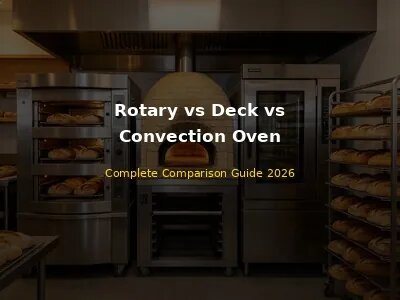
A story from our customer in Riyadh, Saudi Arabia: "I bought a cheap deck oven for my bakery because I thought all ovens were the same. Within 3 months, I was losing 2 hours every day loading and unloading small batches, and my bread quality was inconsistent. I finally invested in a 32-tray rotary rack oven and my production doubled while labor decreased by 40%. The $8,000 extra I spent paid for itself in 4 months. Choosing the right oven type is the most important equipment decision you'll make."
Choosing the right oven is the single most matters equipment decision for any professional bakery. The oven figure outs your product quality, production capacity, labor requirements, and operating costs. Yet many bakery owners buy an oven without understanding the fundamental differences between rotary, deck, and convection ovens.
After helping bakery owners in 20+ countries select and configure their ovens, we've seen every mistake — from buying an oven that's too small, to choosing the wrong type for their products, to underestimating operating costs. This rotary oven deck guide gives you a complete, unbiased comparison of all three oven types, including real pricing, capacity, energy use, product quality, and operating costs. By the end, you'll know exactly which oven (or combination) is right for your bakery.
1. Understanding the Three Oven Types
Before we dive into the comparison, let's understand how each oven type works and what makes it unique.
1.1 Rotary Oven: The High-Volume Workhorse
A rotary oven gets its name from the rotating rack that holds trays of product inside the baking chamber. Hot air is circulated by powerful fans, and the rack rotates slowly to ensure every tray receives uniform heat. This design allows large quantities to be baked in a single cycle with consistent results.
How it works: The oven chamber is heated by gas burners or electric elements. Fans circulate hot air throughout the chamber. The rack (holding 16-128 standard 60x40cm trays) rotates on a turntable, ensuring all products are exposed to the same heat conditions.
Best for: High-volume bread and roll production, commercial bakeries producing 500+ loaves/day, wholesale bakeries supplying multiple retail locations.
1.2 Deck Oven: The Artisan's Choice
A deck oven (also called a hearth oven) has one or more stationary baking decks, each with its own heat source from above (ceiling) and below (floor/stone). The baking surface is typically stone (refractory brick or cordierite) or steel plate. Deck ovens mimic the traditional brick hearth oven, producing Great crust quality.
How it works: Each deck has independent top and bottom heat controls. Heat radiates from the ceiling elements and conducts through the stone/steel deck. Steam injection is often available to create the perfect crust on artisan bread. Products are loaded directly onto the hot deck surface.
Best for: Artisan bread, sourdough, pizza, baguettes, and products requiring hearth baking with superior crust development. Also ideal for small batch specialty production.
1.3 Convection Oven: The Versatile All-Rounder
A convection oven uses fans to circulate hot air rapidly throughout the baking chamber. Unlike a rotary oven, there's no rotating rack — products are placed on stationary shelves. The forced air circulation creates fast, even baking with shorter cooking times. Convection ovens are typically smaller and more compact than rotary or deck ovens.
How it works: Electric or gas heating elements warm the air. Powerful fans circulate the hot air throughout the chamber, eliminating hot spots and reducing cooking time by 20-30% compared to conventional ovens. Most models have adjustable fan speed and humidity control.
Best for: Pastries, cookies, muffins, delicate products, small to medium bakeries with limited space, cafes and coffee shops with baking operations, and as a secondary oven for specialty items.
2. Head-to-Head Comparison
Now let's compare all three oven types across the most worth noting factors for bakery owners.
2.1 Price Comparison
| Reason | Rotary Oven | Deck Oven | Convection Oven |
|---|---|---|---|
| Entry-level price | $3,000 (16-tray electric) | $2,000 (1-deck electric) | $1,500 (half-size electric) |
| Mid-range price | $6,000-$12,000 (32-tray gas) | $4,000-$8,000 (2-3 deck gas) | $3,000-$5,000 (full-size gas) |
| High-end price | $15,000-$25,000 (64-128 tray) | $10,000-$15,000 (4-deck stone) | $6,000-$8,000 (industrial) |
| Gas vs. Electric premium | Gas costs 20-40% more | Gas costs 20-30% more | Gas costs 15-25% more |
| Installation cost | $500-$2,000 (ventilation, gas) | $300-$1,500 | $200-$800 |
2.2 Capacity and Production Volume
| Reason | Rotary Oven | Deck Oven | Convection Oven |
|---|---|---|---|
| Trays per batch | 16-128 trays | 4-20 trays (per deck) | 4-12 trays |
| Loaves per batch | 80-640 loaves | 20-100 loaves | 20-60 loaves |
| Batches per hour | 2-3 batches | 3-4 batches | 3-5 batches |
| Daily capacity (8 hrs) | 1,280-15,360 loaves | 480-3,200 loaves | 480-2,400 loaves |
| Best volume range | High (500+ loaves/day) | Medium (100-500 loaves/day) | Low-Medium (50-300 loaves/day) |
2.3 Product Quality Comparison
| Product Type | Rotary Oven | Deck Oven | Convection Oven |
|---|---|---|---|
| White sandwich bread | Great | Good | Good |
| Dinner rolls / buns | Great | Solid | Solid |
| Artisan sourdough | Good | Great | Fair |
| Baguettes / French bread | Solid | Great | Fair |
| Croissants / pastries | Solid | Good | Great |
| Cookies / biscuits | Good | Good | Great |
| Pizza | Fair | Great | Good |
| Cakes / muffins | Good | Good | Great |
2.4 Energy and Operating Costs
| Reason | Rotary Oven | Deck Oven | Convection Oven |
|---|---|---|---|
| Electric power (typical) | 12-48 kW | 8-24 kW | 5-15 kW |
| Gas consumption (typical) | 0.5-2.0 m³/hr | 0.3-1.5 m³/hr | 0.2-0.8 m³/hr |
| Preheat time | 30-45 minutes | 45-60 minutes (stone) | 15-20 minutes |
| Energy per loaf (est.) | $0.02-$0.05 | $0.03-$0.07 | $0.03-$0.06 |
| Monthly energy cost (est.) | $300-$1,200 | $250-$900 | $150-$500 |
| Maintenance cost/year | $200-$600 | $150-$400 | $100-$300 |
2.5 Labor and Ease of Use
| Reason | Rotary Oven | Deck Oven | Convection Oven |
|---|---|---|---|
| Loading method | Roll-in rack (easy) | Manual peel loading (skilled) | Shelf loading (easy) |
| Operator skill required | Low-Medium | High (artisan skill) | Low |
| Loading time per batch | 5-10 minutes | 15-30 minutes | 5-10 minutes |
| Consistency (batch to batch) | Great | Good (skill-dependent) | Solid |
| Training time for operators | 1-2 days | 1-2 weeks | Half day |
3. Pros and Cons of Each Oven Type
3.1 Rotary Oven Pros and Cons
Advantages
- High production capacity (16-128 trays)
- Great batch-to-batch consistency
- Low labor requirement (roll-in rack)
- Uniform baking with rotating rack
- Efficient for high-volume bread production
- Available in gas or electric
- Fast baking cycles (25-35 min/batch)
Disadvantages
- High upfront cost ($3,000-$25,000)
- Large footprint (needs space for rack)
- Not ideal for artisan/hearth bread
- Requires 3-phase power (electric models)
- Long preheat time (30-45 min)
- Fan can dry out delicate products
- Less flexible for mixed product types
3.2 Deck Oven Pros and Cons
Advantages
- Superior crust quality for artisan bread
- Independent top/bottom heat per deck
- Steam injection for perfect crust
- Great for pizza, baguettes, sourdough
- Stackable design saves floor space
- Traditional baking method
- Can bake different products on different decks
Disadvantages
- Lower capacity per batch
- Requires skilled operator (peel loading)
- Long preheat time (45-60 min for stone)
- Stone decks are heavy and fragile
- Slower loading/unloading
- Less consistent for high-volume production
- Can be energy inefficient (multiple decks)
3.3 Convection Oven Pros and Cons
Advantages
- Fast baking (20-30% faster than conventional)
- Compact size (fits in small spaces)
- Low upfront cost ($1,500-$8,000)
- Easy to operate (minimal training)
- Great for pastries, cookies, cakes
- Short preheat time (15-20 min)
- Even baking with forced air circulation
Disadvantages
- Limited capacity (4-12 trays)
- Fan can dry out bread crusts
- Not ideal for artisan/hearth bread
- Can cause uneven rising in bread
- Not suitable for high-volume production
- Humidity control may be limited
- Fan noise can be large
4. How to Choose the Right Oven for Your Bakery
Now that you understand the differences, here's a step-by-step process to choose the right oven (or combination) for your specific needs.
Step 1: Define Your Product Mix
List every product you plan to bake and estimate the daily volume for each. This is the most important reason in oven selection:
- If 70%+ of your products are bread and rolls: A rotary oven should be your primary oven.
- If you specialize in artisan bread, pizza, or baguettes: A deck oven is necessary for quality.
- If your focus is pastries, cookies, and cakes: A convection oven will give you the best results.
- If You've a mixed product line: Consider a combination — rotary for volume bread + deck or convection for specialty items.
Step 2: Calculate Your Required Capacity
Estimate your peak daily production and work backward to figure out oven capacity:
- Calculate peak daily loaves/pastries needed
- Divide by number of baking hours per day
- Account for 20-30% growth buffer
- Match to oven tray capacity and batches per hour
Example: If you need 800 loaves/day over 8 hours = 100 loaves/hour. A 32-tray rotary oven baking 160 loaves/batch at 2.5 batches/hour = 400 loaves/hour capacity. This gives you Many room for growth.
Step 3: judge Your Space and Utilities
- Floor space: Rotary ovens need room for rack loading (typically 2x3m minimum). Deck ovens are more compact. Convection ovens fit in small spaces.
- Ceiling height: Rotary ovens and multi-deck ovens need 2.5m+ ceiling clearance.
- Power supply: Most commercial ovens need 3-phase power (380V/415V). check your electrical service before purchasing.
- Gas connection: If choosing gas, ensure You've adequate gas supply and proper ventilation/exhaust.
- Ventilation: All ovens require proper exhaust ventilation. Reason in installation costs.
Step 4: Set Your Budget (Including Hidden Costs)
keep in mind that the purchase price is only part of the total cost. Include:
- Equipment purchase price
- Shipping and delivery ($300-$2,000)
- Installation and ventilation ($500-$3,000)
- Gas/electrical upgrades ($500-$5,000 if needed)
- Initial accessories (trays, peels, thermometers) ($200-$1,000)
- First month's energy costs
- Maintenance and spare parts budget
Step 5: Consider Future Growth
Always buy an oven that can handle 30-50% more than your current needs. Replacing an oven in 1-2 years because you outgrew it is a costly mistake. If budget is tight, consider buying a larger rotary oven now and using only part of its capacity initially, rather than buying a small oven and needing to upgrade soon.
5. Recommendations by Bakery Type and Size
5.1 Small Artisan Bakery (50-200 loaves/day)
Recommended: 2-3 deck oven (stone) + small convection oven
- Deck oven for artisan bread, pizza, baguettes
- Convection oven for pastries, cookies, cakes
- Total equipment cost: $5,000-$12,000
- Best for: Quality-focused small bakeries, cafes, specialty shops
5.2 Medium professional bakery (200-800 loaves/day)
Recommended: 32-tray rotary oven (gas) + 1-2 deck oven (for specialty)
- Rotary oven for high-volume bread and rolls
- Deck oven for artisan bread, pizza, specialty items
- Total equipment cost: $10,000-$25,000
- Best for: Retail + wholesale bakeries, hotel kitchens, institutional bakeries
5.3 Large Industrial Bakery (800+ loaves/day)
Recommended: 64-128 tray rotary ovens (2+) + deck ovens (2-3) + convection ovens (2+)
- Multiple rotary ovens for high-volume production
- Deck ovens for specialty/artisan products
- Convection ovens for pastries and cookies
- Total equipment cost: $30,000-$80,000+
- Best for: Wholesale bakeries, supermarket supply, food factories
5.4 Pastry/Croissant Specialist
Recommended: Convection oven (primary) + small deck oven (for bread)
- Convection oven for croissants, Danish, pastries, cookies
- Small deck oven for any bread products
- Total equipment cost: $4,000-$10,000
- Best for: Pastry shops, croissant specialists, dessert bakeries
6. ROI Analysis: When Does Your Oven Pay for Itself?
Understanding the return on investment (ROI) of your oven helps you make smarter purchasing decisions.
6.1 Labor Savings ROI
The biggest ROI from upgrading to a rotary oven comes from labor savings:
- 32-tray rotary oven cost: $8,000
- Saves 2 labor hours/day vs. deck oven loading
- Labor cost: $15/hour
- Daily savings: $30
- Monthly savings: $900
- Payback period: $8,000 ÷ $900 = 8.9 months
6.2 Increased Production ROI
A larger oven that increases your production capacity generates additional revenue:
- Upgrading from 16-tray to 32-tray rotary: +$5,000 cost
- Doubles production capacity
- Additional 100 loaves/day at $1.50 profit/loaf = $150/day
- Monthly additional profit: $4,500
- Payback period: $5,000 ÷ $4,500 = 1.1 months (less than 5 weeks!)
6.3 Waste Reduction ROI
A consistent rotary oven reduces product rejection from inconsistent baking:
- Rotary oven cost: $8,000
- Reduces product rejection from 6% to 2%
- Daily production: 500 loaves at $0.80 ingredient cost each
- Daily waste savings: 500 × 4% × $0.80 = $16
- Monthly waste savings: $480
- Payback period (waste savings only): $8,000 ÷ $480 = 16.7 months
Important Insight: When you combine labor savings, increased production, and waste reduction, most commercial ovens pay for themselves in 3-9 months. The question isn't "Can I afford this oven?" but "Can I afford NOT to have the right oven?"
7. Common Oven Buying Mistakes to Avoid
- Buying based only on price: The cheapest oven often costs more in repairs, downtime, and inconsistent product quality. judge total cost of ownership, not just purchase price.
- Underestimating capacity needs: Buying an oven that's too small means you'll need to run more batches, increasing labor and energy costs. Always buy for 30-50% growth.
- Choosing the wrong oven type for your products: A convection oven won't produce great artisan bread, and a deck oven is inefficient for high-volume roll production. Match the oven to your product mix.
- Ignoring utility requirements: Many buyers don't realize their electrical service can't handle a commercial oven until after delivery. check 3-phase power, gas supply, and ventilation before purchasing.
- Not Given installation costs: Budget an additional 10-20% of the oven price for shipping, installation, ventilation, and utility upgrades.
- Skipping the test run: Always request a video of the oven running with actual product before purchasing. This verifies performance and quality.
- Not asking about after-sales support: Ovens need maintenance and occasional repairs. Ensure the supplier provides spare parts, technical support, and warranty coverage.
Have Questions? We Are Here to Help
Join hundreds of bakery owners worldwide who trust us for their equipment needs. Contact us today to discuss your project and get a personalized quote.
Get Your Free Oven Consultation →8. Conclusion: Make the Right Choice
Choosing between a rotary oven, deck oven, and convection oven doesn't have to be complicated. Here's a quick summary to guide your decision:
- Choose a rotary oven if: You produce 500+ loaves of bread/rolls per day, need high consistency, and want to minimize labor. It's the workhorse of commercial bread production.
- Choose a deck oven if: You specialize in artisan bread, pizza, or baguettes where crust quality is paramount. It's the choice of artisan bakers and pizzerias.
- Choose a convection oven if: You focus on pastries, cookies, and cakes, have limited space, or need a secondary oven for specialty items. It's the most versatile and affordable option.
- Choose a combination if: You've a mixed product line. Most successful medium and large bakeries use a rotary for volume bread plus a deck or convection for specialty products.
keep in mind that the oven is the heart of your bakery. Investing in the right oven (even if it costs more upfront) will pay for itself many times over through labor savings, increased production, consistent quality, and reduced waste. Take the time to judge your needs, compare options, and choose wisely.
We do not just sell equipment — we help bakery owners choose the right machines for their specific volume and menu. We provide honest advice, competitive factory-direct pricing, and reliable after-sales support. Contact us today for a free consultation tailored to your specific needs.
📋 bakery machinery ROI Calculator
Use our interactive ROI calculator to see how quickly your bakery machinery investment pays off.
Calculate Your Equipment ROI →📋 bakery machinery Maintenance Calendar
Get our printable maintenance calendar to keep your bakery machinery running at peak performance.
Printable Maintenance Calendar →📋 baking equipment Energy Cost Calculator
Estimate your baking equipment energy costs and find ways to reduce your utility bills.
Calculate Energy Costs →Related Articles
Learn More
- 👉 bakery machinery Selection Complete Guide: Choose by Output & Product
- 👉 bakery machinery Maintenance Schedule: Daily, Weekly, Monthly, Yearly
- 👉 dough portioning machine Rounder Troubleshooting: 15 Common Problems & Solutions
- 👉 Small bakery machinery ROI & Payback Period Calculator
- 👉 bakery machinery Energy Consumption & Energy Saving Guide
- 👉 baking equipment Food Safety & Hygiene Compliance Complete Guide