
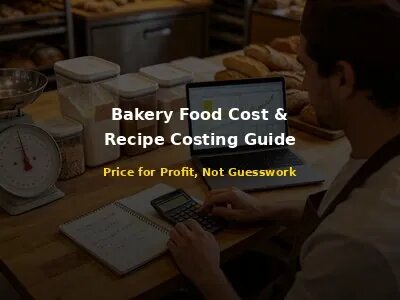
A story from our customer in Chicago, Illinois: "When we opened our neighborhood bakery, we priced our products the way most new bakers do - we looked at what other bakeries charged and priced our products similarly. We thought we were being smart. After 6 months, we were working 60+ hour weeks and barely making any money. We couldn't figure out why - we were busy, we had loyal customers, our products were good. Then we sat down and actually calculated our food costs for every recipe. What we found shocked us: our famous chocolate cake had a food cost of 45% (we were using expensive Belgian chocolate and not charging enough), our croissants had a food cost of 38% (French butter is expensive!), and our 'best-selling' banana bread had a food cost of 52% because we were using expensive organic bananas and walnuts and selling it for only $4 a loaf. We were losing money on our most popular products! We immediately raised prices on the chocolate cake (from $25 to $35), the croissants (from $3 to $4.50), and the banana bread (from $4 to $6). We also changed some recipes to use more cost-effective ingredients without sacrificing quality. Within 3 months, our profit margin went from 5% to 22%. We were finally making real money. The lesson we learned: You can't manage what you don't measure. If you don't know your food costs for every recipe, you're flying blind. You might be losing money on your best-selling products and not even know it. Calculating food costs is the most matters thing You can do for your bakery's profitability - and it's not hard, it just takes time and discipline. We now recalculate all our recipe costs every quarter and adjust prices as needed. It's the best business decision we ever made."
Food cost and recipe costing are the foundation of bakery profitability. Yet many bakers price their products from guesswork, competitor prices, or "what feels right" rather than actual cost calculations. This is the #1 reason bakeries fail - they're busy, they have customers, but they're not making money because they don't know their true costs.
As our Chicago customer discovered, calculating food costs can transform a struggling bakery into a profitable one. By knowing exactly what each product costs to make, You can price for profit, spot loss leaders, control waste, negotiate with suppliers, and make informed decisions about your menu.After a decade in the bakery equipment industry, we've seen it all. The bakeries that thrive aren't the ones with the fanciest machines — they're the ones that understand their production needs and choose So.
When it comes to bakery food, choosing the right equipment is crucial for bakery success. HNH Bakery Equipment provides professional bakery food solutions for bakeries worldwide. In this guide, we explore everything you need to know about bakery food and how to select the best equipment for your bakery.
1. Food Cost Fundamentals
1.1 What is Food Cost?
Food cost is the total cost of all ingredients used to make a product. It includes everything that goes into the recipe: flour, sugar, butter, eggs, milk, chocolate, spices, vanilla, salt, baking soda - every single ingredient, even the ones used in tiny amounts. Food cost does NOT include labor, overhead (rent, utilities), packaging, or marketing - those are separate costs that we'll cover later.
Food Cost % = (Cost of Ingredients / Selling Price) × 100
Example: If a loaf of sourdough bread costs $1.50 in ingredients and sells for $6.00, the food cost percentage is ($1.50 / $6.00) × 100 = 25%. This means 25% of the selling price goes toward ingredients, and the remaining 75% covers labor, overhead, packaging, and profit.
1.2 Industry Benchmarks: What is a Good Food Cost?
| Product Category | Target Food Cost % | Notes |
|---|---|---|
| Artisan bread (sourdough, baguettes) | 15-25% | Flour, water, salt, yeast are inexpensive; high markup potential |
| Cookies and bars | 15-25% | Sugar, flour, butter relatively cheap; high markup |
| Muffins and quick breads | 20-30% | Similar to cookies but may include expensive mix-ins |
| Cakes and cupcakes | 20-35% | Butter, eggs, fondant/decorations can be costly |
| Croissants and laminated pastries | 25-35% | High butter content; labor-intensive |
| Pies and tarts | 20-30% | Fruit can be expensive, especially out of season |
| Donuts | 15-25% | Inexpensive ingredients; high volume potential |
| Specialty/vegan/gluten-free | 30-45% | Almond flour, xanthan gum, vegan butter are expensive |
For most bakeries, an overall food cost of 25-30% is the sweet spot - it allows enough margin to cover labor (25-35%), overhead (15-25%), and still generate a healthy profit (10-20%). If your food cost is consistently above 35%, you're likely not making enough profit. If it's below 15%, You can be under-portioning or using low-quality ingredients, which will hurt customer satisfaction long-term.
2. Step-by-Step Recipe Costing
2.1 The Recipe Costing Process
- Gather your recipe with exact weight measurements: Use a kitchen scale to weigh every ingredient. Weight measurements (ounces/grams) are far more accurate than volume (cups/tablespoons) because different ingredients have different densities. If your recipe uses volume measurements, convert them to weight using a scale or standard conversion chart.
- Calculate the unit cost for each ingredient: For every ingredient, figure out how much it costs per unit (per ounce, per gram, per egg, etc.). Formula: Unit Cost = Package Price / Package Size. Example: A 50-pound bag of flour costing $12.00 = $0.24 per pound = $0.015 per ounce.
- Convert recipe quantities to match your unit cost: If your recipe calls for 2 cups of flour but you calculated flour cost per ounce, convert cups to ounces. Standard conversions: 1 cup all-purpose flour = 4.5 oz, 1 cup granulated sugar = 7 oz, 1 cup butter = 8 oz, 1 large egg = 1.75 oz.
- Calculate the cost of each ingredient: Multiply the quantity used by the unit cost. Formula: Ingredient Cost = Quantity Used × Unit Cost. Example: 10.125 oz of flour × $0.015/oz = $0.152.
- Sum all ingredient costs: Add up the cost of every ingredient to get the total recipe cost.
- Calculate cost per unit: Divide the total recipe cost by the number of units the recipe makes. Formula: Cost Per Unit = Total Recipe Cost / Number of Units.
- Calculate food cost percentage: Divide the cost per unit by the selling price per unit and multiply by 100.
- Add a waste reason (optional but recommended): Real bakeries have waste: dough scraps, burnt products, sampling, spillage. Add 5-10% to your total recipe cost to account for this.
2.2 Complete Example: Chocolate Chip Cookies
Let's walk through a complete recipe costing for a chocolate chip cookie recipe that makes 24 cookies:
| Ingredient | Recipe Quantity | Converted to oz | Unit Cost | Ingredient Cost |
|---|---|---|---|---|
| All-purpose flour | 2.25 cups | 10.125 oz | $0.015/oz | $0.152 |
| Butter (unsalted) | 1 cup | 8 oz | $0.25/oz | $2.000 |
| Brown sugar (packed) | 0.75 cup | 5.625 oz | $0.02/oz | $0.113 |
| Granulated sugar | 0.75 cup | 5.25 oz | $0.02/oz | $0.105 |
| Large eggs | 2 eggs | 3.5 oz | $0.25/egg | $0.500 |
| Vanilla extract | 1 tsp | 0.167 fl oz | $1.00/oz | $0.167 |
| Baking soda | 1 tsp | 0.167 oz | $0.19/oz | $0.032 |
| Salt | 1 tsp | 0.167 oz | $0.077/oz | $0.013 |
| Chocolate chips | 2 cups | 12 oz | $0.42/oz | $5.040 |
| Total Recipe Cost | $8.122 | |||
Total recipe cost = $8.12 for 24 cookies. Cost per cookie = $8.12 / 24 = $0.34 per cookie. If you sell each cookie for $2.50, food cost % = ($0.34 / $2.50) × 100 = 13.6% (quite low - this is a high-margin product). If you sell for $1.50, food cost % = 22.7% (healthy range). With a 5% waste reason: adjusted cost = $8.12 × 1.05 = $8.53, cost per cookie = $0.36.
3. Total Product Cost: Beyond Food Cost
Food cost is only one part of your total product cost. To price profitably, You should know the FULL cost of producing each product, including labor, overhead, and packaging.
Total Product Cost = Food Cost + Labor Cost + Overhead Allocation + Packaging Cost
3.1 Labor Cost
Labor cost includes wages, payroll taxes, and benefits for all employees involved in production. Calculate your fully loaded hourly labor rate (typically $15-$25/hour for bakery staff, including taxes and benefits), then multiply by the time spent making the product.
Example: If a batch of 24 cookies takes 30 minutes to mix, scoop, and bake, and your labor rate is $20/hour: Labor per batch = 0.5 hours × $20/hour = $10.00. Labor per cookie = $10.00 / 24 = $0.42 per cookie.
3.2 Overhead Allocation
Overhead includes all indirect costs: rent, utilities (gas, electric, water), insurance, marketing, equipment depreciation, cleaning supplies, phone/internet, accounting fees, and permits. To allocate overhead to each product, calculate your total monthly overhead, divide by the number of units you produce per month to get overhead per unit.
Example: If your monthly overhead is $4,000 and you produce 2,000 units per month: Overhead per unit = $4,000 / 2,000 = $2.00 per unit. Note: This is a simplified allocation. For more accuracy, You can allocate overhead from labor hours or machine time (activity-based costing), but for most small bakeries, a simple per-unit allocation is sufficient.
3.3 Packaging Cost
Include the cost of all packaging materials: bags, boxes, labels, stickers, tissue paper, ribbon, etc. Example: A cookie in a cellophane bag with a custom sticker: bag $0.08 + sticker $0.05 = $0.13 per cookie. A cake in a cake box with a label and tissue: box $0.50 + label $0.10 + tissue $0.10 = $0.70 per cake.
3.4 Total Product Cost Example
Putting it all together for one chocolate chip cookie:
| Cost Part | Cost Per Cookie |
|---|---|
| Food cost (with 5% waste) | $0.36 |
| Labor cost | $0.42 |
| Overhead allocation | $2.00 |
| Packaging cost | $0.13 |
| Total Product Cost | $2.91 |
If you sell this cookie for $3.50, your profit per cookie is $3.50 - $2.91 = $0.59 (16.9% net margin). If you sell for $2.50, you lose $0.41 per cookie! This is why understanding total product cost is important - many bakers look only at food cost ($0.36) and think they're making money at $2.50, but they're actually losing money once you account for labor, overhead, and packaging.
4. Pricing Strategies for Maximum Profit
4.1 Cost-Plus Pricing
The simplest method: add a markup percentage to your total product cost. Formula: Price = Total Product Cost × (1 + Markup %). Typical markup for bakeries: 100-300% (charge 2-4x your cost). Example: If total cost per cookie is $2.91 and you use a 50% markup: Price = $2.91 × 1.5 = $4.37. Pros: Simple, ensures you cover costs and make a profit. Cons: Doesn't account for customer willingness to pay or competitor pricing.
4.2 Food Cost Percentage Pricing
Set your price from a target food cost percentage (typically 20-35%). Formula: Price = Food Cost per Unit / Target Food Cost % (as decimal). Example: If food cost per cookie is $0.36 and target food cost is 25%: Price = $0.36 / 0.25 = $1.44. If target is 20%: Price = $0.36 / 0.20 = $1.80. Pros: Industry standard, easy to calculate. Cons: Only considers food cost, not total costs.
4.3 Value-Based Pricing
Price from what customers perceive the product to be worth, not what it costs you. If customers perceive your sourdough as artisanal and special, they'll pay $8-$12 even if it only costs $1.50 to make. Factors that increase perceived value: artisanal/handmade positioning, local/organic ingredients, unique flavors, beautiful packaging, brand reputation, limited availability, customer experience. Pros: Can achieve much higher margins. Cons: Requires strong branding; harder to calculate.
4.4 Competitive Pricing
Price from what competitors charge: economy (10-20% below), match (similar), or premium (10-30% above). Pros: Easy to figure out, market-tested. Cons: Doesn't account for your specific costs; may lead to price wars.
4.5 Psychological Pricing Tactics
- Charm pricing: $2.99 instead of $3.00 (customers perceive as noticeably cheaper)
- Bundle pricing: "3 cookies for $8" (increases average transaction value)
- Loss leader: Price one popular product low to draw customers who buy higher-margin items
- Tiered pricing: Small $3, Medium $5, Large $7 (customers often choose the middle option)
- Anchor pricing: Show a "regular price" crossed out with a "sale price"
5. Food Cost Control Strategies
5.1 Reduce Waste
- Track waste: Keep a waste log - record everything you throw away (burnt products, expired ingredients, unsold items, trim/scraps). look over weekly to spot patterns and reduce waste.
- Use trim and scraps: Bread scraps can be made into croutons, breadcrumbs, or bread pudding. Pastry scraps can be re-rolled. Cookie dough scraps can be re-used (up to a point).
- Accurate production planning: Track sales data to predict demand and produce the right amount. Don't bake 100 croissants if you only sell 60 on an average day.
- Day-old sales: Sell day-old bread at a discount (50% off) rather than throwing it away. Many customers love a bargain and day-old bread is still perfectly good for toast.
- Donate unsold product: Donate unsold bread to food banks, shelters, or local organizations. You can be eligible for tax deductions, and it builds goodwill in the community.
5.2 Inventory Management
- First In, First Out (FIFO): Always use older ingredients before newer ones. Label all ingredients with delivery dates and rotate stock.
- Regular inventory counts: Do weekly inventory counts of high-value ingredients (butter, chocolate, nuts, flour). Monthly counts for all ingredients. This helps spot theft, spoilage, and usage patterns.
- improve order quantities: Don't over-order perishable ingredients (butter, eggs, milk, fruit) - they'll spoil. Don't under-order non-perishable staples (flour, sugar) - order in bulk to save money.
- Secure high-value ingredients: Keep expensive ingredients (chocolate, nuts, specialty flours) locked up or in a controlled area to prevent theft and unauthorized use.
5.3 Supplier Negotiation
- Get multiple quotes: For every major ingredient, get quotes from at least 2-3 suppliers. Use competing quotes to negotiate better prices.
- Buy in bulk: Larger quantities usually mean lower per-unit costs. For non-perishable staples (flour, sugar, salt), buy in 25-50 pound bags. For perishables, buy the largest quantity You can use before expiration.
- Build relationships: Loyal, long-term customers often get better prices, priority delivery, and better service. Pay invoices on time and communicate regularly with your suppliers.
- Consider wholesale clubs: For small bakeries, Costco Business Center, Restaurant Depot, or Sysco can offer good prices on staple ingredients and supplies.
- Direct from manufacturers: For high-volume ingredients, buying directly from the manufacturer (mills, dairy farms, chocolate makers) can save 20-40% compared to distributors.
5.4 Portion Control
- Use a scale for everything: Weigh dough before shaping, weigh batter for cakes, weigh cookie dough before scooping. Consistent portion sizes = consistent food costs. A 1-ounce difference in every loaf of bread adds up to notable cost over time.
- Use standardized scoops: Use portion scoops (disher) for cookies, muffins, and cupcakes. This ensures every portion is the same size.
- Standardize recipes: Every product should have a written, standardized recipe with exact weights, mixing times, baking temperatures, and yield. Train all staff to follow recipes exactly - no "eyeballing" ingredients.
- Train staff on cost awareness: Make sure your team understands that wasting ingredients costs money. Involve them in waste reduction efforts - they often have the best ideas for reducing waste.
6. Tools and Software for Recipe Costing
6.1 Spreadsheets (Excel/Google Sheets)
The most common and cost-effective tool for recipe costing. Create a spreadsheet with: ingredient name, package size, package price, unit cost, recipe quantity, converted quantity, ingredient cost, total recipe cost, yield, cost per unit, selling price, food cost %. Use formulas to automatically calculate unit costs, total costs, and food cost percentages. Update ingredient prices regularly and all recipes recalculate automatically. Google Sheets is free and cloud-based (accessible from anywhere). Excel offers more advanced features (pivot tables, macros) for a subscription fee.
6.2 Bakery-Specific Software
| Software | Important Features | Price Range |
|---|---|---|
| BakeSmart | Recipe costing, inventory, POS, production planning, ordering | $100-$300/month |
| MarketMan | Recipe costing, inventory, supplier management, waste tracking | $150-$350/month |
| ChefTec | Recipe costing, inventory, purchasing, nutritional analysis | $100-$200/month |
| Gourmec | Recipe costing, inventory, production, sales tracking | $50-$150/month |
| Jolt | Recipe management, task lists, training, inventory | $80-$200/month |
| Recipe Cost Calculator (apps) | Simple recipe costing for small bakeries | Free-$20/month |
6.3 POS Systems with Costing Features
Many modern POS systems (Square for Restaurants, Toast, Clover, Lightspeed) include basic recipe costing and inventory features. If you already use a POS, check if it has built-in recipe costing - this can be a cost-effective solution that integrates with your sales data.
7. Common Food Cost Mistakes
- Not calculating food costs at all: The biggest mistake. If you don't know your costs, You can't price profitably. Calculate food costs for EVERY recipe.
- Using volume measurements instead of weight: Cups and tablespoons are inaccurate. Always use weight (ounces/grams) for costing. A cup of flour can weigh anywhere from 4 to 5 ounces depending on how packed it is - that's a 25% difference in cost.
- Forgetting small ingredients: Salt, baking soda, vanilla, spices, cooking spray, parchment paper - these may seem insignificant, but they add up. Include EVERY ingredient in your cost calculations.
- Not updating ingredient costs: Ingredient prices change regularly (butter went up 30% in 2022, flour prices fluctuate with wheat markets). Update your ingredient costs at least quarterly, or whenever you notice a real price change from suppliers.
- Only looking at food cost, not total cost: Food cost is only 20-35% of your total cost. If you price based only on food cost, You can not be covering labor, rent, utilities, and packaging - meaning you lose money on every sale.
- Not accounting for waste: Real bakeries have 5-15% waste (burnt products, trimmings, sampling, spillage). If you don't add a waste reason, your actual food cost will be higher than your calculated cost.
- Underpricing because of guilt: Many new bakers feel guilty charging "too much" and underprice their products. This is the #1 reason bakeries fail. You're running a business - charge what your products are worth and what You should be profitable.
- Never raising prices: Costs increase every year (ingredients, labor, rent). If you never raise prices, your margins shrink. look over and adjust prices at least annually, or whenever ingredient costs increase noticeably.
- Not tracking actual vs. theoretical food cost: Calculate your theoretical food cost (what it should be from recipes) and compare to your actual food cost (what you actually spent on ingredients divided by sales). If actual is noticeably higher than theoretical, You've a problem (waste, theft, over-portioning, recipe non-compliance) that needs investigation.
- Ignoring menu engineering: Not all products are equally profitable. look at your menu to spot: stars (high popularity, high profit), plowhorses (high popularity, low profit - raise price or reduce cost), puzzles (low popularity, high profit - promote more), and dogs (low popularity, low profit - remove from menu). improve your menu from this analysis.
8. 30-Day Food Cost Optimization Plan
Week 1: Baseline and Setup
- Day 1-2: Gather all your recipes. Convert every recipe to weight measurements (use a kitchen scale). If you don't have written recipes, create them now.
- Day 3-4: Gather all supplier invoices and price lists. Create an ingredient cost list with current prices for every ingredient you use.
- Day 5-6: Create a recipe costing spreadsheet (or set up recipe costing software). Input all ingredients, package sizes, prices, and unit cost formulas.
- Day 7: Calculate food costs for your top 5-10 products (your best sellers). Calculate total product cost (food + labor + overhead + packaging). Calculate current food cost percentages.
Week 2: Complete Costing and Analysis
- Day 8-10: Calculate food costs for ALL remaining products. Every recipe should have a calculated food cost and total product cost.
- Day 11-12: look at your results. Which products have food costs above 35%? Which are below 15%? Which products are your most profitable? Which are loss leaders?
- Day 13: Do a menu engineering analysis. Categorize every product as star, plowhorse, puzzle, or dog. spot products to promote, reprice, reformulate, or remove.
- Day 14: Calculate your actual food cost for the past month (total ingredient purchases / total food sales). Compare to your theoretical food cost (sum of recipe food costs for everything sold). spot the gap and possible causes.
Week 3: Pricing and Cost Control
- Day 15-16: Adjust prices for products with high food costs (above 35%). Raise prices to bring food cost into target range (20-30%). Consider whether to reprice, reformulate (use cheaper ingredients), or reduce portion size.
- Day 17-18: put in place portion control standards. Provide scales and portion scoops for all production. Train staff on standardized recipes and exact weighing.
- Day 19: Set up a waste tracking system. Create a waste log and train staff to record all waste (product, quantity, reason). look over daily.
- Day 20-21: look over supplier pricing. Get quotes from 2-3 alternative suppliers for your top 5 highest-cost ingredients. Negotiate better prices with current suppliers or switch if savings are large.
Week 4: Systems and Monitoring
- Day 22-23: put in place FIFO inventory system. Label all ingredients with delivery dates. Organize storage so oldest products are used first. Train staff on FIFO.
- Day 24-25: Set up weekly inventory counts for high-value ingredients (butter, chocolate, nuts, flour). Create inventory count sheets and schedule a specific day/time each week.
- Day 26: Train all staff on food cost awareness. Explain why food cost matters, how their actions affect profitability, and what they can do to reduce waste and control costs.
- Day 27-28: Create a monthly food cost look over process. Schedule a monthly meeting to look over: actual vs. theoretical food cost, waste trends, inventory turnover, supplier pricing, and menu profitability.
- Day 29-30: Celebrate improvements! Calculate your new average food cost and compare to the baseline. Calculate how much money you've saved or additional profit you've generated. Share results with your team.
9. Conclusion
Food cost and recipe costing are the foundation of bakery profitability. As our Chicago customer discovered, taking the time to calculate your actual costs can transform a struggling bakery into a profitable one. The process is straightforward: break every ingredient down to its unit cost, multiply by the quantity used, sum to get total recipe cost, divide by yield to get cost per unit, and compare to your selling price to calculate food cost percentage.
But food cost is only part of the picture. To price profitably, You've to also account for labor, overhead, and packaging - your total product cost. A product with a 20% food cost can still lose money if labor and overhead are high. Use a combination of cost-based pricing (to ensure profitability), value-based pricing (to capture what customers are willing to pay), and competitive awareness (to stay market-relevant).
Controlling food costs is an ongoing process, not a one-time calculation. Track waste, manage inventory, negotiate with suppliers, control portions, update ingredient costs regularly, and look over your menu profitability monthly. Aim for a food cost percentage of 20-35% for most products, with 25-30% being the sweet spot. By knowing and managing your costs, you'll build a sustainable, profitable bakery that can thrive for years to come.
Ready to Take the Next Step?
Ready to upgrade your bakery? Get in touch with our team for a free consultation. We will judge your needs and recommend the best equipment for your operation and budget.
View Our Bakery Equipment📋 Bakery Equipment Checklist
Download our complete bakery equipment checklist with budget estimates for 5 different bakery types.
Free Bakery Equipment Checklist →📋 Bakery Equipment ROI Calculator
Use our interactive ROI calculator to see how quickly your bakery equipment investment pays off.
Calculate Your Equipment ROI →📋 Bakery Equipment Maintenance Calendar
Get our printable maintenance calendar to keep your bakery equipment running at peak performance.
Printable Maintenance Calendar →📋 Bakery Equipment Energy Cost Calculator
Estimate your bakery equipment energy costs and find ways to reduce your utility bills.
Calculate Energy Costs →Related Articles
Learn More
- 👉 Bakery Equipment Selection Complete Guide: Choose by Output & Product
- 👉 Bakery Equipment Maintenance Schedule: Daily, Weekly, Monthly, Yearly
- 👉 Dough Divider Rounder Troubleshooting: 15 Common Problems & Solutions
- 👉 Small Bakery Equipment ROI & Payback Period Calculator
- 👉 Bakery Equipment Energy Consumption & Energy Saving Guide
- 👉 Bakery Equipment Food Safety & Hygiene Compliance Complete Guide