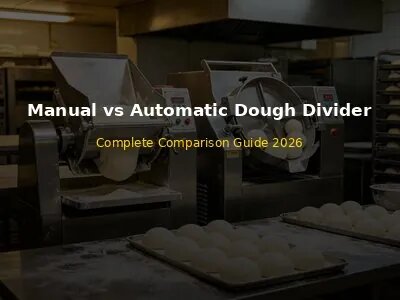
When bakers ask about dough dividers, they often focus on capacity and price. But one of the most worth noting decisions is: how much automation do I need? Fully automatic and semi-automatic dough dividers both produce quality divided dough, but they require quite different levels of operator involvement and have quite different ROI profiles.
Quick Answer
Fully automatic vs semi-automatic dough dividers: Fully automatic ($4,000-$15,000) — PLC touchscreen control, automatic dough feeding, servo motors, 1 operator, 2,000-6,000 pcs/hr, weight memory presets, best for high-volume bakeries. Semi-automatic ($1,500-$4,000) — manual dough feeding, digital or mechanical control, 1-2 operators, 500-2,000 pcs/hr, simpler maintenance, best for small-medium bakeries. Labor savings: fully auto replaces 2-3 workers vs semi-auto 1-2. ROI: fully auto 6-12 months, semi-auto 12-18 months. Choose from daily volume: >2,000 pcs = fully auto, <2,000 = semi-auto.
Table of Contents
- What Is a Fully Automatic Dough Divider?
- What Is a Semi-Automatic Dough Divider?
- Fully Automatic vs Semi-Automatic: Complete Comparison Table
- Labor Savings: How Much Does Each Type Save?
- ROI Calculation: When Does Fully Automatic Pay Off?
- Capacity and Production Flexibility
- Price Comparison: How Much Does Each Type Cost?
- Maintenance and Reliability
- Which Automation Level Is Right for Your Bakery?
- Often Asked Questions
From our perspective as bakery equipment manufacturers, I've seen fully automatic dividers run for hours with minimal supervision, and I've seen semi-automatic dividers produce Great results with an experienced operator. In this guide, I'll walk you through the differences, labor savings, ROI calculations, and best use cases for each automation level.
"I started with a semi-automatic divider because it was cheaper. For the first year, it was fine — I had an employee who ran it full-time. But when that employee left, I realized how dependent I was on having a dedicated operator. I bought a fully automatic divider and now I can run the whole dividing operation myself in 30 minutes a day. The machine paid for itself in labor savings in 8 months. If you're short on labor, fully automatic is the only way to go."
— James W., Bakery Owner in Canada
What Is a Fully Automatic Dough Divider?
A fully automatic dough divider is a high-automation machine that requires minimal operator intervention. The operator simply loads dough into the hopper, sets the desired weight and production speed on the PLC control panel, and starts the machine. The divider then automatically feeds, portions, cuts, and discharges the dough pieces without further human intervention. Many fully automatic models also include an integrated rounder that shapes the divided pieces into smooth balls.
Fully automatic dividers are designed for continuous, unattended operation. They feature automated dough feeding systems (auger or piston), conveyor belts for discharging pieces, sensor-based operation, and PLC controls with programmable product presets. Some models can even alert the operator when the hopper is low or when maintenance is due.
Important Features of Fully Automatic Dough Dividers:
- Minimal operator intervention (load dough + monitor)
- Automated dough feeding system (auger or piston)
- PLC control panel with programmable product presets
- Conveyor belt for automatic discharge
- Sensor-based operation (hopper level, piece count, jam detection)
- Often integrated with dough rounder
- Capacity: 2000-6000 pieces per hour
- One operator can run 2-3 machines simultaneously
- Higher upfront cost ($4,000-12,000)
- Self-diagnostic systems for maintenance alerts
What Is a Semi-Automatic Dough Divider?
A semi-automatic dough divider is a medium-automation machine that requires an operator to be present throughout the dividing process. The operator feeds dough into the machine, monitors the dividing process, and removes the divided pieces as they come out. The machine handles the actual dividing and cutting automatically, but the feeding and collection are manual.
Semi-automatic dividers are simpler machines with fewer complex components. They typically feature manual or semi-automated dough feeding, basic controls (buttons or dials), and a discharge tray or chute where the operator collects pieces. While they require more labor, they are more affordable, easier to maintain, and offer more flexibility for small batch production or frequent product changes.
Important Features of Semi-Automatic Dough Dividers:
- Requires dedicated operator throughout operation
- Manual or semi-automated dough feeding
- Basic controls (buttons, dials, or simple digital panel)
- Operator collects pieces manually from discharge tray
- Simpler mechanical design, fewer complex components
- Often available with optional rounder attachment
- Capacity: 1000-3000 pieces per hour
- One operator per machine (cannot run multiple simultaneously)
- Lower upfront cost ($2,000-5,000)
- Easier maintenance and repair
Fully Automatic vs Semi-Automatic: Complete Comparison Table
| Reason | Fully Automatic | Semi-Automatic |
|---|---|---|
| Operator involvement | Minimal (load + monitor) | Continuous (feed + collect) |
| Labor required | 15-30 min/day per machine | 2-4 hours/day per machine |
| Operators per machine | 1 operator can run 2-3 machines | 1 dedicated operator per machine |
| Capacity | 2000-6000 pieces/hour | 1000-3000 pieces/hour |
| Automation features | PLC, sensors, conveyor, self-diagnostic | Basic controls, manual feeding/collection |
| Upfront cost | $4,000-12,000 | $2,000-5,000 |
| Annual labor savings | $5,000-15,000/year | $2,000-5,000/year |
| Typical ROI | 5-18 months | 12-36 months |
| Maintenance complexity | Medium-High (PLC, sensors, conveyor) | Low-Medium (simpler mechanics) |
| Best for | High volume, limited labor, 24/7 operation | Medium volume, available labor, flexibility |
| Lifespan | 10-15 years | 10-15 years |
Labor Savings: How Much Does Each Type Save?
Labor savings are the biggest advantage of fully automatic dividers. Let me break down the actual labor requirements for each type.
Fully Automatic Divider Labor:
With a fully automatic divider, the operator's tasks are:
- Loading dough: 5-10 minutes per hopper load (typically 10-30kg)
- Monitoring: Periodic checks every 15-30 minutes (can do other tasks while machine runs)
- Collecting pieces: If no conveyor, 5-10 minutes per batch; with conveyor, pieces discharge automatically
- Cleaning: 15-20 minutes at end of day
Total daily labor: 15-30 minutes per machine (not including cleaning)
Because the machine runs unattended, one operator can easily manage 2-3 fully automatic dividers simultaneously, or run the divider while performing other bakery tasks.
Semi-Automatic Divider Labor:
With a semi-automatic divider, the operator must be present throughout the process:
- Feeding dough: Continuous feeding of dough pieces into the machine
- Monitoring: Constant monitoring of dividing quality and machine operation
- Collecting pieces: Manual removal of pieces from discharge tray as they come out
- Adjustments: Frequent adjustments for weight, speed, and dough feeding
- Cleaning: 15-20 minutes at end of day
Total daily labor: 2-4 hours per machine (continuous operator presence required)
Because the machine cannot operate without continuous human intervention, each semi-automatic divider requires a dedicated operator. You can't run multiple semi-automatic machines with one person.
Labor Cost Comparison Example:
| Scenario | Fully Automatic | Semi-Automatic |
|---|---|---|
| Daily production: 2000 pieces | 20 min labor/day | 3 hours labor/day |
| Daily labor cost (@ $15/hour) | $5/day | $45/day |
| Monthly labor cost | $150/month | $1,350/month |
| Annual labor cost | $1,800/year | $16,200/year |
| Annual labor savings | — | $14,400/year more |
As You can see, the labor savings from a fully automatic divider can be large. Even at lower production volumes, the difference in labor costs adds up quickly.
"I run a wholesale bakery with 3 production lines. I used to have 3 employees running 3 semi-automatic dividers. When I upgraded to 3 fully automatic dividers, I was able to reassign 2 of those employees to other tasks and now just one person manages all 3 dividers in between other responsibilities. The labor savings alone paid for all 3 machines in 10 months. Plus, production is more consistent because the machines don't get tired or have off days. Fully automatic is the best investment I've made in my bakery."
— Michael R., Wholesale Bakery Owner in the USA
ROI Calculation: When Does Fully Automatic Pay Off?
The return on investment for a fully automatic divider depends on three factors: production volume, labor costs, and the price difference between fully automatic and semi-automatic models. Let me calculate ROI for different scenarios.
ROI Formula:
ROI (months) = (Price Difference) / (Monthly Labor Savings)
Where:
- Price Difference: Fully automatic price - Semi-automatic price (typically $2,000-7,000)
- Monthly Labor Savings: (Hours saved per day) × (Labor cost per hour) × (Working days per month)
ROI by Production Volume:
| Daily Production | Hours Saved/Day | Monthly Savings (@$15/hr) | Price Difference | ROI |
|---|---|---|---|---|
| 500 pieces | 1-2 hours | $330-660/month | $2,000-3,000 | 3-9 months |
| 1000 pieces | 2-3 hours | $660-990/month | $3,000-5,000 | 3-8 months |
| 2000 pieces | 2.5-3.5 hours | $825-1,155/month | $4,000-7,000 | 3-8 months |
| 3000+ pieces | 3-4 hours | $990-1,320/month | $5,000-10,000 | 4-10 months |
Important insight: Even at relatively low production volumes (500 pieces/day), a fully automatic divider typically pays for itself in under a year. At higher volumes, the ROI is even faster because the labor savings are greater while the price difference doesn't increase proportionally.
Additional ROI Factors:
- Reduced hiring costs: Fewer operators needed means lower recruitment, training, and turnover costs
- Improved consistency: Machine-operated dividing is more consistent than human-operated, reducing product waste and customer complaints
- Increased capacity: Fully automatic machines can run longer hours without operator fatigue, potentially increasing production
- Operator redeployment: Operators freed from dividing can be redeployed to higher-value tasks like product development, quality control, or customer service
- 24/7 operation potential: Fully automatic machines can run overnight or during off-hours with minimal supervision
Capacity and Production Flexibility
Fully Automatic Capacity:
Fully automatic dividers are designed for continuous, high-volume operation:
- Small model: 2000-3000 pieces/hour — suitable for 500-1000 pieces/day
- Medium model: 3000-4000 pieces/hour — suitable for 1000-2000 pieces/day
- Large model: 4000-6000 pieces/hour — suitable for 2000+ pieces/day
Because they run unattended, fully automatic dividers can be run for longer periods (including overnight) to handle peak demand or large orders. The PLC control allows for programmable production counts and automatic shutdown when the target is reached.
Semi-Automatic Capacity:
Semi-automatic dividers are limited by the operator's speed and stamina:
- Small model: 1000-1500 pieces/hour — suitable for 200-500 pieces/day
- Medium model: 1500-2500 pieces/hour — suitable for 500-1000 pieces/day
- Large model: 2500-3000 pieces/hour — suitable for 1000-1500 pieces/day
While the machine's rated capacity may be high, the actual output is limited by the operator's ability to feed dough and collect pieces continuously. Most operators can sustain 60-70% of the machine's rated capacity over an 8-hour shift. Production also must stop when the operator takes breaks or is reassigned to other tasks.
Price Comparison: How Much Does Each Type Cost?
Fully Automatic Dough Divider Prices:
- Small model (2000-3000 pcs/hour): $4,000-6,000 (medium bakery, retail)
- Medium model (3000-4000 pcs/hour): $6,000-8,000 (large bakery, wholesale) — most popular
- Large model (4000-6000 pcs/hour): $8,000-12,000 (industrial, high-volume)
- Fully automatic + integrated rounder: Add $1,500-3,000
- Fully automatic + conveyor system: Add $1,000-2,500
Semi-Automatic Dough Divider Prices:
- Small model (1000-1500 pcs/hour): $2,000-3,000 (small bakery, cafe)
- Medium model (1500-2500 pcs/hour): $3,000-4,000 (medium retail bakery) — most popular
- Large model (2500-3000 pcs/hour): $4,000-5,000 (large bakery, wholesale)
- Semi-automatic + rounder attachment: Add $800-1,500
As a China-based manufacturer, we offer factory-direct pricing that's typically 30-50% below comparable European brands. Our medium fully automatic dividers start at $6,000, and our medium semi-automatic dividers start at $3,000. We also provide detailed operation manuals, training videos, and lifetime spare parts support for all our equipment.
Get Your Questions Answered Today
Ready to upgrade your bakery? Get in touch with our team for a free consultation. We will judge your needs and recommend the best equipment for your operation and budget.
Request a Free QuoteMaintenance and Reliability
Fully Automatic Divider Maintenance:
- Daily: Clean hopper, piston/cylinder, conveyor, and cutting mechanism (15-20 min); check sensor operation; empty waste tray
- Weekly: Lubricate moving parts with food-grade grease; check conveyor belt tension and alignment; check sensors and PLC connections; clean control panel vents
- Monthly: Calibrate weight accuracy; check piston/cylinder wear; check cutting wire/blade; check PLC program and presets; check electrical connections
- Annual: Professional servicing; replace worn piston seals and cutting wires; check PLC calibration; deep clean motor and gearbox; backup PLC program
- Expected lifespan: 10-15 years with proper maintenance
Semi-Automatic Divider Maintenance:
- Daily: Clean feeding area, dividing chamber, and discharge tray (10-15 min); check basic operation; remove dough residue
- Weekly: Lubricate moving parts; check belts and chains; check electrical connections; clean motor housing
- Monthly: Calibrate weight accuracy; check dividing components for wear; check controls and switches
- Annual: Professional servicing; replace worn belts, chains, and dividing components; deep clean
- Expected lifespan: 10-15 years with proper maintenance
Fully automatic dividers have more complex components (PLC, sensors, conveyor) that require more maintenance attention, but most models feature self-diagnostic systems that alert the operator to potential issues before they cause downtime. Semi-automatic dividers are simpler and easier to maintain, but lack the diagnostic features that can prevent unexpected failures. Both types will provide 10-15 years of reliable service with proper maintenance.
Which Automation Level Is Right for Your Bakery?
Choose Fully Automatic If:
- You produce 500+ pieces per day
- You've limited labor or difficulty finding/retaining operators
- You want to redeploy operators to higher-value tasks
- You need consistent, repeatable production quality
- You want the ability to run extended or overnight shifts
- You plan to increase production Later
- You've multiple production lines that could share one operator
- ROI of 5-18 months is acceptable (it typically is)
Choose Semi-Automatic If:
- You produce under 500 pieces per day
- You've available labor and want to keep employees on payroll
- You've a quite limited upfront budget
- You need maximum flexibility for frequent product changes or small batches
- You prefer simpler machines that are easy to repair yourself
- You don't anticipate meaningful production growth
- You've a dedicated, experienced operator who will run the machine consistently
Upgrade Path:
Many bakeries start with a semi-automatic divider and upgrade to fully automatic as they grow. Here's a typical progression:
- Startup (0-6 months): Semi-automatic divider + dedicated operator
- Growth (6-18 months): Semi-automatic divider + operator, Given automation upgrade
- Established (18+ months): Fully automatic divider + operator redeployed to other tasks
- High-volume (3+ years): Multiple fully automatic dividers + one operator managing all
If you're confident your production will exceed 500 pieces per day within the first year, I recommend starting with a fully automatic divider. The labor savings and improved consistency will more than justify the higher upfront cost, and you'll avoid the need to replace a semi-automatic machine too soon.
"I tell every bakery owner I meet: if You can afford it, buy fully automatic. I started with semi-automatic to save money, and I regret it. I spent 2 years paying an operator to stand in front of that machine, when I could have been using that money to pay off a fully automatic machine. When I finally upgraded, I realized how much time and money I had wasted. Do the math — fully automatic almost always pays for itself in under a year. Don't make the same mistake I did."
— David K., Bakery Owner in Australia
📋 Bakery Equipment Checklist
Download our complete bakery equipment checklist with budget estimates for 5 different bakery types.
Free Bakery Equipment Checklist →📋 Bakery Equipment ROI Calculator
Use our interactive ROI calculator to see how quickly your bakery equipment investment pays off.
Calculate Your Equipment ROI →📋 Bakery Equipment Maintenance Calendar
Get our printable maintenance calendar to keep your bakery equipment running at peak performance.
Printable Maintenance Calendar →📋 Bakery Equipment Energy Cost Calculator
Estimate your bakery equipment energy costs and find ways to reduce your utility bills.
Calculate Energy Costs →🏭 Bakery Equipment Capacity Calculator
Not sure what size equipment you need? Use our free interactive calculator to find the perfect dough divider, mixer, oven, and proofer capacity for your production volume.
Calculate Your Equipment Needs →⚖️ Bakery Equipment Comparison Tool
Compare dough dividers, spiral mixers, ovens, proofers and dough sheeters side by side. View specs, prices, capacity and features to find the best equipment for your bakery.
Compare Equipment Now →Often Asked Questions
Q: Which is better: fully automatic or semi-automatic dough divider?
A: It depends on your production volume and labor budget. Fully automatic dough dividers require minimal operator intervention — just load dough and collect pieces — making them ideal for high-volume bakeries (2000+ pieces/day) and operations with limited labor. Semi-automatic dough dividers require an operator to feed dough and remove pieces, but cost less and offer more flexibility, making them ideal for medium-volume bakeries (500-2000 pieces/day) with available labor.
Q: How much does a fully automatic dough divider cost?
A: Fully automatic dough dividers typically cost $4,000-12,000 depending on capacity (2000-6000 pieces/hour), automation features (PLC control, conveyor system, integrated rounder), and build quality. Semi-automatic dough dividers range from $2,000-5,000 depending on capacity (1000-3000 pieces/hour) and features. As a China manufacturer, we offer factory-direct pricing 30-50% below European brands. Fully automatic models have higher upfront cost but can save $5,000-15,000 per year in labor costs.
Q: How much labor does a fully automatic divider save?
A: A fully automatic dough divider can reduce dividing labor by 70-90% compared to hand dividing, and 50-70% compared to semi-automatic dividing. For a bakery producing 2000 pieces per day, a fully automatic divider might require only 15-30 minutes of operator time per day (loading dough and monitoring), while a semi-automatic divider might require 2-3 hours of continuous operator time. At $15/hour labor cost, that's $25-40 per day in savings, or $7,500-12,000 per year. The labor savings alone can pay for a fully automatic divider in 1-2 years.
Q: Can one operator run multiple fully automatic dividers?
A: Yes, one operator can typically run 2-3 fully automatic dough dividers simultaneously, because the machines operate independently once loaded. The operator's main tasks are: loading dough into hoppers, monitoring production, collecting divided pieces, and performing minor adjustments. This is a major advantage for high-volume bakeries, as it allows one operator to manage multiple production lines. With semi-automatic dividers, each machine requires a dedicated operator because the machine cannot operate without continuous human intervention.
Q: What is the ROI for a fully automatic dough divider?
A: The ROI for a fully automatic dough divider depends on production volume and labor costs, but most bakeries see payback in 1-2 years. For a bakery producing 2000 pieces/day with $15/hour labor: fully automatic divider costs $5,000-8,000, saves 2-3 hours/day = $30-45/day = $9,000-13,500/year, ROI = 5-10 months. For a bakery producing 1000 pieces/day: saves 1-2 hours/day = $15-30/day = $4,500-9,000/year, ROI = 8-18 months. Even at lower volumes, the labor savings and improved consistency typically justify the investment within 2 years.
Q: Do fully automatic dividers require more maintenance?
A: Fully automatic dividers have more complex components (PLC controls, sensors, conveyor systems, automated feeding) that require more maintenance than semi-automatic dividers. However, the maintenance is still manageable with a regular schedule: daily cleaning (15-20 minutes), weekly lubrication and checkion (30 minutes), monthly calibration and part check (1 hour), and annual professional servicing (2-3 hours). Most fully automatic dividers have self-diagnostic systems that alert the operator to potential issues before they cause downtime. With proper maintenance, fully automatic dividers have a lifespan of 10-15 years, similar to semi-automatic models.
Q: Can I upgrade from semi-automatic to fully automatic later?
A: Most dough dividers cannot be upgraded from semi-automatic to fully automatic, because the differences are fundamental: fully automatic models have automated dough feeding systems, conveyor belts, PLC controls, and sensor-based operation that are built into the machine's design. Semi-automatic models lack these components and the structural structure to support them. If you start with a semi-automatic divider and later need higher automation, you'll typically need to purchase a new fully automatic machine. However, You can keep the semi-automatic machine as a backup or for smaller production runs. We recommend sizing your divider for 30-50% above current production to avoid needing a replacement too soon.
Closing Thoughts
Choosing between fully automatic and semi-automatic dough dividers comes down to one question: how much is your labor worth? If You've abundant, affordable labor and want to keep costs low, a semi-automatic divider may be the right choice. If labor is scarce, expensive, or you want to redeploy your team to higher-value tasks, a fully automatic divider will almost surely pay for itself quickly.
The biggest mistake I see bakers make is choosing semi-automatic to save money upfront, without calculating the long-term labor costs. A $3,000 semi-automatic divider that requires $15,000/year in labor is more expensive than a $6,000 fully automatic divider that requires $2,000/year in labor. Always calculate the total cost of ownership, not just the purchase price.
If you're still unsure which automation level is right for your bakery, we're here to help. With 7 years of experience selling bakery equipment to over 20 countries, we've helped hundreds of bakers choose the right equipment for their specific production needs and labor situations. Tell us about your bakery — your daily production volume, your labor situation, your available space, and your budget — and we'll give you honest, practical advice on which automation level makes the most sense for you.
Get Your Questions Answered Today
Ready to upgrade your bakery? Get in touch with our team for a free consultation. We will judge your needs and recommend the best equipment for your operation and budget.
Contact HNH Bakery Equipment