
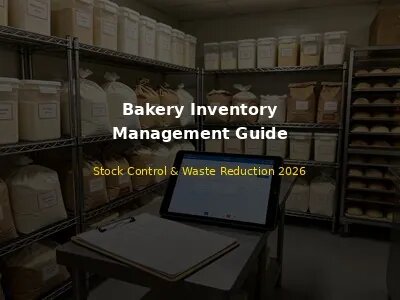
Bakery Inventory Management & Cost Control Complete Guide: Reduce Waste and Boost Profit
Most guides on this topic are written by people who have never actually run a bakery. Here is the real-world version: Bakery A does $50,000 a month in sales and makes $5,000 in profit. Bakery B also does $50,000 a month in sales but makes $12,000 in profit. Same revenue, more than double the profit. What's the difference? Bakery B has their inventory and cost control dialed in. Bakery A is bleeding money through waste, over-ordering, over-portioning, and poor purchasing.
Quick Answer
Bakery ingredient purchasing and storage guide: How to source, purchase, store, and manage bakery ingredients for quality, cost control, and food safety. (1) Why ingredient management matters—Ingredients are 30-40% of bakery costs (largest variable cost); ingredient quality directly figure outs product quality (bad flour = bad bread, no matter how skilled baker); proper storage prevents spoilage/waste (5-15% of ingredients wasted in poorly managed bakeries—directly reduces profit); food safety (improper storage = bacteria growth, cross-contamination, allergen issues—can cause foodborne illness, closure); consistent ingredients = consistent product (customers expect same taste/quality every time—variation in ingredients = variation in product); cost control (bulk purchasing, FIFO, waste reduction = notable savings—ingredient cost reduction 5% can double net profit). (2) Core ingredients and specifications—Flour (most important, highest volume): Types (bread flour (12-14% protein for bread), all-purpose (10-12% protein general), pastry/cake flour (8-10% protein for cakes/pastries), whole wheat (with bran/germ), rye, spelt, gluten-free blends); Specifications (protein content (important for bread—consistent protein = consistent gluten development), ash content (mineral content—indicates extraction rate), moisture (12-14% typical—affects dough hydration), falling number (indicates enzyme activity—too high = sticky dough, too low = poor volume), gluten strength (W value, P/L ratio—for artisan bread)); Storage (cool, dry, well-ventilated, 50-70°F, <60% humidity, in airtight containers or bins, off floor 6", away from walls, away from strong odors, FIFO); Shelf life (white flour 6-12 months if properly stored, whole wheat 3-6 months (germ goes rancid), store whole wheat in fridge/freezer for longer life); Purchasing (buy from reputable mill, specify protein content and other specs, test new flour before switching, buy in bulk (50lb bags save 20-30%), consistent supplier for consistency). Sugar: Types (granulated white, brown (light/dark), powdered/confectioners (with cornstarch), honey, maple syrup, agave, molasses, glucose, invert sugar); Specifications (purity, moisture, color (for brown sugar), particle size (powdered), invert content (for liquid sugars)); Storage (cool, dry, airtight containers, 50-70°F, <60% humidity, away from moisture (sugar absorbs moisture), brown sugar keep soft (bread slice or apple in container, or microwave to soften), honey stores indefinitely (may crystallize—warm to reliquify)); Shelf life (white sugar indefinite if dry, brown sugar 6-12 months (may harden), honey indefinite, molasses 2-3 years); Purchasing (buy in bulk (25-50lb bags), specify type/grade, test new suppliers. Fats/oils: Types (butter (unsalted for baking, salted for flavor), margarine/shortening (vegetable-based, high ratio for cakes), oil (vegetable, canola, olive, coconut), lard (traditional, for flaky crusts)); Specifications (butter: fat content (80-85% standard, European style 82-85%), moisture, salt content; shortening: melting point, solid fat index (SFI), trans fat content; oil: smoke point, flavor, saturation); Storage (butter: fridge 34-40°F for 1-3 months, freezer 0°F for 6-12 months, wrap well (absorbs odors), away from strong-smelling foods; shortening: cool, dry, airtight, 50-70°F, away from heat/light (oxidation = rancidity), check expiration; oil: cool, dark, airtight, away from heat/light, check for rancidity (off smell/taste), don't store near oven); Shelf life (butter: fridge 1-3 months, freezer 6-12 months; shortening: 6-12 months unopened, 3-6 months opened; oil: 6-12 months unopened, 2-3 months opened (refrigerate after opening for nut oils)); Purchasing (buy butter in bulk (blocks/cases), freeze extra, specify unsalted for baking, buy from reputable dairy, test for flavor/performance; buy shortening in bulk, specify trans-free if needed, check melting point for application; buy oil in bulk, consider smoke point/flavor for application). Yeast: Types (active dry (needs rehydration), instant (can mix directly with flour), fresh/compressed (perishable, short shelf life, preferred by some artisan bakers), sourdough starter (wild yeast, maintained continuously)); Specifications (activity/viability (test before use—proof in warm water with sugar, should foam), strain (different strains for different products), moisture (active dry 6-8%, instant 4-6%, fresh 65-70%)); Storage (active dry/instant: cool, dry, airtight, 50-70°F (or fridge for longer life), away from heat/moisture, check expiration; fresh yeast: fridge 34-40°F, use within 1-2 weeks, don't freeze (damages cells); sourdough starter: room temp if using daily (feed daily), fridge if weekly use (feed weekly), can freeze for long-term storage); Shelf life (active dry: 1-2 years unopened, 6 months opened (fridge); instant: similar to active dry; fresh: 1-2 weeks fridge; sourdough starter: indefinite if maintained properly); Purchasing (buy from reputable supplier, check expiration date, test viability before use, buy in quantity you'll use before expiration, fresh yeast from local bakery supplier if available). Eggs: Types (fresh shell eggs (large, extra-large, grade AA/A), liquid eggs (pasteurized, for high-volume), dried eggs (shelf-stable, for emergencies/long storage)); Specifications (size (large = 50g average, extra-large = 56g—weigh for consistency), grade (AA = thick white, high yolk; A = good for most baking), pasteurization (liquid eggs must be pasteurized for food safety), freshness (float test—sinks = fresh, floats = old)); Storage (fridge 34-40°F, in original carton (not door—temp fluctuates), pointed end down (keeps yolk centered), away from strong-smelling foods (eggs absorb odors), use within 3-5 weeks of purchase (check Julian date on carton), don't wash eggs (removes protective coating—US eggs are washed, so refrigerate; European eggs unwashed, can store room temp); Shelf life (3-5 weeks fridge, 1 year frozen (out of shell, beaten, in freezer container)); Purchasing (buy from reputable supplier, check dates, buy size appropriate for recipes (weigh for consistency), consider pasteurized liquid eggs for high-volume (food safety, convenience), buy only what you'll use in 3-5 weeks). Dairy (milk, cream, cheese): Milk (whole 3.25%, 2%, 1%, skim, buttermilk, evaporated, condensed, powdered—specify fat content, pasteurized, use by date; storage: fridge 34-40°F, use by date, don't store in door, shake before use; shelf life: 1-2 weeks fridge unopened, 3-5 days opened; powdered milk: cool dry, 6-12 months); Cream (heavy cream 36-40% fat, whipping cream 30-36%, light cream 18-30%, sour cream—specify fat content, pasteurized, use by date; storage: fridge 34-40°F, use by date, don't freeze (separates), shake before use; shelf life: 1-2 weeks fridge unopened, 3-5 days opened); Cheese (cream cheese, ricotta, mozzarella, parmesan, cheddar, feta—specify type, fat content, moisture, age; storage: fridge 34-40°F, wrap well (prevent drying/odor absorption), hard cheeses can freeze (texture changes), soft cheeses don't freeze well; shelf life: cream cheese 2-4 weeks fridge, ricotta 1-2 weeks, hard cheeses 1-6 months fridge, 6-12 months frozen); Purchasing (buy from reputable dairy supplier, check dates, buy quantity you'll use before expiration, consider block vs pre-shredded (block = better value, less additives, fresher; pre-shredded = convenience but has anti-caking agents)). Other ingredients: Salt (kosher, sea, table, flaky—specify type, grain size, iodine content; storage: cool, dry, airtight, indefinite shelf life; buy in bulk); Leavening (baking powder, baking soda—specify type, check freshness (test: baking powder + hot water = fizz, baking soda + vinegar = fizz); storage: cool, dry, airtight, 6-12 months; buy fresh, don't buy too much at once); Spices/flavorings (vanilla, cinnamon, nutmeg, etc.—specify type, purity, grade; storage: cool, dark, airtight, away from heat/light; shelf life: whole spices 1-2 years, ground 6-12 months, extracts 1-2 years; buy whole spices and grind fresh for better flavor, buy small quantities to ensure freshness); Chocolate/cocoa (dark, milk, white, cocoa powder—specify cocoa content, origin, form (chips/blocks/pistoles); storage: cool, dry, 55-65°F, away from heat/light/moisture, well-wrapped (prevent bloom/odor absorption); don't refrigerate (condensation = bloom); shelf life: dark 1-2 years, milk/white 6-12 months; buy from reputable chocolatier, temper properly for best results); Nuts/seeds (almonds, walnuts, pecans, sesame, etc.—specify type, raw/roasted, blanched, storage: fridge or freezer (nuts go rancid quickly at room temp Because of high oil content), airtight, away from strong odors; shelf life: fridge 3-6 months, freezer 6-12 months; buy in small quantities or freeze extra, toast before use for flavor); Fruit (fresh, frozen, dried, canned, candied—specify type, variety, sweetened/unsweetened, storage: fresh = fridge, frozen = freezer 0°F, dried = cool dry airtight, canned = cool dry; shelf life: fresh 3-7 days fridge, frozen 6-12 months, dried 6-12 months, canned 1-2 years unopened; buy frozen fruit for baking (consistent quality, year-round availability, no waste)). (3) Purchasing plan—Supplier selection: Get 3+ quotes for major ingredients (flour, sugar, butter, eggs—compare price, quality, delivery, terms); Consider: price per unit (not just total—compare cost per lb/kg), quality (test samples before switching), consistency (same quality every delivery—important for product consistency), delivery (free delivery vs pickup cost, delivery frequency, minimum order, reliability), payment terms (net 30 vs COD, early payment discounts), minimum order (can you meet minimum? if not, group with other bakeries or buy from smaller supplier), customer service (responsive, handles issues, flexible), location (local supplier = fresher, faster delivery, lower shipping; regional/national = may be cheaper for bulk). Bulk purchasing: Buy non-perishables in bulk (flour, sugar, salt, oil—50lb bags, 5-gallon buckets—save 20-30% vs small bags); Buy perishables in appropriate quantities (don't overbuy dairy/eggs/fresh fruit—spoilage risk); Consider storage capacity (don't buy more than You can store properly); Calculate savings: bulk price vs small price × quantity used before expiration = actual savings (consider storage cost, waste risk, cash tie-up); Join buying co-ops (group with other local bakeries/restaurants to get volume discounts from suppliers); Warehouse clubs (Costco, Restaurant Depot, Sysco—good for small bakeries, competitive prices, no membership fees for some). Seasonal buying: Buy seasonal ingredients when cheap/abundant (fruit in season, holiday items), preserve for later (freeze, can, dry); Lock in prices for seasonal staples (contract pricing with supplier for flour/sugar/butter—protects against price spikes); Plan menu around seasonal ingredients (lower cost, better quality, marketing opportunity). Inventory management: Set par levels (minimum stock to keep on hand for each ingredient—from usage, delivery frequency, lead time); Reorder point (when stock reaches par + safety stock, reorder—don't wait until empty); Safety stock (extra 1-2 weeks of important ingredients (flour, sugar, yeast, butter) in case of delivery delays/supply issues); FIFO (first in, first out—use oldest ingredients first, rotate stock when receiving, label with receive date, check dates regularly); Track usage (weekly inventory count, compare to sales—spot waste, theft, over-ordering); Use inventory software (or spreadsheet) to track stock, usage, reorder points—reduces stockouts and overstock. Receiving procedures: check every delivery (check quantity against invoice, check quality (freshness, damage, temperature for refrigerated/frozen items), check dates (don't accept near-expiry items), check packaging (intact, no damage/pests)); Reject if issues (wrong items, damaged, warm refrigerated items, expired, pests—note on invoice, contact supplier); Rotate stock (FIFO—put new stock behind/under old stock); Update inventory records (adjust stock levels, note any issues/discrepancies); check against invoice (pay only for what you receive—dispute discrepancies promptly). (4) Storage best practices—Dry storage (flour, sugar, salt, grains, pasta, canned goods, spices): Conditions (cool 50-70°F, dry <60% humidity, dark, well-ventilated, away from heat sources (oven, water heater), away from direct sunlight, away from strong odors (chemicals, onions), away from walls (2"), off floor (6"—prevents moisture/pests), organized (labeled, accessible, FIFO)); Containers (food-grade airtight containers for flour/sugar (prevents moisture, pests, odors), original packaging for canned goods, sealed containers for spices (light-proof for spices), metal or food-grade plastic bins for bulk flour/sugar with scoops); Label everything (contents, date received, use-by date—important for FIFO and food safety); Pest control (seal cracks/holes, keep area clean, no food debris, regular pest checkions, store food in sealed containers, don't store cardboard directly on floor (pests hide in cardboard)). Refrigerated storage (dairy, eggs, fresh fruit/veg, dough, prepared fillings, leftovers): Temperature (34-40°F (1-4°C), check daily with thermometer (don't rely on built-in gauge), log temps, adjust if off); Organization (raw ingredients below ready-to-eat (prevents cross-contamination from drips), all items covered/wrapped (prevents drying, odor absorption, cross-contamination), labeled (contents, date), FIFO (oldest in front), don't overload (blocks airflow = uneven cooling), leave space between items for airflow); Specific items (eggs: in original carton, not door, pointed end down; dairy: back of fridge (coldest), not door; dough: covered, labeled, use within timeframe; prepared fillings: covered, labeled, use within 3-5 days); Cleaning (clean spills immediately, clean shelves weekly, deep clean monthly, check for expired items weekly, don't store chemicals with food). Frozen storage (butter, dough, fruit, nuts, bread, prepared items): Temperature (0°F (-18°C) or below, check daily, log temps); Organization (all items wrapped well (prevents freezer burn—use freezer bags/wrap, squeeze out air), labeled (contents, date frozen), FIFO (oldest in front/top), don't overload (blocks airflow), group similar items together); Specific items (butter: wrap well, can freeze 6-12 months; dough: shape/portion before freezing, wrap well, use within 1-3 months; fruit: wash/dry/pat dry, freeze on tray then bag, use within 6-12 months; nuts: airtight container/bag, fridge or freezer, use within 6-12 months; bread: wrap well, freeze 2-3 months, slice before freezing for easy use); Thawing (fridge (best, 24hrs per 5lbs), cold water (sealed bag, change water every 30min), microwave (if cooking immediately), don't thaw at room temp (bacteria growth), don't refreeze thawed perishables (quality/safety—bread/dough can refreeze if still cold)). (5) Food safety and allergens—Allergen control: spot allergens in ingredients (top 9: wheat/gluten, eggs, milk, soy, tree nuts, peanuts, fish, shellfish, sesame—read labels carefully, ask suppliers about cross-contamination risks); Store allergens separately (if possible, dedicated shelf/area for allergen-containing ingredients, or store below non-allergen items (prevents cross-contamination from drips), clearly label allergen-containing items); Prevent cross-contact (use separate utensils/scoops for allergen-containing ingredients, clean/sanitize equipment between allergen and non-allergen production, wash hands, change gloves, dedicated equipment if possible for high-risk allergens); Label products (list all allergens on product labels/menu, "may contain" warnings for cross-contamination risk, train staff to answer allergen questions accurately); Supplier verification (ask suppliers about allergen controls in their facilities, get certificates/statements, look over if high-risk). Cross-contamination prevention: Separate raw and ready-to-eat (raw ingredients below ready-to-eat in fridge, separate cutting boards/utensils, color-coded boards); Clean and sanitize (all surfaces/equipment between different products, especially allergen/non-allergen, raw/ready-to-eat); Handwashing (between tasks, after touching raw ingredients, after touching face/hair, after restroom—20+ seconds with soap); Personal hygiene (hairnets, no jewelry, clean uniforms, no working while sick); Storage (covered/wrapped items, no chemicals with food, proper temp zones). (6) Common ingredient management mistakes—[ ] No recipe costing (don't know exact cost per item—can't price for profit—calculate recipe costs for every product) [ ] No portion control (inconsistent portions = inconsistent cost/product—weigh everything, use scoops/scales) [ ] No waste tracking (can't reduce what you don't measure—track waste daily, look over weekly, spot causes) [ ] Overproduction (baking more than sells = #1 waste—bake to demand, use sales history, par-bake/freeze) [ ] No FIFO (using new before old = expired ingredients waste—rotate stock, label dates, use oldest first) [ ] Improper storage (spoilage, pests, moisture—proper temp/humidity/containers/location) [ ] Not comparing suppliers (paying too much—get 3+ quotes quarterly, negotiate) [ ] Overbuying inventory (ties up cash, increases waste—buy from usage, par levels, don't overstock) [ ] No receiving checkion (accepting wrong/damaged/expired items—check every delivery, reject issues) [ ] Ignoring ingredient quality (cheap ingredients = poor product—test samples, specify quality standards, consistent supplier) [ ] Inconsistent ingredients (different flour protein = different bread quality—specify specs, test before switching, consistent supplier) [ ] No inventory tracking (stockouts, overstock, theft—track inventory weekly, use software/spreadsheet) [ ] Ignoring allergens (cross-contamination risk, customer safety, legal liability—spot, store separately, prevent cross-contact, label products) [ ] Not training staff (staff don't know proper storage/handling—train, post guides, supervise) [ ] No safety stock (delivery delay = no production = lost sales—keep 1-2 weeks extra of important ingredients) (7) Ingredient management FAQ—Q: How do I know if flour is good quality? A: Check: protein content (consistent %—ask supplier for spec sheet, test with farinograph if possible), ash content (mineral content, indicates extraction), moisture (12-14%), falling number (enzyme activity—too high = sticky dough, too low = poor volume), gluten strength (W value, P/L ratio for artisan bread), freshness (smell—should be mild, not musty/rancid; color—consistent, no clumps; test bake—compare to current flour). Buy from reputable mill, ask for spec sheet and lot analysis, test new flour in small batch before full switch, keep consistent supplier for consistency. Q: How long can I store flour? A: White (all-purpose/bread) flour: 6-12 months if stored properly (cool, dry, airtight, 50-70°F, <60% humidity, off floor, away from heat/light/odors). Whole wheat flour: 3-6 months at room temp (germ contains oil that goes rancid), 6-12 months in fridge/freezer (extend life). Gluten-free flour: 3-6 months (some like almond flour go rancid faster—refrigerate/freeze). Signs of bad flour: musty/rancid smell, clumps (moisture), bugs/weevils, off color, dough doesn't rise properly. Store in airtight food-grade containers (not original paper bags—tears, pests, moisture), label with date, use FIFO. Q: Should I buy ingredients in bulk? A: Yes for non-perishables (flour, sugar, salt, oil—save 20-30% vs small bags, but only if You've proper storage and will use before expiration). For perishables (dairy, eggs, fresh fruit): buy from usage, don't overbuy (spoilage risk). Consider: storage space (do You've room to store bulk properly?), cash flow (bulk = more upfront cost), usage rate (will you use it before expiration? calculate: quantity used per week × weeks before expiration = max to buy), actual savings (bulk price vs small price, minus storage cost/waste risk/cash tie-up). Join buying co-ops if can't meet supplier minimums. Q: How do I handle allergen-containing ingredients? A: 1. spot (read all labels, know top 9 allergens, ask suppliers about cross-contamination risks). 2. Store separately (dedicated shelf/area if possible, or store below non-allergen items, clearly label, use separate containers/scoops). 3. Prevent cross-contact (separate utensils/equipment, clean/sanitize between allergen/non-allergen production, wash hands/change gloves, dedicated equipment for high-risk allergens if possible). 4. Label products (list all allergens, "may contain" warnings, train staff). 5. Supplier verification (ask about allergen controls, get certificates). 6. Training (all staff understand allergen risks and procedures). Allergen cross-contact can cause severe allergic reactions—take seriously, have written allergen control plan. Q: What's the best way to store butter? A: Butter: fridge 34-40°F for 1-3 months (wrap well, away from strong-smelling foods—butter absorbs odors easily, store in original wrapper or airtight container, don't store in door (temp fluctuates)). Freezer 0°F for 6-12 months (wrap well in freezer wrap/heavy-duty foil/airtight freezer bag, squeeze out air, label with date, thaw in fridge 24hrs before use). For daily use: keep 1-2 weeks worth in fridge, freeze rest. Unsalted butter for baking (control salt content), European-style butter (82-85% fat) for laminated dough (croissants) — higher fat = better lamination. Don't store butter at room temp for more than 1-2 days (rancidity risk, especially in warm kitchen). Q: How do I know if ingredients are fresh/good? A: Visual checkion (no mold, discoloration, clumps, pests, unusual texture); Smell (no off, musty, rancid, sour smells—trust your nose); Touch (no sliminess, stickiness, unusual texture); Taste (if unsure, small taste—off flavor = discard); Check dates (use-by/best-by dates—these are guidelines, not safety dates (except infant formula), but use as indicator); Test (yeast: proof in warm water + sugar = should foam in 5-10min; baking powder: add hot water = should fizz; baking soda: add vinegar = should fizz; eggs: float test = sinks fresh, floats old; flour: test bake = compare to known good flour). When in doubt, throw it out—food safety is more important than saving a few dollars on ingredients. Summary: bakery ingredient purchasing and storage = core ingredients and specs (flour, sugar, fats, yeast, eggs, dairy, other—specs, storage, shelf life, purchasing), purchasing plan (supplier selection, bulk buying, seasonal, inventory management, receiving), storage best practices (dry, refrigerated, frozen—conditions, organization, specific items, cleaning), food safety and allergens (allergen control, cross-contamination prevention), common mistakes, FAQ. Ingredients are 30-40% of costs and figure out product quality—manage them carefully: buy quality, store properly, reduce waste, control costs, ensure food safety. Proper ingredient management = consistent quality, lower costs, less waste, happy customers, profitable bakery.
Table of Contents
- Table of Contents
- 1. Why Inventory and Cost Control Is the #1 Profit Lever
- 2. Food Cost Calculation: Know Your Numbers
- 3. FIFO System: First In, First Out
- 4. Par Levels: Never Run Out, Never Overstock
- 5. Waste Reduction: Stop Throwing Away Profit
- 6. Portion Control: Consistency and Cost Savings
- 7. Purchasing Strategies: Buy Smart, Not Cheap
- 8. Supplier Management: Build Win-Win Relationships
- 9. Inventory Turnover: How Fast Should You Move Stock?
Here's the hard truth about the bakery business: you don't make money when you sell bread—you make money when you control your costs. Revenue is vanity. Profit is sanity. And the single biggest lever You've to increase profit is inventory management and cost control. A bakery that reduces food cost from 35% to 28% on $50,000 monthly revenue adds $3,500 to the bottom line every single month. That's $42,000 a year. Same sales, more profit.
In my 15 years selling bakery equipment to clients around the world, I've seen this pattern over and over. The bakeries that survive and thrive aren't the ones with the best-tasting bread (though that helps)—they're the ones that treat inventory and cost control as seriously as they treat baking. The bakeries that fail usually don't fail because their bread is bad. They fail because they can't control their costs, and they slowly bleed out until there's no money left.
This guide is everything I've learned from watching the most profitable bakeries manage their inventory and costs. I'll cover food cost calculation, FIFO systems, waste reduction, par levels, purchasing strategies, supplier management, inventory turnover, portion control, and the common mistakes that sink bakery profits. By the end, you'll have a complete system for taking control of your inventory and boosting your bottom line.
"We were doing $45,000 a month in sales but only making $2,000 profit. I knew something was wrong but couldn't figure out what. We started tracking food cost weekly, put in placeed FIFO, standardized our recipes with scales, and renegotiated with our suppliers. Six months later, our food cost dropped from 38% to 29%, and our profit jumped to $8,500 a month. Same sales, $6,500 more profit. I wish I'd done this years ago." — Marcus, owner of a 1,200 sq ft artisan bakery in Portland, Oregon
Table of Contents
- Why Inventory and Cost Control Is the #1 Profit Lever
- Food Cost Calculation: Know Your Numbers
- FIFO System: First In, First Out
- Par Levels: Never Run Out, Never Overstock
- Waste Reduction: Stop Throwing Away Profit
- Portion Control: Consistency and Cost Savings
- Purchasing Strategies: Buy Smart, Not Cheap
- Supplier Management: Build Win-Win Relationships
- Inventory Turnover: How Fast Should You Move Stock?
- Inventory Software and Tools
- 10 Common Inventory and Cost Control Mistakes
- Often Asked Questions
1. Why Inventory and Cost Control Is the #1 Profit Lever
Before we dive into the how-to, let's make sure you understand the why. Most bakery owners focus on increasing sales—more customers, more orders, more revenue. But here's what they don't realize: increasing sales by 10% doesn't increase profit by 10%. It might increase profit by 2-3%. But reducing food cost by 10% increases profit by almost 100%.
Let me show you the math. Here's a typical bakery P&L:
| Item | Current | +10% Sales | -10% Food Cost |
|---|---|---|---|
| Total Revenue | $50,000 | $55,000 | $50,000 |
| Food Cost (32%) | $16,000 | $17,600 | $14,400 |
| Labor Cost (30%) | $15,000 | $16,000 | $15,000 |
| Rent/Overhead (20%) | $10,000 | $10,000 | $10,000 |
| Net Profit | $9,000 | $11,400 (+27%) | $10,600 (+18%) |
Wait, that shows +10% sales giving more profit. But here's what the table doesn't show: increasing sales by 10% requires more marketing spend, more staff hours, more stress, and more risk. Reducing food cost by 10% requires better systems, not more spending. And here's the kicker—if you do both (increase sales AND reduce food cost), your profit jumps to $13,000, a 44% increase. But the food cost reduction is the easier, faster, more reliable lever.
The True Cost of Poor Inventory Management
Most bakery owners underestimate how much money they're losing to poor inventory management. Here are the hidden costs:
- Waste: Spoiled ingredients, expired products, over-produced items that get thrown away. The average bakery wastes 5-10% of ingredients. On $50,000 monthly revenue with 32% food cost, that's $800-$1,600 thrown away every month.
- Over-portioning: If your bakers put 10% more dough in each loaf than the recipe calls for, you're giving away 10% of your food cost for free. That's $1,600/month on $50,000 revenue.
- Over-ordering: Buying more than you need ties up cash in inventory that may spoil. It also takes up valuable storage space and increases the risk of theft and misplacement.
- Stockouts: Running out of important ingredients means You can't produce certain items, losing sales and disappointing customers. A single stockout of a popular item can cost $500-$2,000 in lost sales.
- Theft and shrinkage: Employee theft, unrecorded giveaways, and recording errors typically account for 2-5% of food cost. That's $320-$800/month.
- Poor purchasing: Buying at the wrong time, from the wrong supplier, or in the wrong quantities can add 5-15% to your ingredient costs.
Add it all up: the average bakery loses 10-20% of potential profit to poor inventory and cost control. On $50,000 monthly revenue, that's $1,600-$3,200 every single month. That's money you've already earned but are throwing away. The good news? This is the easiest profit to recover. You don't need more customers. You don't need higher prices. You just need better systems.
2. Food Cost Calculation: Know Your Numbers
You can't control what you don't measure. The foundation of cost control is accurate food cost calculation. If you don't know your actual food cost percentage, you're flying blind. Let's fix that.
The Food Cost Formula
Food Cost % = (Beginning Inventory + Purchases - Ending Inventory) ÷ Total Food Sales × 100
Let's break this down with a real example:
- Beginning Inventory: The value of all food and ingredients You've on hand at the start of the period. Let's say $3,500.
- Purchases: The total value of all food and ingredients you bought during the period. Let's say $6,000.
- Ending Inventory: The value of all food and ingredients You've on hand at the end of the period. Let's say $2,800.
- Total Food Sales: Your total revenue from food sales (exclude non-food sales like merchandise or catering deposits). Let's say $22,000.
Calculation:
Food Cost = ($3,500 + $6,000 - $2,800) ÷ $22,000 × 100
Food Cost = $6,700 ÷ $22,000 × 100
Food Cost = 30.5%
What's a Good Food Cost Percentage?
| Product Category | Ideal Food Cost | Notes |
|---|---|---|
| Artisan bread, loaves | 20-28% | Mostly flour, water, yeast, salt—low ingredient cost |
| Croissants, laminated dough | 25-32% | High butter content increases cost |
| Muffins, cookies, quick breads | 22-30% | Moderate ingredient cost |
| Cakes, decorated items | 30-40% | Eggs, butter, sugar, decorations increase cost |
| Specialty/vegan/gluten-free | 35-45% | Specialty ingredients are expensive |
| Coffee and beverages | 15-22% | Highest margin category in most bakeries |
| Overall bakery average | 28-32% | Target for a well-run bakery |
Ideal vs Actual Food Cost
There are two food cost numbers You should track:
- Ideal (Recipe) Food Cost: What your food cost should be if every recipe is followed exactly, there's no waste, no theft, and no over-portioning. Calculate this by costing out every recipe and multiplying by units sold.
- Actual Food Cost: What your food cost actually is, calculated using the formula above (beginning inventory + purchases - ending inventory).
The difference between ideal and actual is your "operational loss." If ideal food cost is 26% and actual is 32%, you're losing 6% to waste, over-portioning, theft, or recording errors. On $50,000 monthly revenue, that's $3,000/month disappearing. Your goal to close this gap to 2% or less.
Action Step: Calculate your actual food cost this month. Then calculate your ideal food cost by costing out your top 10 selling items (which represent 70-80% of sales) and multiplying by units sold. Compare the two numbers. The gap is your opportunity. Most bakeries find a 4-8% gap, which translates to thousands of dollars in recoverable profit.
3. FIFO System: First In, First Out
FIFO is the simplest, most effective inventory management technique for bakeries. It stands for "First In, First Out"—meaning the oldest ingredients (first in) get used first (first out), and the newest ingredients get used last. This sounds obvious, but most bakeries don't do it consistently, and it costs them thousands in spoiled ingredients.
Why FIFO Matters in Bakeries
Bakery ingredients are perishable. Here's what happens if you don't rotate stock:
- Butter goes rancid after 1-3 months in the fridge, absorbing odors from other foods
- Eggs spoil after 3-5 weeks, with quality declining steadily
- Yeast loses potency after 4-6 months, causing poor rise and dense bread
- Flour can get pantry moths, go rancid (whole grain), or absorb moisture after 3-6 months
- Cream and dairy spoil in 1-2 weeks
- Fruit and fillings spoil in 3-7 days
When new stock is placed in front of old stock, the old stock gets pushed to the back and forgotten until it expires. Then you throw it away. FIFO prevents this by ensuring older stock is always used first.
How to put in place FIFO in Your Bakery
- Label everything with the receipt date: When a delivery arrives, immediately label every item with the date it was received. Use a marker, labels, or a date gun. No item goes into storage without a date. This is non-negotiable.
- Place new deliveries behind existing stock: When putting away a delivery, move the existing stock forward and place the new stock behind it. This way, the oldest stock is always at the front, where staff will grab it first.
- Train all staff to pull from the front: Every person who takes ingredients from storage must be trained to always take from the front of the shelf (the oldest stock). Never reach to the back for a "fresher" item. Make this a habit, not a choice.
- Organize storage by category and frequency: Keep frequently used items at eye level and within easy reach. Keep less frequently used items on higher or lower shelves. This reduces the chance of items being buried and forgotten.
- Do weekly shelf checks: Once a week, have someone go through all storage areas and check dates. Pull any items expiring within 7 days to the front and flag them for immediate use. Discard any expired items immediately and log them in your waste log.
- Use clear, uniform storage containers: Transfer bulk ingredients (flour, sugar, grains) into clear, labeled containers with tight-fitting lids. This makes it easy to see how much is left and prevents pest infestations. Label each container with the ingredient name and the date it was filled.
FIFO for Prepared Products Too
FIFO isn't just for raw ingredients—it applies to prepared products too. When you bake a batch of croissants in the morning and another batch at noon, the morning batch should be sold first. Place older products at the front of the display case and newer products behind. This ensures customers get the freshest product possible and reduces waste from unsold day-old items.
Result: Bakeries that put in place strict FIFO typically reduce ingredient waste by 15-25%. If you're currently wasting $1,000/month in spoiled ingredients, FIFO can save you $150-$250/month. That's $1,800-$3,000/year. Not bad for a system that costs nothing to put in place.
4. Par Levels: Never Run Out, Never Overstock
A par level is the minimum amount of an item you want to have on hand at all times. It's the "reorder point"—when stock drops below par, you order more. Par levels prevent two costly problems: stockouts (running out of an item and losing sales) and overstocking (having too much of an item, tying up cash and increasing waste).
How to Calculate Par Levels
Par Level Formula:
Par = (Average Daily Usage × Lead Time) + Safety Stock
Where:
- Average Daily Usage = how much of the item you use in a typical day
- Lead Time = how many days it takes from ordering to delivery
- Safety Stock = extra stock to cover unexpected demand or delivery delays (typically 20-30% of usage during lead time)
Example: You use 20 lbs of flour per day. Your supplier delivers 2 days after you order. You want 25% safety stock.
Par = (20 lbs × 2 days) + (20 lbs × 2 days × 0.25)
Par = 40 lbs + 10 lbs = 50 lbs
So when your flour stock drops below 50 lbs, you place an order.
Sample Par Level Sheet for a Small Bakery
| Ingredient | Daily Usage | Lead Time | Par Level | Order Qty |
|---|---|---|---|---|
| Bread flour (50 lb bag) | 40 lbs | 2 days | 100 lbs (2 bags) | 4 bags |
| Butter (1 lb sticks) | 15 lbs | 1 day | 25 lbs | 30 lbs |
| Eggs (dozen) | 8 dozen | 1 day | 15 dozen | 20 dozen |
| Granulated sugar (50 lb bag) | 12 lbs | 2 days | 35 lbs | 1 bag (50 lbs) |
| Fresh yeast (1 lb) | 1.5 lbs | 2 days | 5 lbs | 6 lbs |
Par Level Best Practices
- look over and adjust quarterly: Par levels aren't set it and forget it. look over them every 3 months and adjust from seasonal demand, sales trends, and menu changes. You'll need more flour in December (holiday baking) and less in August (slow summer).
- Separate par levels for peak and off-peak: If your weekend volume is 2x your weekday volume, set different par levels for weekend vs weekday ordering. Don't order the same amount for a Tuesday as a Saturday.
- Reason in delivery schedule: If your supplier delivers Tuesday and Friday, your par level for Tuesday should cover usage through Friday delivery. Your par level for Friday should cover usage through Tuesday delivery (including the weekend).
- Use a par level sheet or app: Post a par level sheet in your storage area or use an inventory app. When taking inventory, staff simply compares current stock to par level and orders the difference. No guesswork, no over-ordering, no stockouts.
- Start with your top 20 items: You don't need par levels for every single ingredient on day one. Start with your top 20 highest-usage, highest-cost items (flour, butter, eggs, sugar, yeast, etc.). These represent 80% of your food cost. Add more items over time.
5. Waste Reduction: Stop Throwing Away Profit
Waste is the silent profit killer in bakeries. Every item you throw away is money you've already spent on ingredients, labor, and overhead—and you get zero revenue from it. The average bakery wastes 5-10% of its food production. Reducing waste is one of the fastest ways to increase profit.
Types of Bakery Waste
- Production waste (over-baking): Baking more than You can sell. This is the biggest waste source in most bakeries. You bake 100 croissants, sell 75, throw away 25. Those 25 croissants cost you $15 in ingredients and labor and generated $0 revenue.
- Ingredient waste (spoilage): Ingredients that expire or go bad before use. Butter goes rancid, eggs spoil, fruit molds, flour gets bugs. This is usually caused by poor FIFO, over-ordering, or improper storage.
- Preparation waste (trim and mistakes): Dough trimmings, uneven cuts, burnt items, collapsed cakes, mistakes during preparation. Some prep waste is unavoidable, but excessive waste indicates poor training or poor processes.
- Portion waste (over-portioning): Putting more dough, filling, or topping than the recipe calls for. If each cookie should be 2 oz but your bakers are making them 2.3 oz, you're giving away 15% more cookie for free.
- Storage waste (improper storage): Ingredients stored at wrong temperature, in wrong containers, or in wrong conditions. Bread stored in the fridge goes stale faster. Butter not wrapped properly absorbs odors. Flour not in airtight containers gets moths.
The Waste Log: Your Most Powerful Tool
The first step to reducing waste is measuring it. Create a waste log and track every single item you throw away. Here's how:
Waste Log Format:
| Date | Item | Qty | Reason | Cost | Staff Initials |
|---|---|---|---|---|---|
| 9/6 | Croissants | 18 | Unsold (over-baked) | $9.00 | JM |
| 9/6 | Butter (1 lb) | 2 | Expired (rancid) | $6.00 | JM |
Waste log rules:
- Every item thrown away gets logged—no exceptions
- Include the reason (unsold, expired, burnt, mistake, trim)
- Include the cost (use your recipe cost or ingredient cost)
- look over the log weekly with your team
- Look for patterns—same item wasted every day? Same reason? Same staff?
- Set a waste reduction goal (e.g., "reduce waste by 20% this month")
Production Planning: Bake the Right Amount
The #1 cause of bakery waste is over-baking. The solution is data-driven production planning. Here's how to do it:
- Track sales by item and day: For each item, record how many you sold each day of the week, for at least 4 weeks. This gives you a baseline.
- Calculate average daily sales by day of week: "On average, we sell 65 croissants on Tuesdays and 120 on Saturdays." Don't use a single daily average—break it down by day of week.
- Reason in weather and events: Rainy days = 20-30% less foot traffic. Sunny weekends = more customers. Local events (farmers market, parade, concert) = more customers. Adjust production So.
- Use the 80% rule: Bake 80% of expected sales upfront, then bake more throughout the day as needed. It's better to sell out of an item at 2pm than to throw away 20% at closing. Selling out creates urgency and perceived value. Over-baking creates waste.
- Do multiple bake cycles: Instead of baking everything at 4am, bake in batches throughout the morning. This ensures product freshness and allows you to adjust production from actual sales. A rotary oven with multiple trays makes this efficient.
- look over and adjust weekly: Every week, compare actual sales to production. If you consistently throw away 15% of croissants, reduce production by 15%. If you consistently sell out by 10am, increase production by 10%.
Day-Old Product Strategies
Even with perfect production planning, you'll have some unsold product at the end of the day. Here's how to minimize the loss:
- Discount day-old items: Sell day-old bread and pastries at 30-50% off. Many customers specifically look for day-old deals. Label them clearly as "day-old" to manage expectations.
- Repurpose day-old items: Day-old croissants → bread pudding or croutons. Day-old bread → breadcrumbs, croutons, French toast, panzanella. Day-old cake → cake pops or trifle. Get creative—turn waste into new products.
- Donate for tax deduction: Donate unsold bread to local food banks, shelters, or churches. In many countries, You can claim a tax deduction for food donations. It's better than throwing it away, and it builds goodwill in the community.
- Freeze for later use: Bread and many pastries freeze well. Freeze unsold loaves and use them for catering, wholesale orders, or as backup stock. Label and date everything in the freezer and use FIFO there too.
- "Bread basket" promotion: Offer a "surprise bag" of day-old items for a low price ($3-$5). Customers love the surprise, and you move product that would otherwise be thrown away. Apps like Too Good To Go can help connect you with customers looking for discounted surplus food.
[Continued: Portion Control, Purchasing Strategies, Supplier Management, Inventory Turnover, Software, Mistakes, FAQ]
6. Portion Control: Consistency and Cost Savings
Portion control is one of the most overlooked cost control measures in bakeries. When bakers portion by eye rather than by weight, the variation can be 10-20%. That means some loaves are 10% underweight (angering customers) and some are 20% overweight (costing you money). Over time, the over-portioning adds up to thousands of dollars in lost profit.
The Cost of Poor Portion Control
Let's do the math. Suppose you sell 200 loaves of bread per day at $6 each. Your recipe calls for 1.5 lbs of dough per loaf. If your bakers are averaging 1.6 lbs per loaf (7% over), that's 0.1 lbs of extra dough per loaf. At $0.80/lb dough cost, that's $0.08 per loaf. 200 loaves × $0.08 = $16/day. $16/day × 6 days = $96/week. $96/week × 52 weeks = $4,992/year. That's almost $5,000 a year you're giving away for free, just on bread. Add pastries, cookies, cakes, and fillings, and the total could be $10,000-$20,000/year.
Portion Control Best Practices
- Use scales for everything: Every ingredient, every dough piece, every filling, every topping should be weighed. No "eyeballing." Invest in good digital scales (0.1 oz precision for small items, 0.1 lb precision for large batches). Place scales at every workstation. A dough divider rounder can automatically portion dough into consistent pieces, saving labor and ensuring accuracy.
- Standardize all recipes with weights: Every recipe should list ingredients by weight (grams or ounces), not volume (cups, tablespoons). Volume measurements are inaccurate—1 cup of flour can weigh anywhere from 4 to 5 ounces depending on how it's scooped. Weight is precise and consistent.
- Create portion guides: Post a portion guide at each workstation showing the exact weight for each item. "Bread loaf: 24 oz dough. Croissant: 3.5 oz dough. Chocolate chip cookie: 2 oz dough. Blueberry muffin: 4 oz batter." Include a photo of what the correctly portioned item looks like.
- Use portion scoops and disher: For cookies, muffins, and cupcakes, use standardized portion scoops (#16, #20, #30, etc.). A #20 scoop delivers exactly 1.6 oz of batter every time. This is faster and more consistent than weighing each individual cookie.
- Train and look over: Train all bakers on portion control. Periodically look over by weighing finished products. If a loaf should be 1.5 lbs and you're finding loaves at 1.3-1.7 lbs, retrain the baker responsible. Make portion accuracy part of performance look overs.
- Control filling and topping amounts: Fillings and toppings are often the highest-cost ingredients. Use squeeze bottles with measured amounts, piping bags with standard tips, or weighed portions. "Each croissant gets 0.5 oz of almond cream." Don't let bakers "eyeball" fillings—this is where over-portioning happens most.
7. Purchasing Strategies: Buy Smart, Not Cheap
Purchasing is where your cost control begins. Buy the right ingredients, in the right quantities, at the right price, from the right suppliers, and you've already won half the battle. Buy poorly and no amount of waste reduction or portion control will save you.
Purchasing Principles
- Buy from par levels, not emotion: Never order because "we might need it" or "it's on sale." Order from your par level sheet. If stock is above par, don't order. If it's below par, order the difference. This prevents over-ordering and stockouts.
- Buy in bulk for non-perishable items: For items with long shelf life (flour, sugar, salt, oil, packaging), buying in larger quantities reduces unit cost. But only buy what You can use before it expires and what You've space to store. A 50 lb bag of flour is cheaper per pound than a 5 lb bag, but if You can't use 50 lbs before it goes bad, it's false economy.
- Buy fresh frequently for perishable items: For butter, eggs, cream, fruit, and other perishables, buy smaller quantities more frequently. It may cost slightly more per unit, but it reduces spoilage waste. The savings from less waste almost always outweigh the slightly higher unit cost.
- Compare prices regularly: Every 3-6 months, get quotes from 2-3 suppliers for your top 20 items. Don't assume your current supplier has the best price. Prices change, and a 5-minute phone call could save you hundreds of dollars a month. But don't switch suppliers solely on price—consider quality, reliability, delivery schedule, and customer service too.
- Negotiate with suppliers: Most suppliers are willing to negotiate, especially if you're a regular customer with consistent orders. Ask about volume discounts, prompt payment discounts (2% off if paid within 10 days), or free delivery. Even a 2-3% discount on your monthly purchases adds up to thousands of dollars a year.
- Join a buying group or co-op: Many small bakeries join buying groups or food co-ops to get better pricing through collective purchasing power. Groups like Independent Restaurant Coalition or local bakery associations often have negotiated pricing with major suppliers.
- Track price changes: Keep a price log for your top 20 items. When a supplier raises prices, you'll know immediately and can ask why or shop around. Without a price log, suppliers can quietly raise prices 5-10% and You can not notice for months.
Quality vs Price: The False Choice
Many bakery owners think they have to choose between quality and price. They buy the cheapest ingredients to save money, but the result is lower-quality products, unhappy customers, and eventually lower sales. The truth is, quality ingredients are often cheaper Over time because:
- Higher-quality butter has higher fat content, so you need less of it
- Higher-quality flour has higher protein content, producing better bread with less waste
- Higher-quality chocolate has higher cocoa content, so you need less for the same flavor
- Higher-quality ingredients produce better products, which command higher prices and more repeat customers
The important is to find the sweet spot: good enough quality to produce Great products, at a price that allows for healthy margins. Test different brands and grades. Calculate the actual cost per recipe, not just the cost per unit. Sometimes a more expensive ingredient produces a better product at a lower per-recipe cost because you need less of it.
8. Supplier Management: Build Win-Win Relationships
Your suppliers are partners in your success, not just vendors. A good supplier relationship can save you money, ensure consistent quality, and provide valuable industry insights. A bad supplier relationship can cost you money, cause stockouts, and hurt your product quality. Here's how to manage suppliers effectively.
Supplier Evaluation Criteria
| Criteria | What to Look For | Weight |
|---|---|---|
| Price | Competitive pricing, volume discounts, transparent pricing | 25% |
| Quality | Consistent quality, grade specifications, product testing | 25% |
| Reliability | On-time delivery, complete orders, few stockouts | 20% |
| Service | Responsive, helpful, easy to reach, problem-solving | 15% |
| Flexibility | Will-call orders, rush delivery, custom orders, returns | 10% |
| Payment terms | Net 30 terms, prompt payment discounts, easy billing | 5% |
Building Strong Supplier Relationships
- Pay on time, every time: This is the #1 thing You can do to build a good relationship. Suppliers value customers who pay reliably. Paying on time may also qualify you for prompt payment discounts (2% off if paid within 10 days).
- Consolidate purchases: Instead of buying from 10 different suppliers, consolidate to 3-4 primary suppliers. Higher volume with each supplier means better pricing, better service, and stronger relationships. It also reduces administrative work.
- Communicate proactively: If You should change an order, let them know as early as possible. If you're going to have a large order (holiday season), give them advance notice. If there's a quality issue, tell them immediately and give them a chance to fix it. Good communication builds trust.
- Ask for their expertise: Good suppliers know the industry. Ask them about new products, price trends, seasonal availability, and best practices. They may have insights that save you money or improve your products. "What are other bakeries doing for gluten-free flour?" "What's the price outlook for butter this quarter?"
- Don't switch suppliers for tiny price differences: If Supplier A is 2% cheaper but has unreliable delivery and poor service, the 2% savings isn't worth the headaches and stockouts. A reliable supplier that delivers on time and stands behind their products is worth paying a small premium for. Only switch if the price difference is large (5%+) or if there are ongoing quality/service issues.
- Have backup suppliers: Never be 100% dependent on a single supplier for important items. Have a backup supplier for your top 5-10 ingredients. If your primary supplier has a stockout, delivery delay, or quality issue, You can switch to the backup without disrupting production.
9. Inventory Turnover: How Fast Should You Move Stock?
Inventory turnover is a measure of how quickly you sell and replace your inventory. A high turnover means you're moving stock quickly (good—less waste, less cash tied up). A low turnover means stock is sitting around (bad—more waste, more cash tied up, more risk of spoilage).
How to Calculate Inventory Turnover
Inventory Turnover Ratio = Cost of Goods Sold ÷ Average Inventory Value
Average Inventory = (Beginning Inventory + Ending Inventory) ÷ 2
Days in Inventory = 365 ÷ Inventory Turnover Ratio
Example: Your annual cost of goods sold (food cost) is $192,000. Your beginning inventory was $4,000 and ending inventory was $3,500.
Average Inventory = ($4,000 + $3,500) ÷ 2 = $3,750
Inventory Turnover = $192,000 ÷ $3,750 = 51.2 times per year
Days in Inventory = 365 ÷ 51.2 = 7.1 days
This means, on average, your inventory turns over 51 times per year, and items sit in inventory for about 7 days before being used. That's Great for a bakery.
What's a Good Inventory Turnover for a Bakery?
| Rating | Turnover Ratio | Days in Inventory | Interpretation |
|---|---|---|---|
| Great | 50+ | Under 7 days | Quite efficient, minimal waste, minimal cash tied up |
| Good | 35-50 | 7-10 days | Efficient, well-managed inventory |
| Average | 20-35 | 10-18 days | Room for improvement, likely over-ordering some items |
| Poor | Under 20 | Over 18 days | Excess inventory, high waste risk, too much cash tied up |
Most well-run bakeries have an inventory turnover of 35-50 (7-10 days in inventory). If your turnover is below 20, you're likely over-ordering, and reducing inventory levels will free up cash and reduce waste. If your turnover is above 60, You can be under-ordering and risking stockouts—find the balance.
10. Inventory Software and Tools
The right software can make inventory management much easier and more accurate. But you don't need the most expensive, feature-rich system to get started. Here are the options, from simplest to most sophisticated.
Option 1: Spreadsheet (Free, Best for Tiny Bakeries)
A simple Google Sheets or Excel spreadsheet can handle inventory tracking for a small bakery. Create columns for: Item Name, Unit, Par Level, Current Stock, Reorder Quantity, Supplier, Unit Cost, Last Order Date. Update current stock daily or weekly. Use formulas to calculate total inventory value and flag items below par.
Pros: Free, flexible, no learning curve. Cons: Manual data entry, error-prone, no integration with sales or purchasing, time-consuming to maintain.
Option 2: POS Built-In Inventory (Best for Most Small Bakeries)
Most modern POS systems (Square, Toast, Clover, Lightspeed) have built-in inventory tracking. When you sell an item, inventory is automatically deducted. You can set par levels and get low-stock alerts. Some systems can even generate purchase orders from par levels and current stock.
Pros: Integrates with sales automatically, no manual entry, low cost (included or cheap add-on), easy to use. Cons: Basic features, may not handle recipe costing or production planning, limited reporting.
Option 3: Bakery-Specific Software (Best for Growing Bakeries)
Software designed specifically for bakeries includes inventory, recipe costing, production planning, ordering, and sales tracking all in one system. Popular options include BakeSmart, BakeryBoss, Optimum Control, and Cake & Bread.
Pros: Designed for bakeries, recipe costing, production planning, waste tracking, complete reporting, integrates with POS and accounting. Cons: More expensive ($50-$200/month), learning curve, may be overkill for tiny bakeries.
Option 4: General Inventory Apps (Affordable Middle Ground)
General inventory apps like Sortly, Zoho Inventory, or TradeGecko offer more features than a spreadsheet but are more affordable and easier to use than bakery-specific software. They include barcode scanning, low-stock alerts, purchase order management, and reporting.
Pros: Affordable ($20-$80/month), easy to use, barcode scanning, good reporting. Cons: Not bakery-specific, no recipe costing or production planning, may not integrate with your POS.
My Recommendation: Start with your POS's built-in inventory features (or a spreadsheet if your POS doesn't have inventory). Once you're doing $10,000+ monthly in sales and inventory management is taking more than 2 hours a week, invest in bakery-specific software. The software pays for itself through reduced waste, better purchasing, and time savings. The important is to start tracking now, with whatever tool You've. A simple system used consistently is better than a sophisticated system used inconsistently.
11. 10 Common Inventory and Cost Control Mistakes
Mistake #1: Not tracking food cost at all
The biggest mistake is not knowing your numbers. If You can't tell me your food cost percentage for last month, you're flying blind. Fix: Calculate food cost monthly using the formula in this guide. It takes 30 minutes once You've the system down.
Mistake #2: No FIFO system
New stock gets placed in front, old stock gets pushed to the back and expires. Fix: put in place FIFO—label everything with dates, place new stock behind old, train staff to pull from the front. Do weekly shelf checks.
Mistake #3: Over-baking everything at once
Baking all your product at 4am and throwing away 20% at closing. Fix: Use data-driven production planning. Bake 80% upfront, then bake more throughout the day from actual sales. Do multiple bake cycles.
Mistake #4: Portioning by eye
Bakers guessing portion sizes, causing 10-20% variation. Fix: Use scales for everything. Standardize recipes with weights. Use portion scoops for cookies and muffins. look over finished products regularly.
Mistake #5: No par levels, ordering by guesswork
Ordering from "I think we need more" rather than data. Fix: Set par levels for your top 20 items. Order from par levels, not emotion. look over and adjust par levels quarterly.
Mistake #6: Not tracking waste
Throwing items away without recording them, so You've no idea how much you're wasting or why. Fix: put in place a waste log. Track every item thrown away, with reason and cost. look over weekly. Look for patterns.
Mistake #7: Buying the cheapest ingredients without testing
Switching to cheaper ingredients to save money, causing lower quality products and lost customers. Fix: Test new ingredients before switching. Calculate cost per recipe, not just cost per unit. Find the quality-price sweet spot.
Mistake #8: Not comparing supplier prices
Using the same supplier for years without checking if their prices are competitive. Fix: Get quotes from 2-3 suppliers every 3-6 months for your top 20 items. Negotiate with your current supplier from competitive quotes.
Mistake #9: No backup suppliers
Being 100% dependent on one supplier, and being stuck when they have a stockout or delivery delay. Fix: Have backup suppliers for your top 5-10 important ingredients. Test them occasionally so you know their quality and reliability.
Mistake #10: Doing inventory infrequently and inconsistently
Doing a full inventory once a year (if at all), at inconsistent times, with different people counting. Fix: Do full inventory monthly, always at the same time (closing or before opening), with the same person or team. Do weekly counts of high-value perishable items. Consistency is more matters than frequency.
📋 Bakery Equipment ROI Calculator
Use our interactive ROI calculator to see how quickly your bakery equipment investment pays off.
Calculate Your Equipment ROI →📋 Bakery Equipment Maintenance Calendar
Get our printable maintenance calendar to keep your bakery equipment running at peak performance.
Printable Maintenance Calendar →📋 Bakery Equipment Energy Cost Calculator
Estimate your bakery equipment energy costs and find ways to reduce your utility bills.
Calculate Energy Costs →🏭 Bakery Equipment Capacity Calculator
Not sure what size equipment you need? Use our free interactive calculator to find the perfect dough divider, mixer, oven, and proofer capacity for your production volume.
Calculate Your Equipment Needs →⚖️ Bakery Equipment Comparison Tool
Compare dough dividers, spiral mixers, ovens, proofers and dough sheeters side by side. View specs, prices, capacity and features to find the best equipment for your bakery.
Compare Equipment Now →12. Often Asked Questions
Q: What is a good food cost percentage for a bakery?
A good food cost percentage for a bakery is 25-35% of total revenue. Bread and yeast-based products typically have lower food costs (20-28%) because they're mostly flour, water, and yeast. Pastries, cakes, and decorated items have higher food costs (30-40%) because they use more butter, eggs, sugar, and expensive decorations. If your food cost is above 35%, you're likely losing money to waste, over-portioning, theft, or poor purchasing. If it's below 20%, You can be under-portioning or using low-quality ingredients, which hurts customer satisfaction. The sweet spot for most profitable bakeries is 28-32%.
Q: How do bakeries reduce food waste?
Bakeries reduce food waste through several strategies: (1) Accurate production planning from historical sales data and weather forecasts—don't bake the same amount on a rainy Tuesday as a sunny Saturday; (2) FIFO (First In, First Out) inventory rotation to use older ingredients first; (3) Par level management—maintain minimum stock levels to avoid over-ordering; (4) Day-old product strategies—discount day-old bread, turn day-old croissants into bread pudding, donate unsold product for tax deductions; (5) Portion control—use scales and standardized recipes to ensure consistent portion sizes; (6) Regular inventory counts to spot shrinkage from theft, spoilage, or recording errors. The most effective bakeries track waste daily and look over it weekly to spot patterns and solutions.
Q: How often should a bakery do inventory?
The frequency depends on the item category. High-value, perishable items (butter, eggs, cream, specialty ingredients) should be counted weekly or even daily. Medium-value items (flour, sugar, yeast, packaging) should be counted bi-weekly or monthly. Low-value, bulk items (salt, oil, cleaning supplies) can be counted quarterly. A full physical inventory of all items should be done at least monthly for accurate food cost calculation. Many successful bakeries do a daily opening inventory check of important items and a full monthly count. The important is consistency—pick a schedule and stick to it, always counting at the same time (typically at closing or before opening) to ensure accuracy.
Q: What is FIFO and why is it important in bakeries?
FIFO stands for First In, First Out. It means using the oldest ingredients first and the newest ingredients last. In a bakery, this is important because most ingredients have limited shelf life—butter goes rancid, eggs spoil, yeast loses potency, flour can get bugs. FIFO ensures that ingredients are used before they expire, reducing waste and maintaining product quality. To put in place FIFO: label every ingredient with the receipt date, place new deliveries behind existing stock, train all staff to always pull from the front (oldest) first, and do regular checks to ensure no expired product is hidden at the back of shelves. FIFO can reduce ingredient waste by 15-25% in most bakeries.
Q: How do I calculate food cost percentage?
Food cost percentage is calculated with this formula: (Beginning Inventory + Purchases - Ending Inventory) ÷ Total Food Sales × 100 = Food Cost Percentage. For example: Beginning inventory = $3,000, Purchases = $5,000, Ending inventory = $2,500, Food sales = $18,000. Food cost = ($3,000 + $5,000 - $2,500) ÷ $18,000 × 100 = $5,500 ÷ $18,000 × 100 = 30.6%. You should calculate this monthly at minimum. For more accurate tracking, calculate it weekly. Compare your actual food cost to your ideal (recipe) food cost to spot waste, over-portioning, or theft. If actual food cost is 5%+ higher than ideal, You've a problem that needs investigation.
Q: What inventory software should a small bakery use?
For small bakeries, the best inventory software options are: (1) Your POS system's built-in inventory features (Square, Toast, Clover all have basic inventory tracking) — this is the best starting point because it integrates with sales automatically; (2) Spreadsheet-based tracking (Google Sheets or Excel) — free, flexible, but requires manual data entry and is error-prone; (3) Specialized bakery inventory software like BakeSmart, BakeryBoss, or Optimum Control — designed specifically for bakeries with recipe costing, production planning, and inventory features, but costs $50-$200/month; (4) General inventory apps like Sortly or Zoho Inventory — affordable ($20-$50/month), easy to use, but not bakery-specific. My recommendation: start with your POS inventory features or a spreadsheet. Once you're doing $10,000+ monthly in sales, invest in bakery-specific software. The software pays for itself through reduced waste and better purchasing decisions.
Putting This Into Practice
Inventory management and cost control aren't glamorous. They don't involve creative recipe development or beautiful product displays. But they are the foundation of a profitable bakery. You can bake the best bread in the world, but if your food cost is 40% and you're wasting 10% of production, you'll struggle to stay in business.
The good news is that inventory and cost control are systems, not talents. Anyone can put in place them. You don't need an MBA or an accounting degree. You need a scale, a waste log, a par level sheet, and the discipline to use them consistently. Start with one thing—calculate your food cost this month. Then put in place FIFO. Then start a waste log. Then set par levels. One step at a time, one system at a time.
Within 3-6 months, you'll see your food cost drop, your waste decrease, and your profit increase. You'll have more cash in the bank, less stress about money, and more time to focus on what you love—baking great bread and serving your customers. That's the payoff of good inventory management and cost control.
At HNH Bakery Equipment, we've helped hundreds of bakeries scale their production while maintaining cost control. As your volume grows, the right equipment can actually reduce your food cost by improving consistency, reducing waste, and increasing efficiency. A spiral mixer ensures consistent dough development every batch. A rotary oven provides even baking, reducing rejected product. A dough divider rounder ensures precise portioning, eliminating over-portioning waste. Reach out to us for a free consultation on equipment that can help you control costs while scaling production.
Ready to Scale Your Bakery Production?
As you put in place cost control and grow sales, you need equipment that can keep up with consistent quality and efficiency. HNH Bakery Equipment offers high-quality ovens, mixers, and dough processing equipment for bakeries of all sizes.
View Our EquipmentRelated Articles



Learn More
- 👉 Bakery Equipment Selection Complete Guide: Choose by Output & Product
- 👉 Bakery Equipment Maintenance Schedule: Daily, Weekly, Monthly, Yearly
- 👉 Dough Divider Rounder Troubleshooting: 15 Common Problems & Solutions
- 👉 Small Bakery Equipment ROI & Payback Period Calculator
- 👉 Bakery Equipment Energy Consumption & Energy Saving Guide
- 👉 Bakery Equipment Food Safety & Hygiene Compliance Complete Guide