
Understanding the Two Main Mixer Types
A commercial dough mixer is one of the most important investments for any bakery. The mixer directly impacts dough quality, fermentation, bread texture, and production efficiency. The two most common types of commercial mixers — spiral mixers and planetary mixers — use fundamentally different mixing technologies and are designed for different purposes.
Understanding the difference between these two mixer types is essential before making a purchase decision, as choosing the wrong mixer can lead to poor dough quality, increased energy costs, and reduced production capacity.
Spiral Mixer
Spiral mixers (also called spiral dough mixers) use a unique mixing action where a spiral-shaped hook rotates through the dough while the bowl also rotates. This dual rotation creates a gentle but efficient kneading action that develops gluten quickly with minimal heat buildup. Spiral mixers are designed specifically for dough and typically come with only a spiral hook attachment.
The spiral hook's unique shape mimics the folding and stretching action of hand kneading, creating a well-developed gluten network without overworking the dough. The rotating bowl ensures all dough is consistently mixed, eliminating the need to stop and scrape down the bowl.
Best for: Bread dough, pizza dough, bagel dough, and any high-gluten dough where temperature control and gluten development are critical.
Planetary Mixer
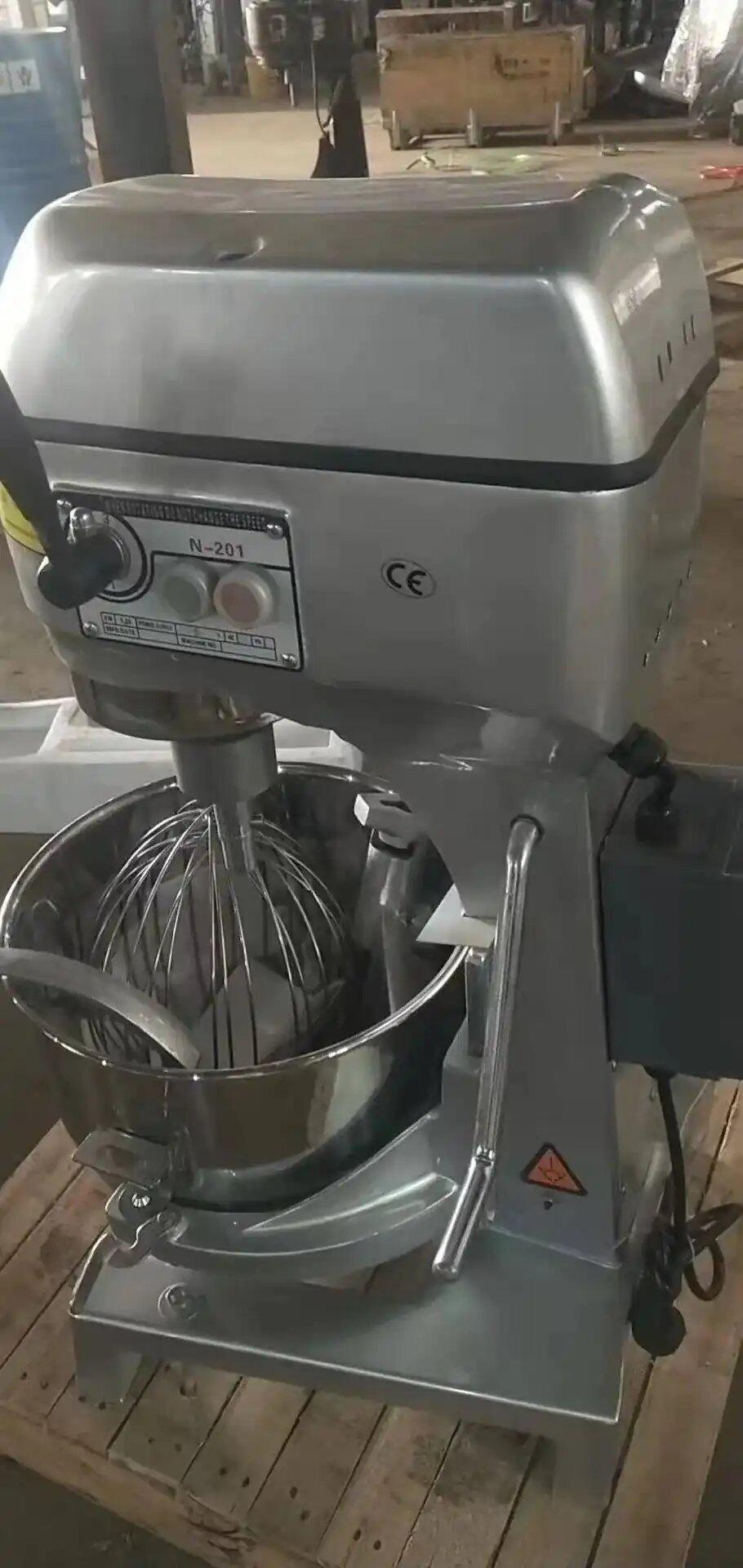
Planetary mixers (also called planetary dough mixers or beaters) use a mixing action where the attachment (beater, whisk, or hook) rotates on its own axis while also orbiting around the stationary bowl — similar to how planets orbit the sun. This creates a versatile mixing action that can handle everything from thick bread dough to delicate whipped cream.
Planetary mixers come with multiple interchangeable attachments — typically a dough hook, flat beater, and wire whisk — making them the most versatile type of commercial mixer. The stationary bowl allows for easy addition of ingredients during mixing, and the high-speed whisk attachment can incorporate air into egg whites and cream quickly.
Best for: Bakeries that need versatility — cakes, cookies, whipped cream, frosting, and moderate amounts of bread dough.
Side-by-Side Comparison
| Feature | Spiral Mixer | Planetary Mixer |
|---|---|---|
| Price Range | $1,500 - $8,000 | $800 - $6,000 |
| Bowl Capacity | 20 - 200+ liters | 5 - 80 liters |
| Flour Capacity (per batch) | 10 - 100+ kg | 2 - 40 kg |
| Mixing Action | Spiral hook + rotating bowl | Orbiting attachment + stationary bowl |
| Attachments Included | Spiral hook only (some models add beater) | Dough hook, flat beater, wire whisk |
| Dough Development Time | 8-15 minutes (fast, efficient) | 15-25 minutes (slower for dough) |
| Heat Buildup in Dough | Low (2-4°C rise) | High (5-10°C rise) |
| Noise Level | Moderate (65-75 dB) | High (70-85 dB) |
| Energy Consumption | 0.75 - 5.5 kW | 0.5 - 4 kW |
| Speed Settings | 1-2 speeds (some variable) | 3-4 speeds + pulse |
| Bowl Lift | Manual or electric bowl lift | Manual bowl lift or tilt head |
| Footprint (W×D×H) | ~600×900×1200 mm (20L) | ~500×600×900 mm (20L) |
| Weight | 150-500 kg | 50-250 kg |
| Best For | Bread-focused bakeries, pizzerias, high-volume dough | Versatile bakeries, cafes, cake shops, mixed production |
| Typical ROI Period | 6-18 months | 4-12 months |
Spiral Mixer: Pros and Cons
✓ Advantages
- Superior dough development — spiral hook develops gluten efficiently and evenly
- Minimal heat buildup — gentle mixing keeps dough temperature low, critical for fermentation
- High capacity — available in very large sizes (100+ kg flour per batch)
- Fast mixing — develops dough in 8-15 minutes vs 15-25 for planetary
- Consistent results — rotating bowl ensures uniform mixing every time
- Low maintenance — simple, strong design with few wearing parts
- Energy efficient for dough — develops dough faster with less energy per kg
- Better for high-hydration dough — handles wet, sticky doughs better than planetary
✗ Disadvantages
- Limited versatility — designed for dough only, can't whip or beat effectively
- Higher price — typically more expensive than equivalent capacity planetary
- Larger footprint — rotating bowl mechanism takes more space
- Heavier — difficult to move once placed
- No high-speed whisk — can't make whipped cream, meringue, or light cake batter
- Bowl removal can be awkward — some models require lifting heavy dough-filled bowls
- Limited speed control — most models have only 1-2 speeds
- Not for small batches — minimum dough quantity is relatively high (bowl must be 20-30% full)
Planetary Mixer: Pros and Cons
✓ Advantages
- Maximum versatility — mix dough, beat batter, whip cream with interchangeable attachments
- Lower price — more affordable than equivalent capacity spiral mixer
- Compact design — stationary bowl means smaller footprint
- Multiple speeds — 3-4 speed settings plus pulse for precise control
- Easy ingredient addition — stationary bowl allows adding ingredients while mixing
- High-speed whipping — wire whisk incorporates air quickly for meringue and cream
- Good for small batches — can mix small quantities effectively
- Widely available — more manufacturers, more options, easier to find parts and service
✗ Disadvantages
- Slower dough development — takes 15-25 minutes vs 8-15 for spiral
- More heat buildup — friction from orbiting hook warms dough significantly
- Less consistent dough — can develop uneven gluten, especially in large batches
- Limited dough capacity — dough hook capacity is typically 50-60% of bowl capacity
- Noisier operation — gear-driven planetary action is louder than spiral
- More maintenance — complex gearbox, multiple attachments, more wearing parts
- Not for high-volume bread — inefficient for bakeries producing 50+ kg dough daily
- Bowl scraping required — stationary bowl means ingredients can stick to sides
Which Mixer Is Right for Your Bakery?
Choose Spiral Mixer If:
- Your primary product is bread, pizza, bagels, or other high-gluten dough products
- You mix 20+ kg of dough per day
- Dough temperature control is critical for your fermentation process
- You want fast, efficient dough development to maximize production capacity
- You have dedicated space for a larger, heavier machine
- Your budget is $1,500-$8,000
- You plan to focus on bread production rather than cakes and pastries
Choose Planetary Mixer If:
- You produce a variety of products — bread, cakes, cookies, whipped cream, frosting
- Your daily dough production is under 20 kg
- You need one machine that does everything (dough, batter, whipping)
- You have limited space and need a compact machine
- Your budget is under $3,000 for a versatile mixer
- You operate a cafe, cake shop, or small bakery with mixed production
- You need high-speed whipping for meringue, whipped cream, and light batters
Common Mixer Combinations
Many successful bakeries use both types of mixers to maximize both efficiency and versatility:
Combination 1: Bread-Focused Bakery
Large Spiral Mixer + Small Planetary Mixer — The large spiral mixer handles all bread and pizza dough production efficiently, while the small planetary mixer handles cake batter, cookie dough, whipped cream, and other non-dough mixing tasks. This is the most common setup in medium to large bread bakeries.
Combination 2: Small Artisan Bakery
Medium Spiral Mixer (20-40L) + Countertop Planetary (5-10L) — The spiral mixer handles daily bread dough, while a small countertop planetary mixer handles small batches of whipped cream, frosting, and specialty items. This combination is space-efficient and cost-effective for small artisan bakeries.
Combination 3: Cafe / Cake Shop
Large Planetary Mixer (20-40L) + Small Spiral Mixer (10-20L) — The large planetary mixer handles cakes, cookies, and whipped cream as the primary production machine, while a small spiral mixer handles daily bread dough and pizza dough. This setup is ideal for cafes and cake shops that also offer fresh bread.
Real-World Examples
Example 1: Artisan Bread Bakery in Portland
A small artisan bread bakery producing 80 kg of dough daily invested in a 40L spiral mixer ($3,800). The mixer develops dough in 10-12 minutes with minimal temperature rise, allowing the bakery to produce consistent, high-quality sourdough and artisan breads. The owner reports the mixer paid for itself in 9 months through labor savings and improved product consistency.
Example 2: Cafe and Cake Shop in Bangkok
A busy cafe producing cakes, cookies, and 15 kg of bread daily chose a 20L planetary mixer ($1,800). The versatile machine handles cake batter in the morning, whipped cream for desserts, and bread dough in the afternoon. The owner notes that while dough development takes longer than a spiral mixer, the versatility of having one machine for all mixing tasks was the deciding factor. ROI achieved in 6 months.
Example 3: Hotel Bakery in Dubai
A 5-star hotel bakery producing 200+ kg of dough daily for restaurants, room service, and banquets invested in both a 80L spiral mixer ($6,500) and a 40L planetary mixer ($3,200). The spiral mixer handles all bread and roll dough, while the planetary mixer handles cakes, pastries, and whipped cream. The executive pastry chef reports that having both machines doubled production capacity and improved consistency across all product lines.
📋 Bakery Equipment Checklist
Download our complete bakery equipment checklist with budget estimates for 5 different bakery types.
Free Bakery Equipment Checklist →📋 Bakery Equipment ROI Calculator
Use our interactive ROI calculator to see how quickly your bakery equipment investment pays off.
Calculate Your Equipment ROI →📋 Bakery Equipment Maintenance Calendar
Get our printable maintenance calendar to keep your bakery equipment running at peak performance.
Printable Maintenance Calendar →📋 Bakery Equipment Energy Cost Calculator
Estimate your bakery equipment energy costs and find ways to reduce your utility bills.
Calculate Energy Costs →🏭 Bakery Equipment Capacity Calculator
Not sure what size equipment you need? Use our free interactive calculator to find the perfect dough divider, mixer, oven, and proofer capacity for your production volume.
Calculate Your Equipment Needs →⚖️ Bakery Equipment Comparison Tool
Compare dough dividers, spiral mixers, ovens, proofers and dough sheeters side by side. View specs, prices, capacity and features to find the best equipment for your bakery.
Compare Equipment Now →Often Asked Questions
Need Help Choosing the Right Mixer?
Tell us about your products, daily dough volume, and available space, and we'll recommend the perfect mixer for your bakery.
Related Products
Looking for Mixer Comparison?
Find the best commercial bakery equipment from HNH Bakery Equipment, a leading bakery equipment manufacturer and bakery equipment supplier from China. We offer bakery equipment for sale at competitive bakery equipment price for small businesses, startups, and industrial bakeries. Whether you need bakery equipment wholesale or a single unit, our bakery equipment factory provides reliable equipment with global shipping. Learn how to choose bakery equipment with our expert buying guides.
Ready to Choose the Right Equipment?
Get a free consultation and customized recommendation from our bakery equipment experts.
Get a Free Quote