
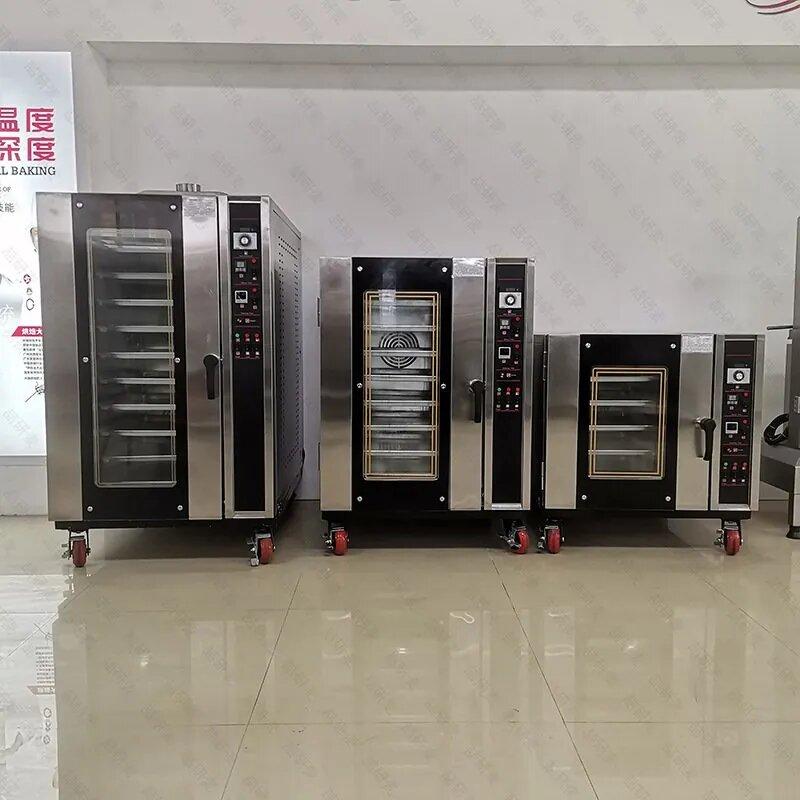

Understanding the Three Main Oven Types
The oven is the heart of any bakery, and choosing the right type directly impacts your product quality, production capacity, and operating costs. The three most common commercial bakery ovens each have distinct advantages and are designed for different production scenarios.
Before comparing specifications, it's important to understand how each oven type works and what products it's best suited for.
Deck Oven
Deck ovens (also called hearth ovens or stone ovens) bake products directly on heated stone or metal decks. Heat comes from above and below, creating the intense, direct heat that produces artisan bread with thick crusts and open crumb structure. Deck ovens are available in single-deck, double-deck, and triple-deck configurations, and can be electric, gas, or wood-fired.
Best for: Artisan bread, pizza, focaccia, baguettes, and any product where direct hearth heat improves quality.
Rotary Rack Oven
Rotary rack ovens (also called rack ovens or rotating ovens) bake products on a rotating rack inside a large, insulated chamber. Hot air circulates uniformly around the rotating rack, ensuring even baking across all products. Rotary ovens are designed for high-volume production and can bake an entire rack of products (typically 36-72 trays) in a single batch.
Best for: High-volume bakeries, hotels, catering operations, and any bakery producing large quantities of bread, rolls, pastries, and cookies.
Conveyor Pizza Oven
Conveyor ovens (also called tunnel ovens or impingement ovens) move products through a heated tunnel on a continuous conveyor belt. Hot air is forced down onto the product from above and below at high velocity, cooking quickly and consistently. Conveyor ovens are designed for continuous, high-volume production of flat products like pizza, flatbread, and cookies.
Best for: Pizza shops, fast-casual restaurants, food courts, and high-volume flatbread and cookie production.
Side-by-Side Comparison
| Feature | Deck Oven (Electric) | Rotary Rack Oven | Conveyor Pizza Oven |
|---|---|---|---|
| Price Range | $2,000 - $8,000 | $8,000 - $25,000 | $5,000 - $15,000 |
| Capacity per Batch | 4-12 trays (per deck) | 36-72 trays (full rack) | Continuous, 50-200 pizzas/hour |
| Daily Output | 50-300 kg dough | 200-1,000 kg dough | 100-500 kg (flat products) |
| Baking Method | Direct radiant heat from decks | Convection hot air + rotation | Impingement hot air + belt |
| Temperature Range | 50-400°C (some to 500°C) | 50-300°C | 50-350°C |
| Steam Injection | Yes (manual or automatic) | Yes (automatic) | No (not needed for pizza) |
| Power (Electric) | 6-24 kW | 18-60 kW | 12-36 kW |
| Footprint (W×D×H) | ~900×800×600 mm (per deck) | ~1500×1300×2200 mm | ~1800×1000×1500 mm |
| Weight | 150-400 kg | 800-1,500 kg | 200-500 kg |
| Best Products | Artisan bread, pizza, baguettes | Bread, rolls, pastries, cookies | Pizza, flatbread, cookies, quesadillas |
| Labor Requirement | 1 operator (manual loading) | 1 operator (rack loading) | 1 operator (continuous feeding) |
| Typical ROI Period | 6-18 months | 8-24 months | 4-12 months |
Deck Oven: Pros and Cons
✓ Advantages
- Superior bread quality — direct hearth heat produces thick crusts and open crumb
- Affordable entry price — single deck models start under $3,000
- Compact footprint — fits in small bakeries and can be stacked vertically
- Versatile — bakes bread, pizza, pastries, cookies, and more
- Steam injection — essential for artisan bread with shiny crusts
- Simple maintenance — fewer moving parts than rotary or conveyor
- Energy efficient for small batches — only heat the decks you're using
✗ Disadvantages
- Limited capacity — even triple-deck models can't match rotary volume
- Manual loading — requires skilled operator to load/unload each tray
- Heat loss — opening doors frequently reduces temperature and wastes energy
- Slow recovery — takes time to reheat after loading cold dough
- Heavy — stone decks make deck ovens very heavy and hard to move
- Uneven baking — hot spots can occur if not properly calibrated
- Not for tall products — limited vertical space between decks
Rotary Rack Oven: Pros and Cons
✓ Advantages
- High capacity — bakes 36-72 trays in a single batch
- Uniform baking — rotating rack ensures even heat distribution
- Minimal door openings — one load per batch means less heat loss
- Labor efficient — one operator can manage multiple ovens
- Versatile — bakes bread, rolls, pastries, cookies, cakes
- Automatic steam — programmable steam injection for consistent results
- Programmable recipes — save baking programs for different products
- Energy efficient per unit — high volume spreads energy cost across many products
✗ Disadvantages
- High purchase price — typically $8,000-$25,000
- Large footprint — requires significant floor space and ceiling height
- Very heavy — 800-1,500 kg, requires reinforced floor
- High power demand — electric models need 380V three-phase
- Not for artisan bread — convection heat doesn't produce the same crust quality
- Batch production — must wait for full batch to finish before next load
- Complex maintenance — rotating mechanism, fans, and seals require regular service
- Long preheat time — 30-60 minutes to reach baking temperature
Conveyor Pizza Oven: Pros and Cons
✓ Advantages
- Continuous production — no waiting for batches, products flow continuously
- Consistent results — every product sees identical heat and time
- Fast cooking — impingement technology cooks pizza in 3-6 minutes
- High volume — 50-200 pizzas per hour depending on size
- Easy to operate — set temperature and speed, feed products in
- No skill required — unlike deck ovens, no artisan baking skill needed
- Stackable — double-stack models double capacity in same footprint
- Great for takeout — consistent quality even during peak hours
✗ Disadvantages
- Limited product range — only for flat products (pizza, flatbread, cookies)
- No steam injection — can't bake artisan bread that needs steam
- High energy use — impingement fans and heating elements consume significant power
- Long warm-up — 30-45 minutes to reach operating temperature
- Large footprint — conveyor belt extends beyond oven body
- No vertical space — products must be flat, can't bake tall loaves
- Belt maintenance — conveyor belt needs regular cleaning and replacement
- Not versatile — can't replace a deck or rotary oven for full bakery operations
Which Oven Is Right for Your Bakery?
Choose Deck Oven If:
- You specialize in artisan bread, pizza, or baguettes
- Your daily output is under 300 kg of dough
- You have limited floor space but can stack vertically
- You value product quality over maximum volume
- You have a skilled baker who can manage manual loading
- Your budget is under $8,000
- You need steam injection for crusty breads
Choose Rotary Rack Oven If:
- You operate a high-volume bakery, hotel, or catering operation
- Your daily output exceeds 200 kg of dough
- You produce a wide variety of products (bread, rolls, pastries, cookies)
- You have dedicated floor space and high ceilings
- You want labor efficiency — one operator manages large batches
- Your budget is $8,000-$25,000
- You need programmable recipes for consistent results
Choose Conveyor Pizza Oven If:
- You operate a pizza shop, fast-casual restaurant, or food court
- You primarily produce pizza, flatbread, or cookies
- You need continuous, high-volume production during peak hours
- You want consistent results without skilled labor
- Your budget is $5,000-$15,000
- You have counter or floor space for the conveyor extension
- You want to increase throughput without adding skilled bakers
Common Oven Combinations
Many successful bakeries use a combination of oven types to maximize both quality and capacity:
Combination 1: Artisan Bakery
Deck Oven + Small Rotary Oven — The deck oven handles signature artisan breads and pizza where quality matters most, while the small rotary oven handles volume products like rolls, cookies, and pastries. This combination gives you the best of both worlds without the cost of a large rotary oven.
Combination 2: High-Volume Bakery
Large Rotary Oven + Deck Oven (for specialty) — The rotary oven handles the bulk of daily bread and roll production, while a single deck oven is reserved for specialty artisan products and pizza. This is the most common setup in medium to large bakeries.
Combination 3: Pizza + Bakery Cafe
Conveyor Pizza Oven + Deck Oven — The conveyor oven handles pizza volume during lunch and dinner rushes, while the deck oven bakes fresh bread and pastries for the cafe. This combination maximizes revenue across multiple dayparts.
📋 Bakery Equipment Checklist
Download our complete bakery equipment checklist with budget estimates for 5 different bakery types.
Free Bakery Equipment Checklist →📋 Bakery Equipment ROI Calculator
Use our interactive ROI calculator to see how quickly your bakery equipment investment pays off.
Calculate Your Equipment ROI →📋 Bakery Equipment Maintenance Calendar
Get our printable maintenance calendar to keep your bakery equipment running at peak performance.
Printable Maintenance Calendar →📋 Bakery Equipment Energy Cost Calculator
Estimate your bakery equipment energy costs and find ways to reduce your utility bills.
Calculate Energy Costs →🏭 Bakery Equipment Capacity Calculator
Not sure what size equipment you need? Use our free interactive calculator to find the perfect dough divider, mixer, oven, and proofer capacity for your production volume.
Calculate Your Equipment Needs →⚖️ Bakery Equipment Comparison Tool
Compare dough dividers, spiral mixers, ovens, proofers and dough sheeters side by side. View specs, prices, capacity and features to find the best equipment for your bakery.
Compare Equipment Now →Often Asked Questions
Need Help Choosing the Right Oven?
Tell us about your products, daily volume, and available space, and we'll recommend the perfect oven configuration for your bakery.
Related Products
Looking for Oven Comparison?
Find the best commercial bakery equipment from HNH Bakery Equipment, a leading bakery equipment manufacturer and bakery equipment supplier from China. We offer bakery equipment for sale at competitive bakery equipment price for small businesses, startups, and industrial bakeries. Whether you need bakery equipment wholesale or a single unit, our bakery equipment factory provides reliable equipment with global shipping. Learn how to choose bakery equipment with our expert buying guides.
Ready to Choose the Right Equipment?
Get a free consultation and customized recommendation from our bakery equipment experts.
Get a Free Quote